Why Does the Chinese Dragon Hold a Ball?

Most people assume the Dragon Ball is a prop — something a dragon clutches for dramatic effect, the way a king holds a scepter. That assumption misses everything.
The Dragon Ball is not held by the Chinese Dragon; it is part of it. Strip away the orb, and you strip away the dragon’s power, its intelligence, its life force itself. How did a single luminous sphere come to carry this weight? The answer runs deeper than mythology — through cosmology, Buddhist philosophy, imperial politics, and the most fundamental desires of the human spirit. This article traces that entire arc.
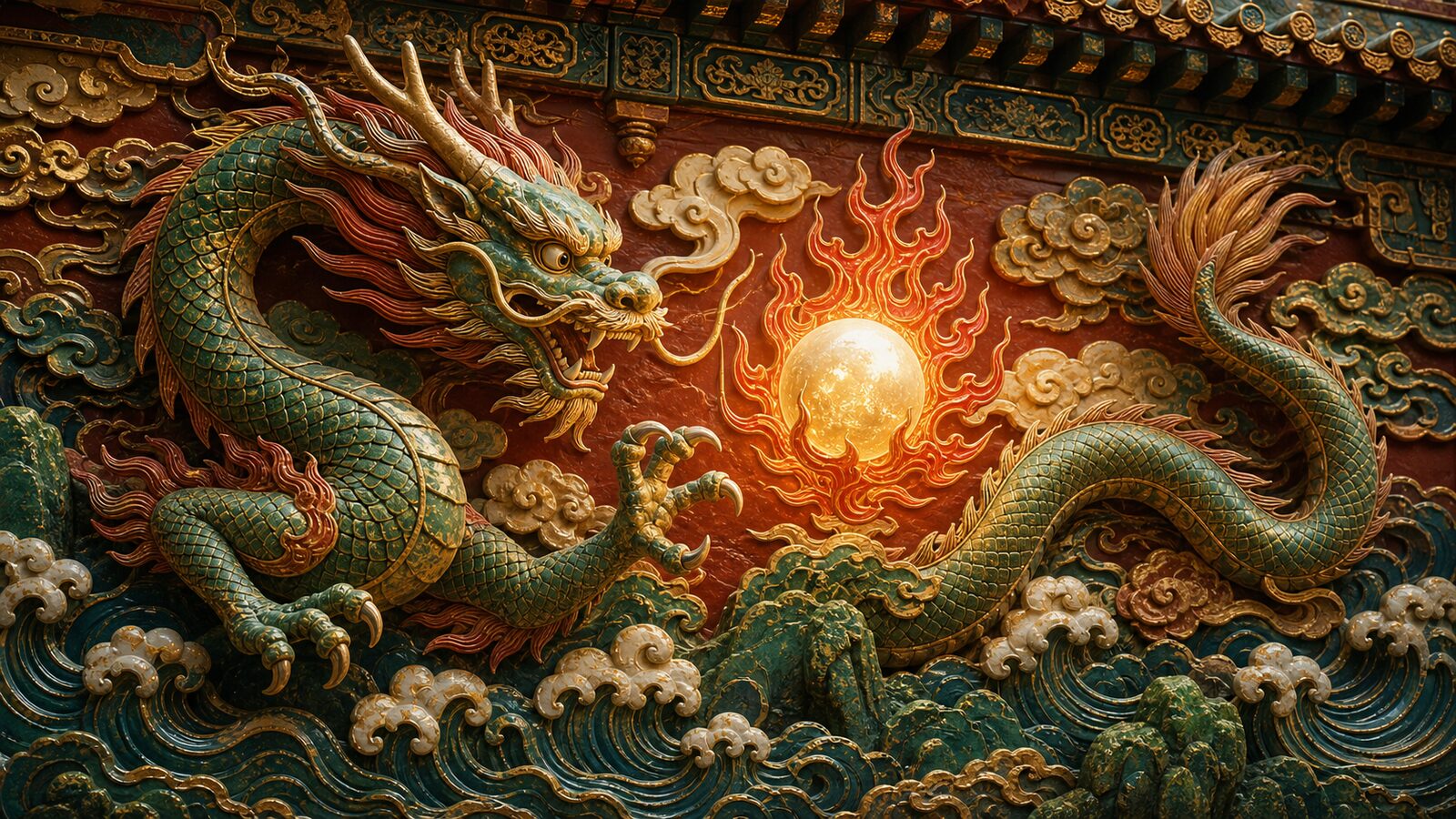
The Dragon Ball: Essence of Power and Wisdom
Classical texts such as the Huainanzi (淮南子) and Ge Hong’s Baopuzi (抱朴子) describe the Dragon Ball as the dragon’s ‘inner elixir’ (内丹) or ‘quintessence’ — a crystallization formed over ages of cultivation, absorbing the vital energies of heaven and earth until the dragon’s soul itself becomes tangible. This is not an accessory. It is the dragon’s core.
Folk tales vividly illustrate what that means in practice: a dragon separated from its Dragon Ball suffers severe weakening, sometimes losing its divine powers entirely. The orb is the origin of everything the dragon can do — cloud-soaring, command over rain and wind, invisibility, and the wisdom to understand right from wrong and glimpse the future. Lose it, and the dragon is no longer itself.
- Source of Power: The Dragon Ball is brimming with immense energy, fundamental to all the dragon’s supernatural feats.
- Symbol of Wisdom: It embodies insight into cosmic laws, allowing the dragon to perceive what others cannot.
- Essence of Life: This orb contains the dragon’s condensed life force, intrinsically tied to its survival and well-being.
The Dragon Ball’s Evolving Symbolism
Cosmic Perspective and Mastery over Natural Forces
From a cosmological perspective, the Dragon Ball represents the fundamental energies of heaven and earth. Through mastery of this orb, the Chinese Dragon is believed to balance yin and yang, commanding natural elements — particularly water and thunder.
This mastery over nature is evident in several key aspects:
- Commanding Rain and Wind: The Dragon Ball is central to the dragon’s control over rainfall and natural elements, directly influencing the prosperity of agrarian societies throughout history.
- Power of Thunder and Lightning: It also symbolizes the power of thunder, used to deter evil and purify spaces, functioning as an aspect of cosmic order.
- Yin-Yang Balance: The Dragon Ball’s perfect roundness reflects the unbroken cycle of yin and yang. Its radiant glow represents the ceaseless interaction of opposing forces — not conflict, but equilibrium made visible.
This mastery over natural forces solidified the dragon’s status as a deity connected to human survival. But the Dragon Ball’s story doesn’t end with cosmic control — it was about to absorb an entirely different tradition’s spiritual vocabulary.
Fusion of Philosophy and Religion: Illumination from the Mani Jewel
The ‘Mani Jewel’ (摩尼宝珠) from Buddhism left a decisive mark on the Dragon Ball’s imagery. This sacred jewel signifies wish fulfillment, calamity prevention, and the granting of light and wisdom. When Buddhism reached China, the Mani Jewel’s symbolism gradually merged with the existing concept of the dragon’s pearl, expanding the Dragon Ball’s cultural significance.
This fusion transcended the Dragon Ball’s role as a simple power symbol, instilling it with spiritual depth. Museum collection records often describe Chinese dragons as chasing or holding flaming pearls, and that visual detail matters: the flame turns the sphere from an inert object into a sign of awakened energy. The Mani Jewel’s spherical shape, radiance, and wish-fulfilling function naturally corresponded with the dragon’s mystical orb, forming a potent combined symbol.
- Spiritual Enlightenment: It symbolizes awakening, wisdom, and truth, leading practitioners toward deeper understanding.
- Meritorious Perfection: Represents the accumulation of good karma through spiritual cultivation and eventual achievement. The connection to spiritual bracelets is not merely decorative: bead-by-bead practice turns the same idea of roundness into repetition, discipline, and inner refinement.
- Wish Fulfillment: Represents the aspiration to alleviate suffering, bringing happiness and abundance into the world, reflecting a compassionate intent.
The Mani Jewel introduced a compassionate dimension of universal salvation and blessing to the Dragon Ball, greatly enhancing its sacred status. This concept originates from the core principles of enlightenment and compassion.
Where the dragon’s pearl once spoke of natural dominance, it now also spoke of inner liberation. That dual register — outer power and inner awakening — is what made the Dragon Ball so useful as a symbol for the next force to claim it: the imperial throne.
The Emblem of Imperial Authority
In Chinese mythology, the dragon is a powerful symbol of imperial authority, representing the Son of Heaven. Consequently, the dragon holding the Dragon Ball reflects the emperor’s ultimate authority, wisdom, and control over the realm.
The parallels between the Dragon Ball and imperial rule are quite striking:
- Supreme Authority: Just as the Dragon Ball concentrates the vital forces of heaven and earth, the emperor was believed to hold all power in the land.
- Wise Governance: The emperor, like the dragon, was expected to possess deep wisdom to lead the nation and ensure public welfare. This aligns with Confucian principles emphasizing sagely rule for societal harmony.
- Control over the Realm: The Dragon Ball symbolizes comprehensive control over the nation’s future and the welfare of its populace.
In this context, the Dragon Ball’s radiance mirrored the emperor’s virtue and wisdom, symbolizing enlightenment and prosperity across the realm. By this point in Chinese history, a single spherical object had simultaneously absorbed cosmological, spiritual, and political meaning — a convergence that set the stage for its deepest role yet.
The Human Connection: A Spiritual Totem
The classic image of ‘the dragon holding the Dragon Ball’ extends beyond mythology. It has become a significant spiritual totem in Chinese culture, influencing art, literature, and the spiritual aspirations of the people — and in each of these domains, the inner elixir logic holds: the ball is always what gives meaning to the creature that carries it.
The symbol’s significance is interwoven with broader cultural systems. As one of the twelve animal signs, the dragon is a central figure in the Chinese Zodiac Dragon tradition, where it marks authority, vitality, and auspicious transformation within the annual cycle.
Manifestations in Art and Literature
From antiquity to the present, the ‘dragon holding the Dragon Ball’ motif appears widely across various art forms, reflecting its enduring cultural importance.
- Sculpture and Architecture: The motif is carved into palace eaves and monumental stonework — the Nine-Dragon Wall (九龙壁) in Beijing’s Palace Museum complex is one of the most celebrated surviving examples, each of its nine dragons depicted in dynamic pursuit of a flaming pearl.
- Decorative Arts: ‘Dragons playing with pearls’ patterns adorn bronze ware, porcelain, and jade, symbolizing good fortune and prosperity.
- Literature: Classical novels like Journey to the West depict the Dragon King’s Pearl alongside artifacts such as the Ruyi Jingu Bang — these magical objects consistently mark the boundary between mortal and divine power.
These representations reinforce the Dragon Ball’s sacred status within popular consciousness, securing its lasting legacy. Yet the most revealing layer isn’t found in these external artifacts — it’s found in what the Dragon Ball says about the people who created it.
A Reflection of Spiritual Pursuits
The Dragon Ball transcends a mere mythical treasure, serving as a powerful emblem of self-improvement, the pursuit of harmony, and the quest for perfection. The philosophy of ‘Gezhi’ (格致) — the investigation of things to gain knowledge — offers a precise parallel: just as a scholar studies the observable world to extract its underlying principles, the Dragon Ball is itself the distilled essence of heaven and earth made observable. Its perfect roundness is not decoration; it is the visual argument that order underlies the cosmos.
- Quest for Wisdom: Like a calligrapher studying one stroke until its hidden structure appears, the seeker looks for principle inside form.
- Quest for Power: Power is not brute force here. It is the ability to move with timing, like the dragon turning only when the pearl turns.
- Quest for Perfection: The round pearl gives moral cultivation a visible shape: no corners, no fracture, no wasted motion.
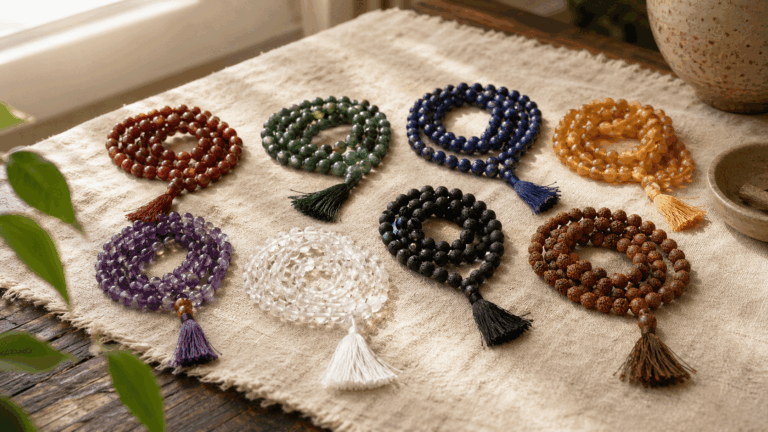
- Self-Transcendence: This is where beads, pearls, and ritual objects meet. Whether in a mala, a dzi bead, or a dragon’s pearl, the small rounded object becomes a repeated reminder to refine attention rather than scatter it.
This enduring symbol sits beside other protective and prosperity-bearing creatures in Chinese visual culture, but it has a distinct logic. Pixiu gathers wealth; the dragon pearl gathers meaning. One draws fortune inward, while the other gives the dragon direction, radiance, and legitimacy.
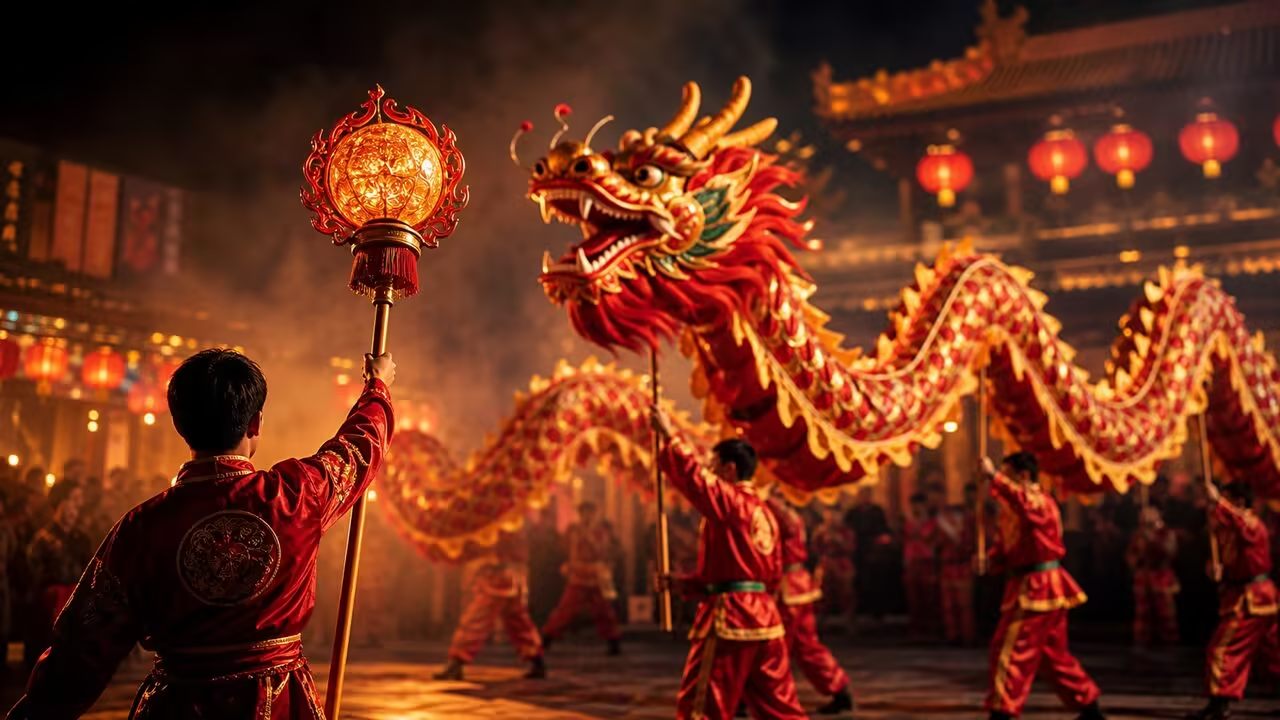
Modern Continuations and New Interpretations
The clearest evidence that this symbolism remains alive is found not in popular culture, but in the dragon dance (舞龙) still performed at festivals and civic ceremonies across China and Chinese diaspora communities worldwide. In this tradition, a dedicated performer called the 珠者 (zhū zhě) — the pearl bearer — walks ahead of the dragon, holding a luminous ball aloft on a pole. The dragon does not lead. It follows the ball.
The material of the pearl varies by region — silk, lacquered wood, or lit lantern — but the choreographic logic is always the same: the inner elixir sets the direction, and the creature of power moves in its wake. What ancient texts described as metaphysics, the dragon dance makes physically literal every time it is performed.
The Chinese Dragon’s inseparable bond with the Dragon Ball is more than a mythological tale. Across its long history, this orb has carried the weight of at least four distinct meaning-systems at once: it is a natural force, a spiritual attainment, a political mandate, and a mirror of human ambition.
That is why the image still works when the drums begin and the pearl rises above the crowd. The dragon’s silk body may be carried by many hands, but its attention gathers around one glowing point. The old lesson remains visible: power without a center is only movement; power with a pearl becomes direction.
References
- Cleveland Museum of Art: Dragons Chasing Flaming Pearls – supports the dragon-chasing-flaming-pearl motif in Chinese textile art.
- Asian Art Museum: The Dragon’s Pearl – supports the educational explanation that Chinese dragons are often shown holding or chasing round flaming objects.
- National Museum of Asian Art archive: Ring with dragon and flaming pearl – supports the early jade object context for the dragon-and-flaming-pearl motif.
Recommended Reading
- Dragon zodiac meaning: Chinese Zodiac Dragon
- Buddhist dragon symbolism: Buddhist Dragons: Dharma Guardians
- Complete zodiac system: Chinese Zodiac: Your Personal Insight System
- Twelve animal signs: What Are the Twelve Chinese Zodiac Animals?
Frequently Asked Questions
What is the primary significance of the Dragon Ball for the Chinese Dragon?+
The Dragon Ball is considered the "essence" of the Chinese Dragon, serving as the source of its immense power, unparalleled wisdom, and cosmic energy. It enables the dragon's supernatural abilities and is an indispensable part of its very being.
How did Buddhist philosophy influence the symbolism of the Dragon Ball?+
The Dragon Ball's symbolism was profoundly enriched by its fusion with the Buddhist "Mani Jewel." This connection infused it with meanings related to spiritual enlightenment, meritorious perfection, and the fulfillment of wishes, elevating its sacredness.
What does the Dragon Ball symbolize in relation to cosmic forces and nature?+
From a cosmic perspective, the Dragon Ball symbolizes the essence of all things and the convergence of universal energy. It represents the Chinese Dragon's mastery over natural forces like rain, wind, and thunder, and embodies the balance of yin and yang.
What is the connection between the Dragon Ball and Chinese imperial authority?+
Given the dragon's status as a symbol of imperial power, the Dragon Ball also mirrors the emperor's supreme authority, wisdom, and control over the realm. Its radiance reflects the emperor's virtue and ability to govern the nation.