Leo Birthstone: Ruby, Peridot, and More Gems for the Fire Sign

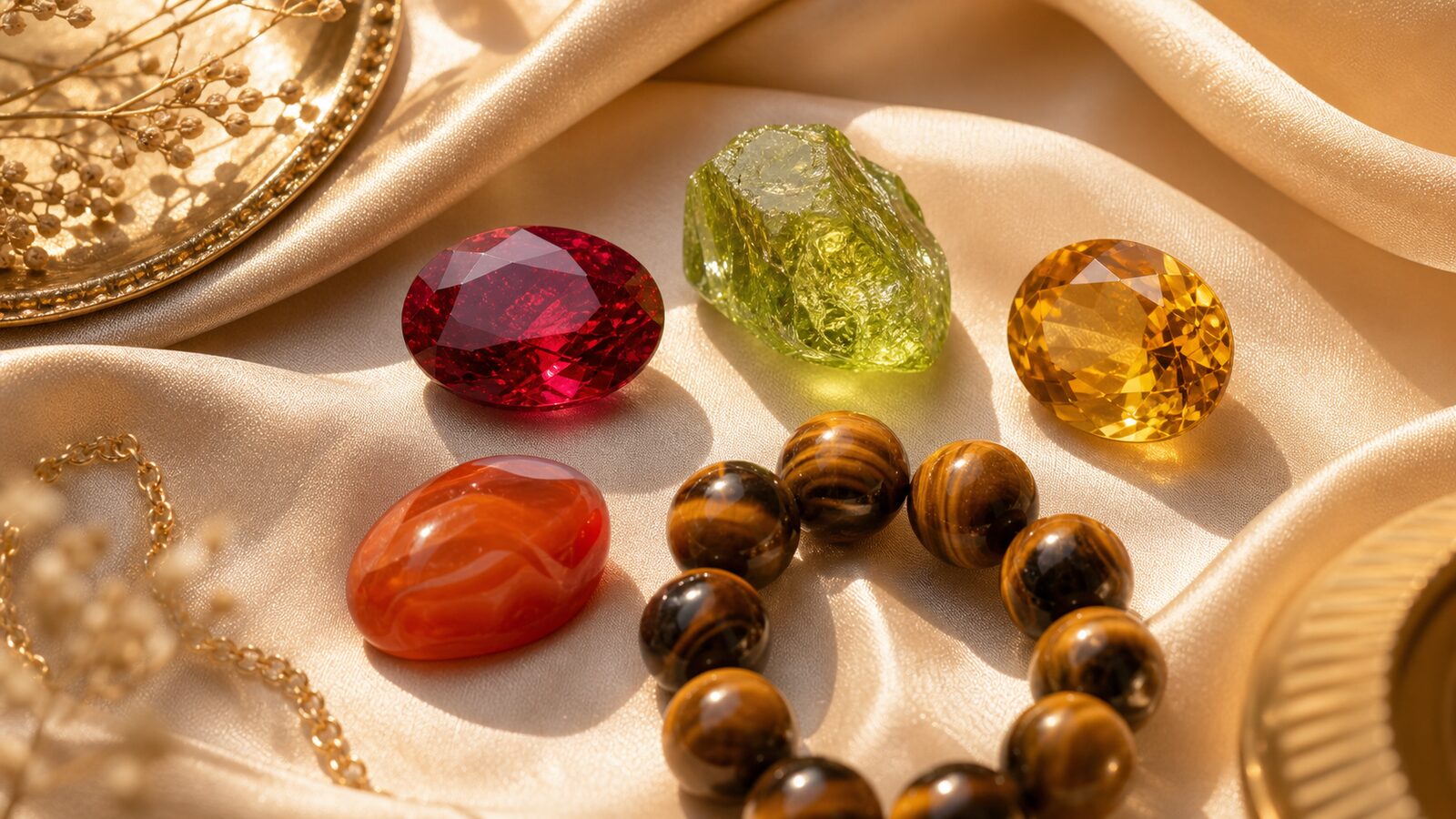
Leo birthstones speak in heat: ruby red, golden citrine, sunlit peridot, orange carnelian, and the steady brown-gold flash of tiger’s eye. That color language is not accidental. Leo is a fixed fire sign, traditionally linked with confidence, visibility, loyalty, creativity, and a strong personal presence — and its stones match that energy with unusual consistency.
This guide keeps two things clearly separate: the gem facts that help you choose durable jewelry, and the symbolic meanings people attach to these stones in astrology, meditation, and personal ritual. Both sides matter, depending on why you are choosing.
What Is the Leo Birthstone?
The primary Leo birthstone is ruby, particularly for Leos born in July. Ruby is the red variety of corundum — the same mineral family as sapphire — colored by chromium. Its Mohs hardness of 9 makes it one of the most durable colored gemstones available for rings, pendants, and everyday bracelets.
For August Leos, peridot is the traditional second birthstone. Where ruby is bold and direct, peridot is bright and fresh — a useful counterbalance, and a reason why the two stones are often considered together as a pair rather than rivals.
Beyond these two anchors, Leo’s broader palette includes carnelian, citrine, and tiger’s eye. Each expresses a different facet of the sign, and the right choice depends more on what you actually need the stone to do — symbolically or practically — than on which one is “most Leo.”
Leo Birthstone Colors at a Glance
| Stone | Color | Best For | Jewelry Notes |
|---|---|---|---|
| Ruby | Deep red | Confidence, passion, leadership | Excellent durability (Mohs 9); ideal for daily jewelry when properly set |
| Peridot | Yellow-green | Renewal, generosity, emotional warmth | Moderate durability (Mohs 6.5–7); protect from hard knocks and thermal shock |
| Carnelian | Orange to red-orange | Creativity, motivation, expressive action | Durable chalcedony (Mohs 6.5–7); works well in beads, bracelets, and pendants |
| Citrine | Golden yellow | Optimism, abundance, solar energy | Durable quartz (Mohs 7); avoid prolonged harsh sunlight |
| Tiger’s Eye | Golden brown | Focus, grounded confidence, steadiness | Common in beads and cabochons (Mohs 7); strong choice for bracelets |
Ruby: The Primary Leo Stone
Ruby is the most direct Leo birthstone. Its red is vivid and emotionally charged — which is why it gets chosen for milestone gifts, meaningful rings, and pieces worn when confidence matters. In traditional gemstone language, ruby is linked with courage, vitality, love, and leadership: exactly the qualities Leo at its best embodies.
For Leo specifically, ruby can represent the healthy version of pride. Not arrogance, but a steady willingness to show up fully. If you are choosing a stone that feels bold rather than decorative, ruby earns that role clearly.
From a durability standpoint, corundum is hard and tough. Ruby handles daily wear better than most colored gemstones. Settings still matter: a raised ruby ring should be inspected occasionally for loose prongs, while a pendant or bead bracelet faces less direct impact and is more forgiving.
One practical note worth stating plainly: fine ruby can be expensive, and the majority of rubies on the market are treated to improve color or clarity. That is not automatically a problem — but if you are buying a high-value piece, ask for treatment disclosure and, when the price justifies it, a report from a reputable gem lab. For a more accessible entry point, ruby accents or red corundum designs carry the visual warmth without the same price pressure.
Peridot: The August Leo Stone
Peridot is the gem variety of olivine, and its yellow-green to olive-green color is bright without being loud. That makes it a natural counterweight to ruby’s intensity — not a lesser stone, but a different kind of Leo statement.
Symbolically, peridot is associated with growth, renewal, openness, and generosity. If ruby says “stand tall,” peridot says “stay open.” For Leos who want a stone that softens the edges of pride and turns attention outward into warmth, peridot is the more fitting choice.
It is less hard than ruby, so it needs more considered care. Peridot should be kept away from sharp impacts, ultrasonic cleaners, steam cleaning, and sudden temperature changes. In bracelet or pendant form — where it faces less direct stress than a ring — it is a beautiful and practical Leo stone for everyday wear.
Carnelian: Leo Creativity in Motion
Carnelian is a warm orange to red-orange variety of chalcedony, with a Mohs hardness of 6.5–7. It does not carry ruby’s formal prestige, but it expresses a different kind of Leo energy: creative drive, personal warmth, and the courage to begin.
For people who identify with Leo’s artistic, performative, or entrepreneurial side, carnelian is often more approachable than ruby. It is a natural fit for bracelets, mala-style beads, pocket stones, and casual pieces meant to be worn often rather than saved for occasions.
In practical terms, carnelian is a low-maintenance stone. Its chalcedony hardness makes it resilient enough for daily wear, and its warm color stays visible in bracelet form throughout ordinary movement — which is exactly where its symbolism works best as a quiet daily reminder to act rather than over-prepare.
Citrine: Leo’s Solar Alternative
Citrine is a yellow to golden variety of quartz. Its color fits Leo’s solar symbolism naturally — brightness, optimism, generosity, and the kind of warmth that draws people in rather than demanding attention.
One buying detail worth knowing upfront: natural citrine is relatively rare. Much of the citrine in the jewelry market is produced by heating amethyst or smoky quartz. That does not make treated citrine undesirable, but if natural origin matters to you, ask the question before buying rather than after.
For Leo styling, citrine pairs well with gold-tone metal, red cord, carnelian, tiger’s eye, and warm wood beads. It is especially effective when the goal is not a luxury statement, but a sunny everyday piece that simply feels encouraging to wear.
Tiger’s Eye: The Grounding Stone
Tiger’s eye brings a quality the other Leo stones do not lead with: steadiness. Its golden-brown bands and moving cat’s-eye effect give it a watchful, protective feeling. Where ruby and citrine amplify brightness, tiger’s eye helps anchor that fire.
This makes it a useful choice for Leos who want confidence without impulsiveness — or for anyone who finds ruby’s intensity a bit much for daily wear. Tiger’s eye is commonly cut into beads, which makes it a practical bracelet stone that pairs naturally with lava rock, hematite, jasper, and other grounding materials.
How to Choose the Right Leo Birthstone
The most useful frame for choosing is not “which stone is most Leo” — they all are, in different ways. The better question is: what do you need from this stone right now?
Some stones press forward; others pull inward. Think of it as a dial between assertion and reflection:
- Need to show up boldly or mark a milestone? Ruby. It is the least subtle option and earns that role.
- Need to stay open and generous, not just visible? Peridot, especially if you are an August Leo or if ruby’s intensity feels like too much right now.
- Need to start something — a project, a conversation, a new habit? Carnelian. It is the action stone of this group.
- Need warmth and optimism without drama? Citrine. It is the most approachable stone here for daily wear.
- Need focus and groundedness more than fire? Tiger’s eye. It steadies rather than amplifies.
For daily wear durability, ruby, citrine, carnelian, and tiger’s eye are the practical top four. Peridot is beautiful but needs more protection, especially in ring form.
How to Wear Leo Birthstone Jewelry
Leo stones work best when the design has presence — but presence does not require scale or expense. A single red bead, a golden pendant, or a tiger’s eye bracelet can carry the theme clearly without needing to announce itself.
For meditation or intention-setting, bracelets are practical because they stay visible throughout the day. Touching the beads can become a small pause before speaking, leading, creating, or making a difficult decision. For more formal styling, rings and pendants bring ruby, citrine, and peridot into a more ceremonial register.
Color pairing is straightforward: red and gold for full Leo energy, green and gold for generosity and renewal, orange and brown for creative stamina, tiger’s eye with black lava rock for a steadier protective combination.
Cleaning and Care
Most Leo stones can be cleaned with warm water, mild soap, and a soft cloth or brush. Avoid harsh household chemicals, bleach, and abrasive cleaners. Let jewelry dry fully before storing.
Ruby is durable, but treated or heavily included stones may need extra caution — check with your jeweler if you are unsure. Peridot is the most sensitive stone in this group: keep it away from ultrasonic cleaners, steam cleaning, and sudden temperature changes. Citrine, carnelian, and tiger’s eye are generally practical for everyday pieces, but store them separately so harder jewelry does not scratch them over time.
For bracelets specifically, check the cord, elastic, or metal links periodically. The stone may be tough enough for daily wear; the construction still needs attention.
Closing Note
Ruby is the classic answer, and it earns that position. But peridot, carnelian, citrine, and tiger’s eye each express something real about Leo’s range — from the fire that demands attention to the steadiness that sustains it. The best Leo birthstone is the one that matches where you are, not just the sign you were born under.
References
- Encyclopaedia Britannica: Corundum — supports ruby as a corundum variety, chromium’s role in red color, and Mohs hardness 9.
- Encyclopaedia Britannica: Olivine — supports peridot as gem-quality olivine.
- Encyclopaedia Britannica: Chalcedony — supports carnelian as red chalcedony colored by iron oxides.
- Encyclopaedia Britannica: Citrine — supports citrine’s quartz identity and common heat-treatment context.
- Minerals.net: Tiger’s Eye — supports tiger’s eye as a quartz-family gemstone with chatoyancy.
- International Gem Society: Gemstone Care Guide — supports general gemstone cleaning and care cautions for ruby, peridot, citrine, and related stones.