What a Spiritual Bracelet Actually Does

Personal Energy Management
Many people hit moments where their thinking turns muddy—not from tiredness, but from a kind of internal static. Focus slips. The day’s noise accumulates faster than it gets processed.
Spiritual bracelets work on a simple premise: a physical object, deliberately chosen and worn with intention, can act as a reset switch. Not because the stone has magic properties, but because the human nervous system responds to consistent cues. A bracelet worn during morning meditation becomes a portable version of that stillness—present on your wrist during the meeting, the commute, the difficult conversation.
This is the practical core of understanding the meaning of spiritual bracelets. A clear intention paired with a physical anchor trains the mind to return to that intention on contact. The bracelet becomes a non-verbal cue—something the body recognizes before the conscious mind has to do any work.
Underlying Principles
A spiritual bracelet earns its place not through mysticism but through the specific properties of what it’s made from—and what those materials ask of your attention.
Natural stones, woods, and metals each interact with the body in concrete ways. Quartz, for instance, has a crystalline atomic lattice that vibrates at a stable frequency and exhibits piezoelectricity—it generates a measurable electric charge under mechanical pressure. This isn’t a metaphor. It’s a material property that ancient practitioners observed empirically, long before the physics had a name, and interpreted as the stone’s responsiveness to intention.
Wood engages through the senses rather than through electrical properties. The steady fragrance of sandalwood or the warming scent of agarwood activates the olfactory system—a direct line to the brain’s limbic region, which governs emotional regulation. Copper conducts heat with unusual efficiency, creating a subtle thermal loop where body warmth moves into the metal and back. The faint tingling that copper wearers often notice is a real physiological response, not imagination.
Historically, people across cultures reached the same conclusion through different frameworks: certain materials, worn close to the body, change how you move through the world. The Egyptian Shebyu collar, the Tibetan mala, the copper cuff of Himalayan healers—each operates on this same logic. The material isn’t decorative noise. It’s the functional core.
Many also wear these pieces as protective jewelry—not in a literal deflection sense, but as a psychological perimeter. The bracelet signals, to the wearer first, that they have chosen to engage with the day from a particular state.
Adornment Beyond Categories
Long before contemporary identity labels existed, bead jewelry functioned as a universal language of power and transformation—one that didn’t require a gender to work.
Consider the Shebyu, the Gold of Honor awarded to officials of Egypt’s 18th Dynasty. These heavy collars of gold and lapis lazuli were designed to smooth the physical contours of the chest, deliberately blurring the biological form of the wearer. The Shebyu didn’t mark gender. It marked the transformation of a person into a vessel of cosmic authority. The adornment changed who you were perceived to be—and how you perceived yourself.
Mala beads operate through a different but parallel logic. The repetitive movement of fingers over wood or stone focuses the mind through proprioception—the body’s awareness of its own position and movement. In this state, the practitioner’s gender becomes irrelevant to the practice. What remains is breath, rhythm, and intention.
This historical thread matters because it establishes something important: the power of these objects was never contingent on who was wearing them. For transgender and non-binary individuals, Tibetan jewelry carries this lineage forward. It connects to a tradition that understood identity as something far more fluid than biology—long before the modern vocabulary existed to say so.
These beads serve as a tangible anchor. Not a statement, but a quiet affirmation that the soul’s expression has always preceded the categories others use to describe it.
Himalayan Origins
Tibetan bracelets emerged from one of the most demanding environments on earth. At altitude, where resources were scarce and the spiritual and physical were inseparable, these objects earned their place through function first.
Traditional crafting relies on techniques passed quietly through generations—skills held in the hands rather than written down. Through repoussé, a silversmith hammers metal from behind until a three-dimensional form pushes outward on the front face. The process requires reading the metal’s resistance in real time, adjusting force and angle by feel.
Filigree work pulls raw metal into wire thin enough to braid into lace-like patterns. Precision inlay presses turquoise or coral into custom-carved grooves, each stone fitted individually. These aren’t production techniques. They’re slow, material-specific conversations between the maker and the metal.
As Tibetan artisans settled beyond the Himalayas, they carried these methods with them. The bracelets that reach buyers today often carry that lineage intact—not as heritage marketing, but as a measurable difference in how they’re made and how long they last.
Material Influence
Each material brings a different set of physical properties to the wrist—and those properties are what make the symbolic associations feel grounded rather than arbitrary.
Copper conducts heat at roughly 385 watts per meter-kelvin, making it one of the most thermally responsive metals a person can wear against skin. That efficiency creates a perceptible feedback loop: body warmth transfers into the metal and radiates back, producing the faint thermal sensation that copper wearers consistently describe. In Himalayan culture, this conductivity was interpreted as the metal facilitating energy flow—preventing stagnation by keeping things moving. The physics and the symbolism are describing the same phenomenon from different angles.
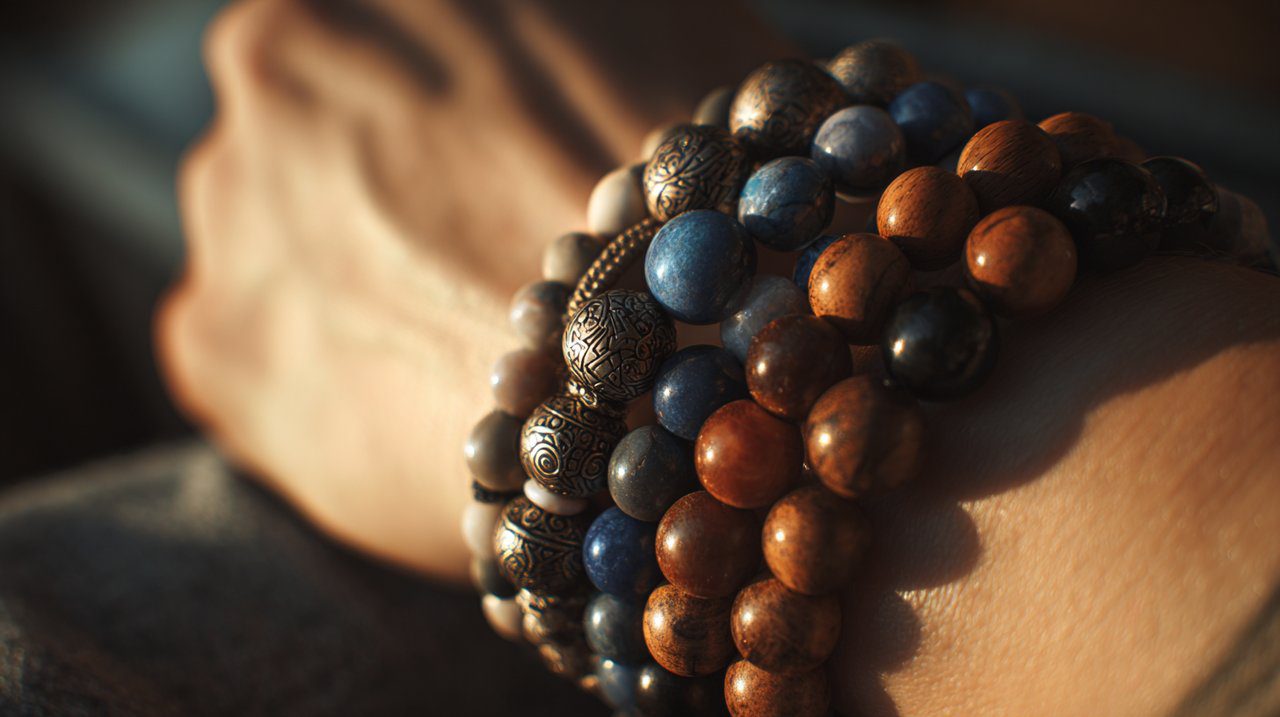
Sandalwood emits a sesquiterpene compound called santalol, which research has associated with measurable reductions in heart rate and galvanic skin response. When the bead warms against the skin, the release intensifies. Bodhi seeds carry weight and a slightly irregular surface that rewards slow, deliberate handling—the tactile equivalent of something that asks you to slow down before you engage with it.
Rosewood is dense enough to provide genuine physical pressure against the wrist in crowded or overstimulating environments. Agarwood’s aroma releases only through skin warmth—it’s chemically inactive until activated by contact, which makes each moment of noticing it feel earned rather than ambient.
Moving the beads creates what I’d call a multimodal anchor. The tactile rhythm, the temperature shift, the scent—each channel reinforces the others. Together they send a signal the nervous system processes before the thinking mind intervenes: shift from reactive to present.
Design Configurations
The arrangement of beads and the specific symbols incorporated into a bracelet shape how it functions as a focus tool.
The Endless Knot appears frequently in Tibetan bracelet design. Geometrically, it has no beginning and no end—a form that makes the concept of interconnection physically visible rather than merely stated. When a maker ties a knot while maintaining meditative focus, the intention isn’t separate from the object; it’s structurally embedded in it. The physical sensation of a knot pressing against the skin during wear functions as a recurring prompt—a small, reliable interruption to autopilot thinking.
Carved mantras serve a different but complementary function. The sequence Om Mani Padme Hum, present on the wrist as visible text, keeps a specific orientation accessible without requiring recall. Each syllable in the Tibetan tradition addresses a particular pattern of ego-based obstruction. Having it present—literally readable on the wrist—means the reminder costs no effort to access.
Gemstone Categorization
Understanding spiritual bracelet stone meanings is most useful when it moves past general associations and gets specific about what each stone actually does when worn.
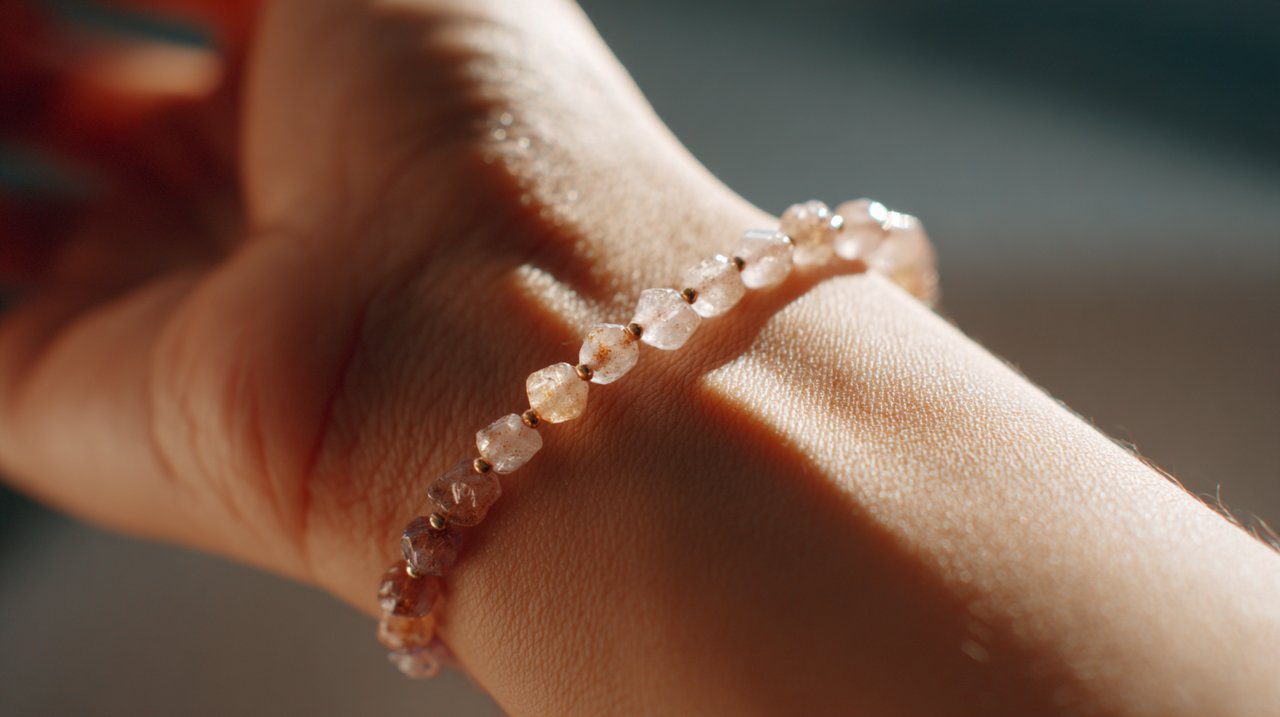
Emotional Equilibrium
For navigating emotional intensity, the most useful stones are the ones that give the nervous system something concrete to engage with—a physical counter-signal rather than a symbolic one.
Amethyst has real weight and a slightly rough, textured surface that rewards slow, deliberate touch. Pressing your thumb firmly into the bracelet interrupts a mental spiral by giving the nervous system a specific task. The attention shifts from internal noise to external sensation.
Rose Quartz conducts heat away from the skin noticeably quickly. Holding it against the inside of the wrist provides a direct sensory counter-signal to the flushed, heated feeling that strong emotion produces. The cooling is real and physiologically measurable—which is why it works as an intervention rather than just a symbol.
Rhodonite has a higher thermal conductivity than most silicate stones, making it particularly responsive in high-emotion situations. If you run hot under pressure—physical warmth in the face, neck, or chest—a rhodonite bracelet actively pulls heat away from the contact point, creating a localized cooling sensation that functions as a physiological anchor.
Protection Attributes
The most effective stones for this category work through clear physical properties rather than vague energetic claims.
Black Tourmaline has a long cross-cultural history as a boundary stone. Its iron content gives it a slight electromagnetic responsiveness, and its opaque density creates a visual weight on the wrist that registers as presence. In draining social environments—open offices, crowded transit, high-conflict interactions—that visual and physical weight serves as a constant reminder that you occupy a defined space within the situation, not a dissolved one.
Obsidian has low thermal conductivity, which means it stays noticeably cool against the skin even after extended wear. In moments of social stress, that persistent coolness provides a reliable physiological anchor—something unchanging when the surrounding environment isn’t.
Tiger’s Eye has a fibrous internal structure that produces its characteristic chatoyancy—the shifting band of light visible as the stone moves. That visual dynamism tends to draw attention without demanding it, which subtly reinforces the wearer’s sense of presence in a room. For situations where you need to hold your ground without escalating, it’s a quieter tool than its reputation suggests.
For high-pressure office environments specifically: a black tourmaline or obsidian bracelet worn during back-to-back meetings gives the hands something to return to during transitions—a physical reset between contexts that doesn’t require stepping away.
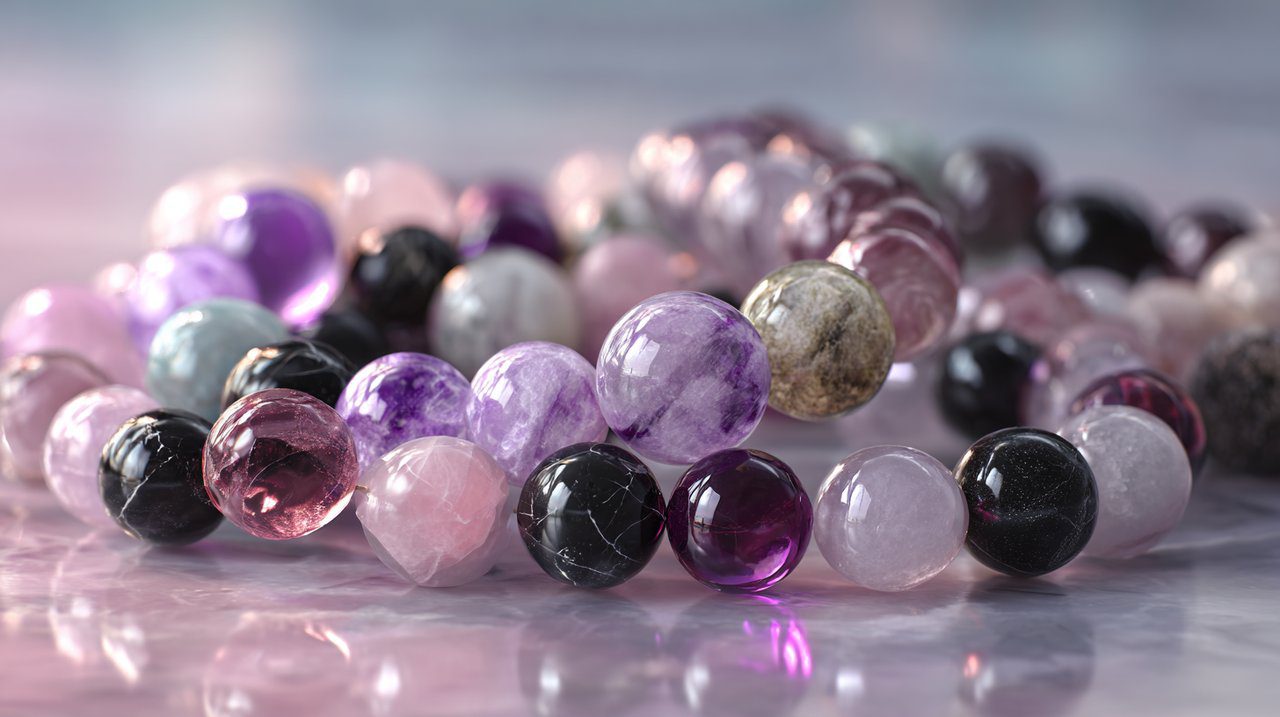
Mental Clarity
Clear Quartz has the highest optical clarity of any common mineral, which gives it a visual quality that functions as a useful metaphor made physical: looking at it is, in a small but real way, an act of focusing through noise to find a clean signal.
Jade is chemically resistant to most common substances—acids, oils, and moisture leave it largely unchanged. The jade bracelet Chinese meaning of integrity and incorruptibility isn’t arbitrary symbolism; it’s a description of the stone’s actual material behavior, translated into human terms across centuries of observation.
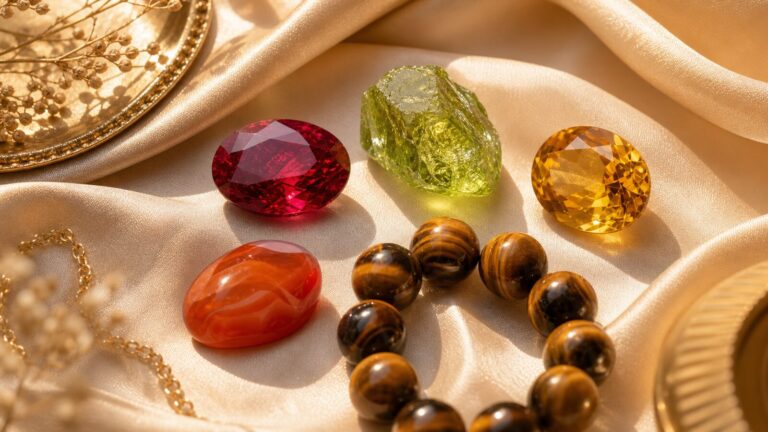
The red agate stone meaning centers on grounding and vitality. Its iron oxide content gives it density and warmth in the hand—a reliable physical steadiness for moments when mental focus is slipping toward scattered rather than still.
Precision Sizing
A bracelet that fits poorly becomes a distraction. One that fits well disappears into the background until you need it—which is exactly when you want it to be there.
For wrist measurement and fit:
- Snug fit (stays close to the pulse point): measure your wrist circumference and add 0.5–1 cm
- Comfort fit (shifts slightly with movement): add 1.5–2 cm to your measurement
- If you were born in January or February, check whether your birthday falls before or after that year’s Lunar New Year—this affects Chinese zodiac calculations that sometimes accompany sizing guides
For bead size adjustments:
- Standard beads (under 10mm): standard sizing applies
- Larger stones (exceeding 12mm): the chord effect reduces available internal diameter significantly—add an additional 1.5–2.0 cm to the strand length to maintain a comfortable orbit around the wrist
Fuller wrists benefit from wider cuffs that distribute pressure across a broader surface. Slender wrists carry delicate chains without being overwhelmed by them. Linear wrist profiles work well with multi-strand designs that prevent excessive rotation.
Traditional dzi beads have an elongated tubular structure that creates friction against the arm during movement. Himalayan artisans address this with spacers called Kogpu—soft leather or yak horn pieces that act as flexible buffers, absorbing rotational tension and preventing the stone edges from digging in. If you’re wearing dzi beads for the first time, the spacers aren’t optional.
Professional Maintenance
The materials that make spiritual jewelry effective are often the same ones that require careful handling. Porous stones, organic materials, and treated metals each have specific vulnerabilities that daily wear exposes.
Dzi beads have a microscopic porous structure. In dry environments, that porosity makes them vulnerable to micro-cracking. A small amount of pure sandalwood oil or traditional yak butter, applied periodically, prevents this by penetrating the surface and stabilizing the mineral matrix. Over time, this treatment interacts with the warmth of your skin to develop a patina that’s specific to you—a record of how and where the piece has been worn.
Turquoise reacts with sweat. The copper compounds in the stone oxidize when exposed to perspiration, gradually shifting the color toward dark green. A thin layer of microcrystalline wax applied to the setting edges creates an invisible barrier that slows this process without altering the stone’s surface appearance.
Elastic cords degrade faster than the stones they hold. Choose silicon-coated multi-filament cord, which resists breakdown from body oils better than standard elastic. Always roll the bracelet gently over the hand when putting it on—pulling and stretching the cord is how most pieces fail before the stones do.
Renewal Rituals
Clearing accumulated energy from stones is a practice with real sensory logic behind it.
Moonlight clearing places bracelets on a windowsill under a full moon. The ritual functions as a reliable monthly checkpoint—a moment of deliberate attention to objects that otherwise operate in the background of daily life.
Sound clearing with a singing bowl works through physical vibration. Strike the bowl and hold the piece near the rim so the sound waves pass through the stones. The vibration is measurable and tactile—you can feel it in the bracelet.
Daily maintenance is simpler: a brief soak in lukewarm water, a soft-bristled brush for hollows and crevices, and a dry with unbleached cotton. The ritual of cleaning reinforces the same attentiveness that makes the bracelet useful in the first place.
Holistic Insights
- Feng Shui Rings:The Power of Feng Shui Rings: Ancient Wisdom for Daily Balance
- Koi Symbolism:Koi Fish Bracelets: Symbols of Strength in Daily Life
- Bodhi Bead Serenity:Bodhi Beads: Cultivating Inner Serenity Through Sacred Practice
- Tibetan Bead Meanings:Tibetan Beads Meaning, Benefits, and How to Incorporate Them into Your Life
- Cinnabar Jewelry:Cinnabar Jewelry: A Legacy of Artistry and Allure
- Red Bead Symbolism:Red Bead Bracelet: Symbolism, Style, and Significance
- Peridot Necklace:Peridot Gem Necklace: Meaning, Benefits, and Styling Tips
- Tibetan Prayer Rings:Tibetan Prayer Rings: Ancient Wisdom for Modern Serenity
- Yellow Agate:Yellow Agate Bracelet: A Guide to Inner Radiance and Manifested Joy
- Dragon Bracelets:
- Hamsa Evil Eye:The Hand and the Gaze: Unraveling the Mystical Meanings of Hamsa and Evil Eye
- Harmonizing Jewelry:Harmonizing Symbols: Wearing Multiple Spiritual Jewelry Pieces with Purpose