How to Layer Buddhist and Spiritual Jewelry — Without Getting It Wrong

Wearing spiritual jewelry isn’t a rigid practice governed by rules handed down from a single tradition. Instead of adhering to a fixed doctrine, the real question is whether the pieces you wear carry genuine personal meaning — and whether they work together visually and symbolically without creating noise.
Below are six practical approaches to wearing multiple buddha necklaces and other spiritual protection bracelets, covering both the cultural grounding and the actual styling mechanics.
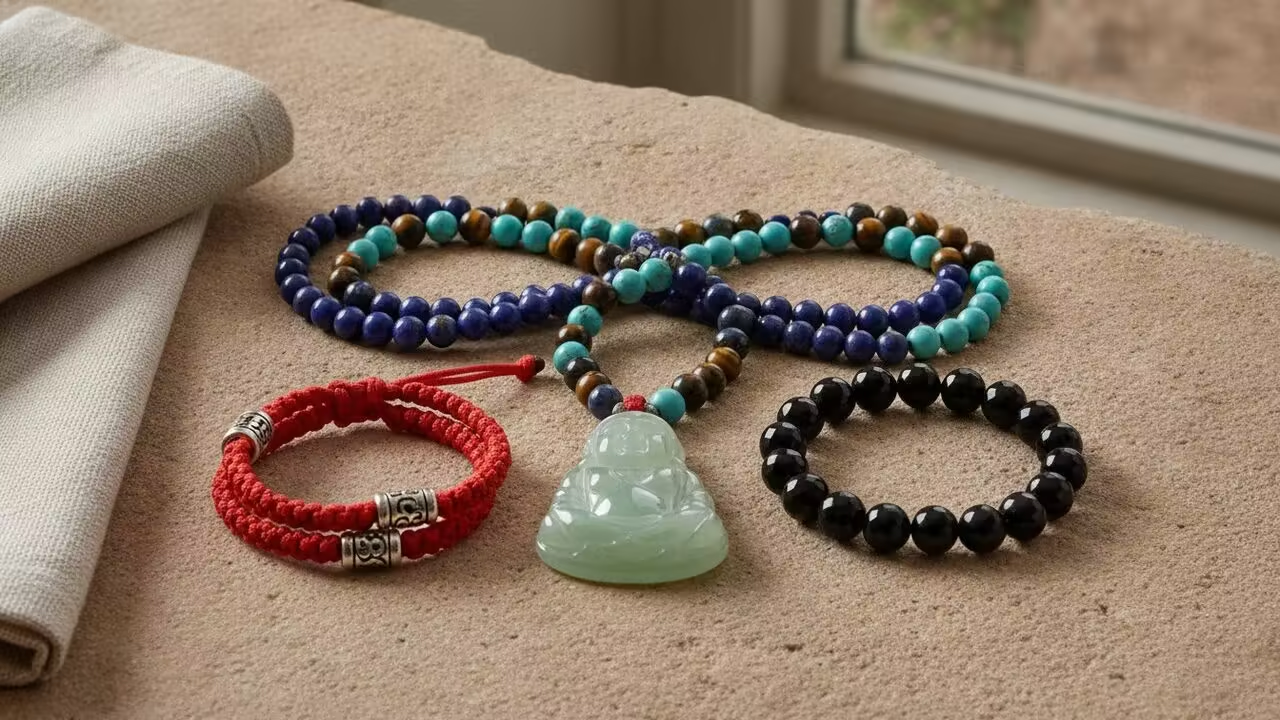
1. Know What Each Piece Is For
Before layering anything, understand what each piece represents individually. A buddha necklace is not merely decorative — in Tibetan Buddhist tradition, wearing a Buddha image corresponds to the Body (身, kāya) aspect of the Three Secrets (身語意, the trinity of body, speech, and mind). It functions as a visual mindfulness anchor in daily practice, a reminder of compassion and awareness rather than a passive ornament.
A Tibetan protection bracelet, by contrast, may carry specific mantra syllables or symbols tied to a particular deity or teaching. Knowing this distinction matters: it shapes how you combine pieces and which wrist or neckline you choose.
This clarity doesn’t require encyclopedic knowledge. It means knowing the personal meaning and focus behind your choices before adding more to the stack.
2. Personal Resonance, Not Energetic Dogma
Traditional cautions about wearing too many sacred items — “energetic clashes,” “dilution of power” — are worth taking seriously as cultural knowledge rather than dismissing outright. In some Tibetan lineages, specific combinations of deity images are indeed advised against, not because of abstract energy, but because they represent conflicting doctrinal emphases.
The practical test is simpler than any rule system: if a combination feels right and you can articulate why each piece is there, it’s working. If a combination feels heavy, confused, or you’ve forgotten why you added a piece, that’s worth addressing.
Wearing a buddha necklace alongside an evil eye bracelet, for example, draws from two distinct traditions (Buddhist and Mediterranean/Middle Eastern). There’s no inherent conflict — but the pairing works better when you’re clear that they serve different functions rather than treating them as interchangeable spiritual accessories.
The true power of a symbol lies not in its form, but in the meaning you infuse it with.
3. The Physical Mechanics of Layering
This is where most styling guides go vague. Here’s what actually works:
Length formula for necklaces: Start with an 18-inch (approx. 45cm) fine metal chain carrying your primary pendant — a buddha image or a single significant amulet. Layer a 24-inch (approx. 60cm) strand beneath it, ideally in a contrasting material such as 108-bead wood mala. The length difference keeps chains from tangling; the material contrast (fine metal vs. matte wood) creates visual separation so neither piece gets lost.
If you want a third layer, go to 30 inches or longer, and keep it lightweight — a thin cord or a delicate gemstone strand. Three chains of similar weight and length will knot constantly.
For bracelets: Stack on one wrist, leave the other relatively clear. Mixing bead sizes works well — 6mm stone beads alongside 10mm wood beads creates texture without visual chaos. Avoid stacking more than four pieces on one wrist if any of them have significant pendants or charms.
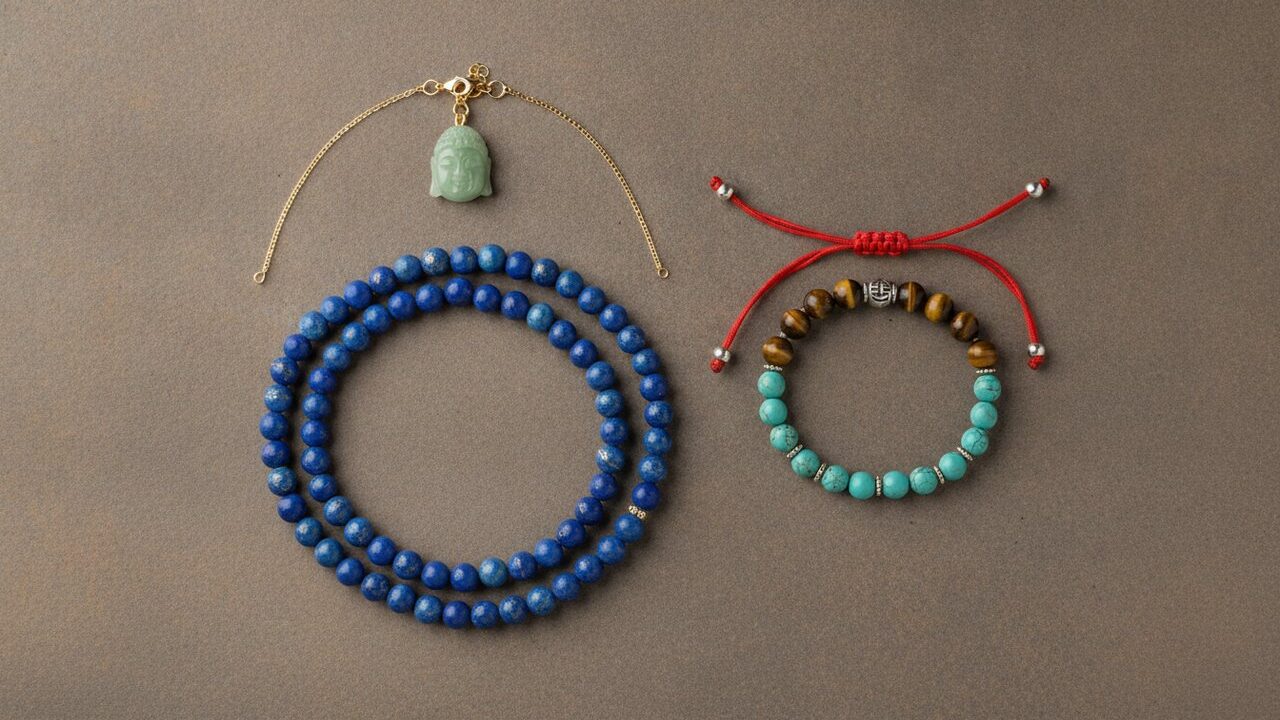
4. Pairing Buddha Pieces with Healing Crystals
Crystal pairings work best when you consider both the visual and the symbolic register. Here’s a working reference for common combinations:
| Crystal | Pairs Well With | Avoid Pairing With | Notes |
|---|---|---|---|
| Amethyst | Peaceful Buddha image, Quan Yin pendant | Red agate, carnelian | Calming register; pairs with imagery emphasizing stillness |
| Black Obsidian | Protection amulets, Mahakala imagery | Rose quartz, moonstone | Strong grounding quality; suits protective deity pieces |
| Lapis Lazuli | Medicine Buddha pendants, wisdom symbols | Highly activating stones (red jasper) | Traditionally associated with truth and clarity |
| Red Agate | Vitality-focused pieces, earth element symbols | Amethyst, blue lace agate | Higher energy stone; works with activating imagery, not calming |
| Clear Quartz | Most combinations | No common conflicts | Visually neutral; useful as a separator between stronger stones |
The practical goal is that combined pieces reinforce a consistent focus rather than pulling attention in competing directions. A calming amethyst alongside a serene Buddha image creates a coherent message. A high-energy red agate next to the same image introduces a tension that may or may not serve you.
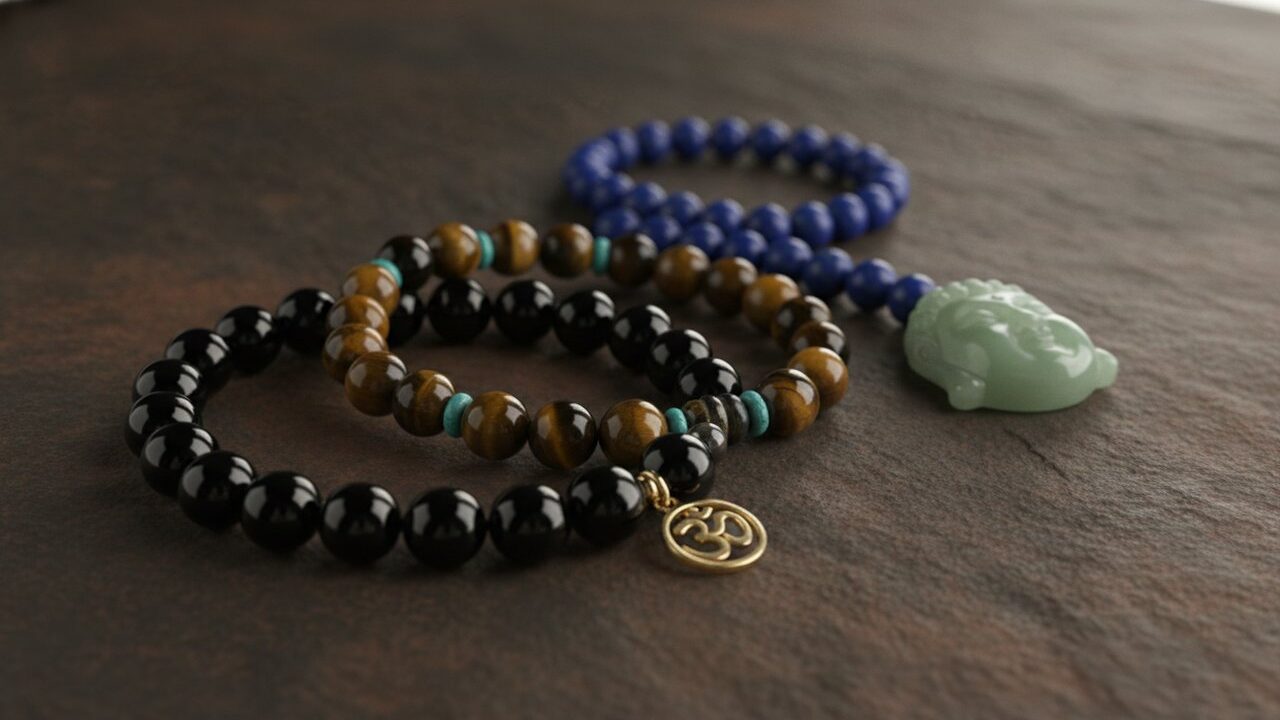
5. Placement and Basic Etiquette
Across most Buddhist traditions, images of the Buddha or bodhisattvas are worn above the waist — typically at chest or throat level. This reflects the same logic that governs the placement of sacred images in a home: elevation signals respect. It isn’t a superstition so much as a consistent cultural convention worth observing.
Practically, this means keeping your buddha necklace at a length that keeps the pendant above the sternum. An 18-inch chain typically achieves this for most builds. Longer chains risk the pendant dropping to the solar plexus or below, which reads differently in a traditional context.
During strenuous physical activity, it’s worth removing pieces that could be damaged — both for the sake of the jewelry and because a cracked pendant mid-workout is a distraction you don’t need.
6. Cleansing and Maintenance
Regular cleansing is as much about refreshing your own relationship to a piece as it is about the object itself. The practices are simple:
- Moonlight exposure — leave pieces out overnight during or near a full moon.
- Smoke cleansing — pass pieces through sage or palo santo smoke briefly.
- Selenite contact — rest pieces on a selenite slab for several hours.
These are intentional rituals rather than technical processes. The act of setting aside time to clean and reset your jewelry is itself a form of attention — it’s when you’re most likely to notice whether a piece still belongs in your rotation or has quietly stopped serving its purpose.
For more on what specific bracelet symbols and materials carry, the guide on Spiritual Bracelet Meaning covers the material breakdown in more depth.
Frequently Asked Questions
What is the core philosophy behind wearing multiple spiritual jewelry pieces?+
The article emphasizes that wearing multiple spiritual jewelry pieces is about combining ancient wisdom with modern personal expression, focusing on intention, personal connection, and mindful self-expression, rather than strict rules or dogma.
How important is understanding the intention behind each spiritual jewelry piece?+
It is essential to understand the individual purpose and symbolism of each piece. This amplifies its impact, prevents mental clutter, and ensures it genuinely contributes to your personal journey as a powerful visual reminder of your intentions.
Can wearing too many spiritual items lead to 'energetic clashes'?+
While traditional beliefs mention 'energetic clashes,' the article suggests this is more about maintaining a clear sense of intention and inner calm. Your personal resonance is paramount; if wearing multiple pieces brings peace, it aligns. If it feels confusing or heavy, that's your intuition guiding you.
What are some tips for effectively layering spiritual jewelry?+
Effective layering involves balancing visual weight, textures, and lengths to allow each piece to shine harmoniously. It's recommended to select a focal piece and then add complementary pieces, varying lengths to create visual interest and prevent tangling.
Why is it important to cleanse and charge spiritual jewelry, and what are some methods?+
Regular cleansing and charging are essential to maintain the vibrancy and effectiveness of spiritual jewelry by resetting its energetic potential. Simple methods include placing them under the light of a full moon, gently smudging them with sage or palo santo, or allowing them to rest on healing crystals like selenite.