Chinese Zodiac: Which Buddha Protects Your Sign?

Most people know their Chinese zodiac sign. Fewer know that each sign has a corresponding guardian Buddha—a Benming Fo (本命佛)—assigned not by chance but through a system rooted in Tang Dynasty esoteric Buddhism. This is not a personality horoscope. It is a framework of virtues: each guardian embodies specific qualities that practitioners are invited to cultivate within themselves over a lifetime.
Within this Chinese zodiac cluster, read this page as the spiritual-protection branch. If you need the full zodiac framework first, begin with our Chinese Zodiac guide. If you want the animal sequence and birth-year table, use the twelve Chinese zodiac animals guide.
Where the System Comes From
The Benming Fo system was codified during the Tang Dynasty, when Vajrayana Buddhism was formally transmitted to China. The scholar-monk Amoghavajra (不空金刚, 705–774 CE) played a central role in translating and systematizing esoteric texts, including those underpinning the Garbhadhatu (Womb Realm) mandala—a cosmological diagram that maps eight principal Buddhas and Bodhisattvas across its structure.
This explains a feature of the system that often puzzles newcomers: twelve zodiac signs share only eight guardians, with four Buddhas each covering two signs. This is not an oversight. It reflects the mandala’s geometry, in which certain enlightened qualities correspond to multiple expressions of human nature. The system’s architecture is deliberate, not improvised.
Your Guardian Buddha by Zodiac Sign
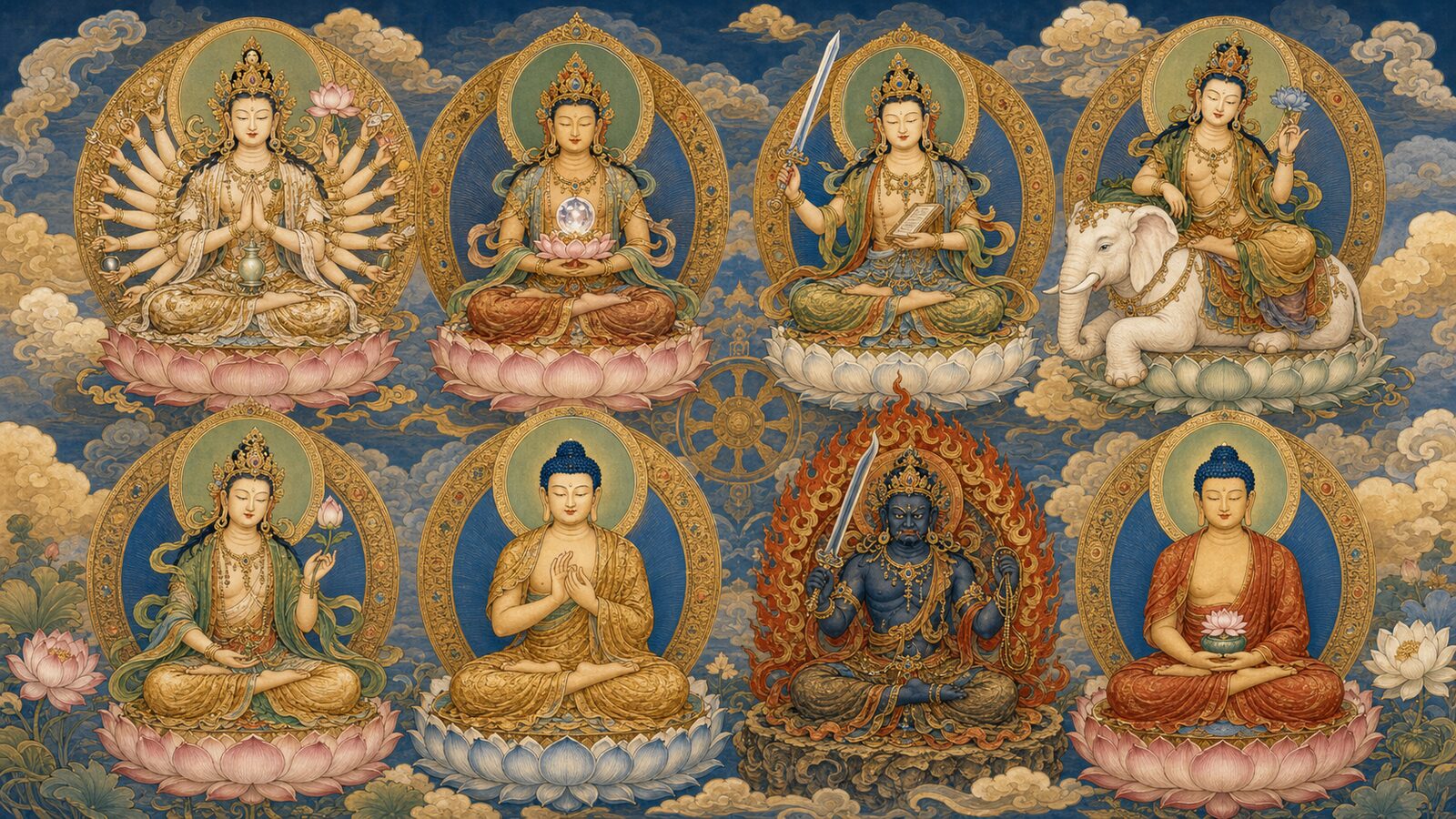
| Zodiac sign | Guardian Buddha or Bodhisattva | Core virtue |
|---|---|---|
| Rat | Thousand-Handed Guanyin | Compassion that responds quickly |
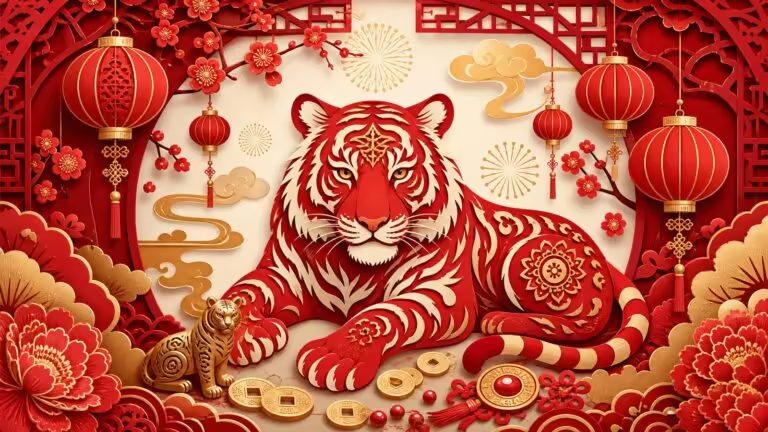
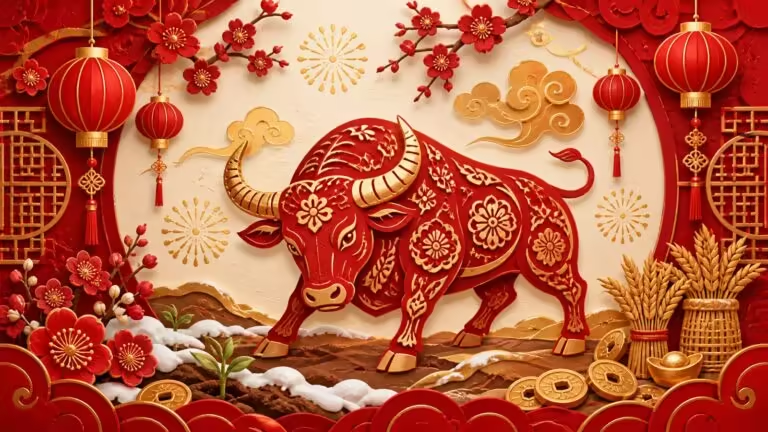
| Ox, Tiger | Akasagarbha Bodhisattva | Boundless perspective under pressure |
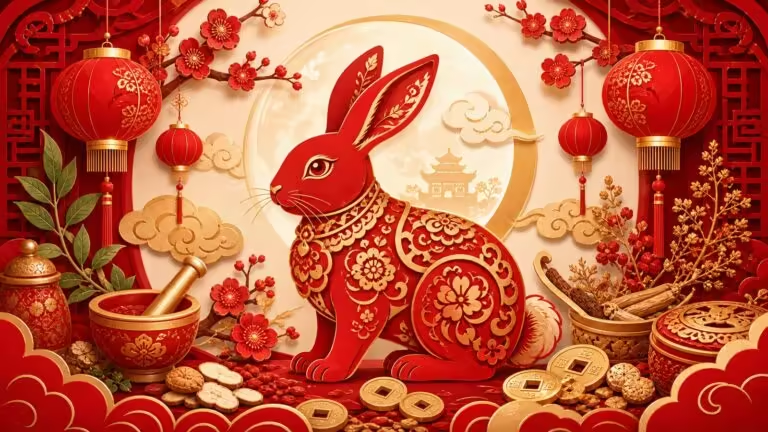
| Rabbit | Manjushri Bodhisattva | Wisdom that cuts through confusion |
| Dragon, Snake | Samantabhadra Bodhisattva | Virtue expressed through action |
| Horse | Mahasthamaprapta Bodhisattva | Strength that becomes usable wisdom |
| Goat, Monkey | Vairocana Buddha | A stable center for sensitivity and intelligence |
| Rooster | Acala Bodhisattva | Immovable discipline |
| Dog, Pig | Amitabha Buddha | Light, trust, and replenishing compassion |
Rat: Thousand-Handed Guanyin
Thousand-Handed Guanyin Bodhisattva is among the most recognized figures in East Asian Buddhism, revered as the embodiment of compassion. Her iconography is precise: many hands represent the ability to respond in many directions at once.
- Willow branch: healing and gentle restoration.
- Lotus: purity that can emerge from difficult conditions.
- Vase: compassion held and poured out when needed.
- Eye in the palm: seeing and responding are treated as one act.
Her core mantra, Om Mani Padme Hum, remains one of the most widely recited compassion mantras in Mahayana Buddhism. For the Rat, a sign defined by adaptability and resourcefulness under pressure, this guardian reflects the same quality: the ability to find a way through without losing sight of others in the process.
Ox and Tiger: Akasagarbha Bodhisattva
Akasagarbha—whose name translates as “Treasury of the Sky”—is a Bodhisattva of inexhaustible wisdom. In classical iconography, he holds a cintamani resting on a lotus. A cintamani is a wish-fulfilling jewel: less a symbol of ordinary desire than of wisdom that can answer a sincere need without being depleted.
The sky metaphor is deliberate. Just as the sky contains everything without being diminished by any of it, Akasagarbha’s store of wisdom is considered structurally boundless rather than merely large.
For the Ox, whose strength lies in steady persistence, and the Tiger, whose power is most effective when channeled with clarity, this guardian offers the quality both signs need most: perspective that holds under sustained pressure rather than running out when it is needed most.
Rabbit: Manjushri Bodhisattva
Manjushri Bodhisattva is Buddhism’s primary symbol of wisdom, and his iconography makes his function unmistakable. In his right hand he raises a flaming sword—not a weapon of harm, but one that severs ignorance at its root in a single stroke. In his left hand rests a lotus bearing the Prajnaparamita sutra, the foundational text on the nature of wisdom. He is often depicted riding a blue lion, representing the disciplined power of the intellect held under conscious control.
Practitioners seeking mental clarity traditionally recite his seed syllable, Dhih, as a focal point for study and discernment. For the Rabbit—associated with careful thought and an instinct for avoiding unnecessary conflict—Manjushri offers the sharpness that caution alone cannot always provide.
Dragon and Snake: Samantabhadra Bodhisattva
Samantabhadra Bodhisattva (普贤, Puxian) is classically depicted riding a six-tusked white elephant. The six tusks are not decorative—they correspond directly to the six paramitas: generosity, discipline, patience, diligence, meditation, and wisdom. His practice is structured around the Ten Great Vows (十大愿), a framework for ethical aspiration that remains among the most studied texts in Mahayana curricula, particularly in the Avatamsaka Sutra tradition.
For the Dragon, whose ambition runs high, and the Snake, whose strategic instincts are most effective when paired with a clear moral framework, Samantabhadra’s emphasis on virtue as the foundation of achievement offers a useful counterweight to the temptation of results at any cost.
Horse: Mahasthamaprapta Bodhisattva
Mahasthamaprapta Bodhisattva stands alongside Amitabha Buddha and Guanyin as one of the Three Sages of the Western Pure Land—a position that marks him as a transmitter of wisdom rather than simply a repository of it. His name means “arrival of great strength.” In iconography, he holds a lotus bud with a water vessel set within his crown: symbols of receptivity and the capacity to bring wisdom downward into practical use rather than holding it in reserve.
His practice is rooted in Pure Land recitation: Namo Amituofo (南无阿弥陀佛). For the Horse—energetic, driven, and occasionally prone to burning through reserves—this guardian’s emphasis on channeled strength over raw momentum is well-matched to the sign’s most common challenge.
Goat and Monkey: Vairocana Buddha
Vairocana Buddha occupies the center of the Dharmadhatu, the field of all phenomena, and is understood as the source from which all other Buddhas emanate. His iconography is immediately distinctive: he forms the bodhyangi mudra, in which the left index finger is enclosed within the right fist—a gesture found nowhere else in Buddhist iconography. It represents the union of wisdom and skillful means, theory and application held together in a single form.
The philosophical basis for this guardian is elaborated in the Mahavairocana Tantra (大日经), one of the foundational texts of Tang Esoteric Buddhism. For the Goat, whose sensitivity benefits from a stable center, and the Monkey, whose quick intelligence is most productive when grounded, Vairocana’s all-encompassing nature provides exactly that kind of anchor.
Rooster: Acala Bodhisattva
Acala (Fudo Myoo in Japanese tradition) is unusual among Buddhist figures: his appearance is deliberately fearsome. He is surrounded by flames, holds a sword in his right hand and a lasso in his left, and wears an expression of fierce concentration. The Mahavairocana Tantra describes this form specifically as a manifestation of Vairocana’s adamantine resolve—the flames consume delusion, the sword cuts through it, and the lasso binds what remains before it can regroup.
The Rooster‘s association with Acala reflects the sign’s orientation toward precision and order. Acala’s wrathful appearance is not anger—it is the refusal to be moved by distraction. For a sign that functions best with clear standards and reliable structure, this guardian’s core quality reads less as aggression and more as a form of practiced discipline.
Dog and Pig: Amitabha Buddha
Amitabha Buddha, the Buddha of Infinite Light, is depicted in deep meditation posture with hands forming the dhyana mudra and a lotus resting within. His Pure Land, Sukhavati, is described in the Amitabha Sutra as a realm where conditions for awakening are ideal—not a paradise in the escapist sense, but a state of unobstructed clarity. His name mantra—Namo Amituofo (南无阿弥陀佛)—is the most widely recited phrase in East Asian Buddhism, crossing school and sectarian boundaries in a way few others have.
For the Dog, whose loyalty requires a sense of purpose to remain sustainable, and the Pig, whose generosity can become self-neglect without a stabilizing practice, Amitabha’s boundless compassion offers both direction and replenishment.
From Symbol to Practice
The Benming Fo tradition is not primarily about veneration. At its functional core, it offers a map of virtues—specific qualities each guardian embodies at their fullest expression—and invites practitioners to cultivate those same qualities in themselves. Three qualities appear consistently across all eight guardians:
- Compassion: Practice it in daily interactions, even when—especially when—it is inconvenient. Guanyin’s thousand hands exist because one pair is never sufficient.
- Clarity: Separate observation from assumption before you act. Manjushri’s sword is only useful when it is sharp.
- Resolve: Make decisions under pressure without surrendering to panic. Acala’s stability is not the absence of uncertainty—it is the refusal to be governed by it.
While faith in a guardian Buddha offers immense spiritual strength, its true power lies in its ability to inspire a kind and upright heart in daily life, transforming abstract belief into tangible positive action.
When you recite Om Mani Padme Hum before a difficult conversation, or pause on Manjushri’s seed syllable Dhih before a decision that requires clear thinking, these are not purely religious acts. They are practiced psychological anchors—deliberate ways of returning to a specific quality of attention before the moment demands it. The guardian is a map. The territory is your own daily behavior.
References
- Rubin Museum of Himalayan Art: Manjushri – supports the description of Manjushri as a wisdom deity whose sword cuts through ignorance and whose book symbolizes Buddhist teaching.
- Cleveland Museum of Art: Samantabhadra – supports the six-tusked elephant iconography and Samantabhadra’s protective role in Buddhist art.
- Nelson-Atkins Museum of Art: Ruyilun Guanyin, Cintamani Chakra Bodhisattva – supports the Guanyin/Avalokiteshvara and cintamani jewel context used in the iconography discussion.
Recommended Reading
- Complete zodiac system: Chinese Zodiac: Your Personal Insight System
- Twelve animal signs: What Are the Twelve Chinese Zodiac Animals?
- Rat sign deep dive: Chinese Zodiac Rat
- Dragon sign deep dive: Chinese Zodiac Dragon
- Dog sign balance: Chinese Zodiac Dog: Inner Harmony
Frequently Asked Questions
What is the main concept discussed in the article?+
The article explains that each of the 12 Chinese zodiac signs has a specific guardian Buddha associated with it, which is believed to offer unique energy, blessings, and guidance.
How do these guardian Buddhas assist individuals?+
These guardian Buddhas are said to bring good luck, inspire inner wisdom and strength, help people overcome obstacles, guide them through difficulties, and provide spiritual support for a happy and fulfilling life.
Which Buddha protects the Rat sign, and what are their attributes?+
The Rat sign is protected by the Thousand-handed Guanyin, who embodies wisdom, compassion, and endless power to help those in distress, bringing well-being and eliminating suffering.
Who are the guardian Buddhas for the Ox and Tiger, and what do they represent?+
The Ox and Tiger signs are guarded by the Bodhisattvas of the Void, who symbolize boundless wisdom and guide individuals in overcoming mental obstacles, strengthening faith, and realizing their aspirations.
What is the broader significance of these guardian Buddhas beyond their religious aspect?+
Beyond religion, these guardian Buddhas symbolize life wisdom, encouraging individuals to maintain a kind heart, actively pursue their dreams, and use their wisdom and power as a guide to navigate life's challenges towards a bright future.