Red Bead Bracelet: Symbolism, Style, and Significance

Red bead bracelets have been worn as protective talismans, status markers, and personal touchstones for centuries, long before modern trends turned mindfulness into a marketing buzzword. Today, they serve a similar, practical function: a small, physical object you can return your attention to during a busy day.
The meaning attached to a red bead bracelet typically falls into a few overlapping categories—protection, good fortune, passion, vitality, and confidence—depending on the cultural tradition and the specific material used. The rest of this guide breaks down what those meanings actually come from, what the beads are made of, how to wear them, and how to take care of them properly.
Each material and tradition discussed below fits into a larger picture of how people use wearable objects to support a personal practice. For a broader look at that topic, see our guide on Spiritual Bracelet Meaning: Your Complete Guide to Energy Practice.
Cultivating Intentions with Red
Red carries strong associations across most cultures, though the specific meaning shifts depending on context—from cultural symbolism to private intention-setting. Wearing red is one of the simplest ways people attach a personal value to something they can see and touch every day.
Symbolic Meanings of Red
The five meanings below are the ones most commonly attached to red beads. None of them require religious belief to use—they work as a personal reference point either way.
Protection. Many traditions treat red as a marker of a protective boundary. The clearest example is the sungdü—a Tibetan Vajrayana Buddhist protection cord, traditionally blessed by a lama who recites a mantra, most often the six-syllable Om Mani Padme Hum, while tying the knot. The knot itself is believed to hold the blessing. Similar red-string protection traditions exist in Kabbalah and several other Asian folk practices, each with its own specific rules.
When you feel a wave of tension or distraction, try a simple physical practice: touch one of the red beads, close your eyes for a moment, and take a slow, deliberate breath. Allow yourself to feel the smooth texture or cool surface of the bead. Let that simple sensation pull your mind back from your thoughts and anchor you directly in the present moment.
Good fortune and prosperity. In Chinese culture, red is tied directly to luck and prosperity—most visibly in the red envelopes (hóngbāo) exchanged during Lunar New Year and at weddings. The Pixiu, a mythical creature associated with wealth, is also commonly rendered in red for the same reason.
Wearing red with this association in mind works less as a guarantee of luck and more as a regular prompt to notice your surroundings. When you look down at your wrist, take a second to pause and identify one small thing you are grateful for in this exact moment.
Love and passion. Red’s association with the heart and romance is one of the oldest and most consistent across cultures. As a bracelet, it works as a quiet reminder to stay open—to relationships, to creative projects, or simply to your own enthusiasm. Try this: rest your hand over your chest for three quiet breaths when you put the bracelet on, setting a simple intention to meet your day with kindness.
Vitality and energy. Red is widely linked to life force, strength, and physical energy, likely because it’s the color of blood and fire—two things humans have associated with survival and intensity for a very long time. As a bracelet, it can function as a physical cue: pause for a moment, stand up, stretch, and reset your posture.
Action and confidence. Red is also associated with boldness and decisiveness. It’s no accident the color is used for warning signs, stop lights, and clearance sales—all situations that call for an immediate decision. Worn as a bracelet, it can work as a quiet cue before a difficult conversation: a small physical reminder to pause and speak with clarity rather than hesitate.
None of this requires believing the bead itself has power. The bracelet works the same way a sticky note on your monitor works—as a small, repeated cue that points your attention back to something you’ve already decided matters.
What Red Beads Are Actually Made Of
The material a bracelet is made from isn’t just a style choice. Different materials carry their own composition and history, and in some cases, a few specific things worth knowing before you buy.
Common Materials for Red Beads
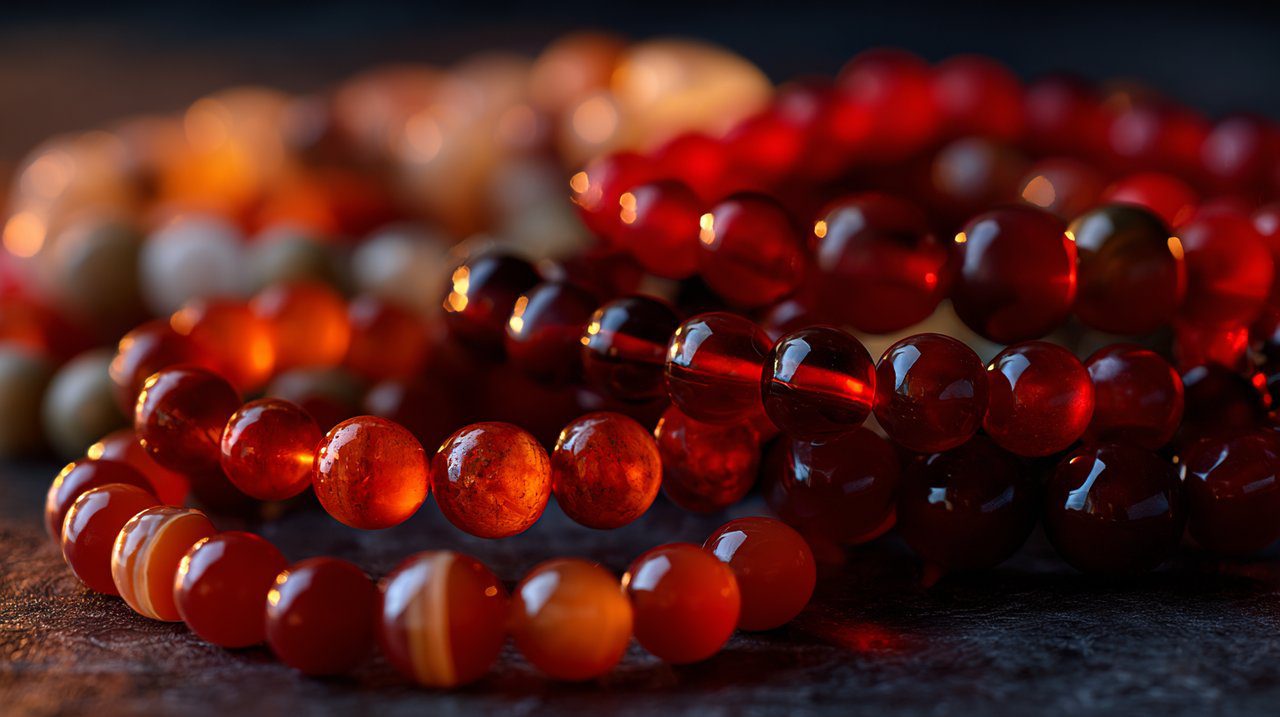
Most “red beads” come from one of a handful of materials, each grouped under the same color for a different reason.
- Red Agate: A banded variety of chalcedony (a form of quartz) where the red color comes from iron oxide trapped in the stone as it formed. Agate sits around 6.5–7 on the Mohs hardness scale, which makes it highly durable for daily wear.
- Red Jasper: Also a quartz variety, but opaque rather than translucent due to a denser mix of mineral impurities. Jasper has been used as an amulet stone across several ancient cultures, generally associated with stamina and physical endurance.
- Carnelian: A chalcedony colored by iron oxide (hematite), giving it its characteristic orange-red tone. Ancient Egyptians used carnelian extensively in jewelry and burial amulets, including pieces tied to protection in the afterlife—one of the better-documented historical uses of any stone on this list.
- Garnet: Not a quartz variety, but a silicate mineral, with its deep red coming from iron and manganese content. Its name traces back to the Latin granatum (“pomegranate”), a reference to its resemblance to pomegranate seeds. Garnet is harder than the chalcedony stones above (6.5–7.5 Mohs) and is one of the few on this list cut as a faceted gemstone rather than simply polished into beads.
- Red Coral: An organic material—the calcium carbonate skeleton of coral polyps, not a mineral at all. Historically, red coral was traded along overland routes into Tibet and Mongolia, where it became one of the most valued materials in traditional jewelry, often paired with turquoise. Because many red coral species are now protected under international trade restrictions, a large share of “coral” beads sold today are dyed bamboo coral, reconstituted coral, or glass and resin imitations. Genuine coral usually shows subtle, irregular color variation and a slightly porous, matte surface; imitations tend to look unnaturally uniform and glassy. If in doubt, ask the seller directly whether the material is natural, dyed, or reconstituted.
- Lava Stone: Porous volcanic basalt, sometimes dyed red. Its porosity is the actual reason it’s popular for “diffuser” bracelets—it absorbs a drop of essential oil and releases the scent gradually over the day.
To help you choose the material that best fits your daily rhythm, here is a quick physical comparison of the most common natural red beads:
| Material | Mohs Hardness | Mineral Composition | Core Care Precaution |
|---|---|---|---|
| Red Jasper | 6.5–7 | Opaque microcrystalline quartz | Avoid harsh chemical cleaners; wash with warm soapy water. |
| Red Agate | 6.5–7 | Banded chalcedony (quartz) | Avoid ultrasonic cleaners; wipe down after wearing to clear skin oils. |
| Garnet | 6.5–7.5 | Silicate mineral | Keep away from sudden extreme temperature changes to protect natural inclusions. |
| Red Coral | 3.5–4 | Organic calcium carbonate | Highly sensitive to acids, perfumes, and cosmetics; wipe with a damp cloth only. |
Other Materials
Beyond stone, a few other materials show up regularly in red bead bracelets:
- Glass beads—manufactured, available in nearly any finish from matte to faceted, and generally the most affordable option.
- Ceramic beads—typically handmade, with more visible piece-to-piece variation than mass-produced glass.
- Wood beads—lightweight, sometimes stained red, and the least durable option in humid climates since wood can warp or crack over time.
Most bracelets are strung on elastic cord for an easy slip-on fit, or on nylon or silk thread finished with a clasp for a more structured look. Some designs add metal spacers, charms, or tassels.
Styling Your Red Bead Bracelet
How you wear a red bead bracelet is a separate decision from what it means to you—the two don’t have to match perfectly.
The styling itself also has roots in history. In several cultures, the specific design of a red bead bracelet—from a simple single strand to an elaborate multi-layer piece—has signaled status, tribal affiliation, or a specific ceremonial role, not just decoration. A modern bracelet borrows from that visual language even when it isn’t tied to a specific tradition.
Mindful Adornment
A few practical ways to wear one:
- Solo statement: A single bracelet stands out against a neutral outfit, or blends in if matched to warm tones already in your wardrobe.
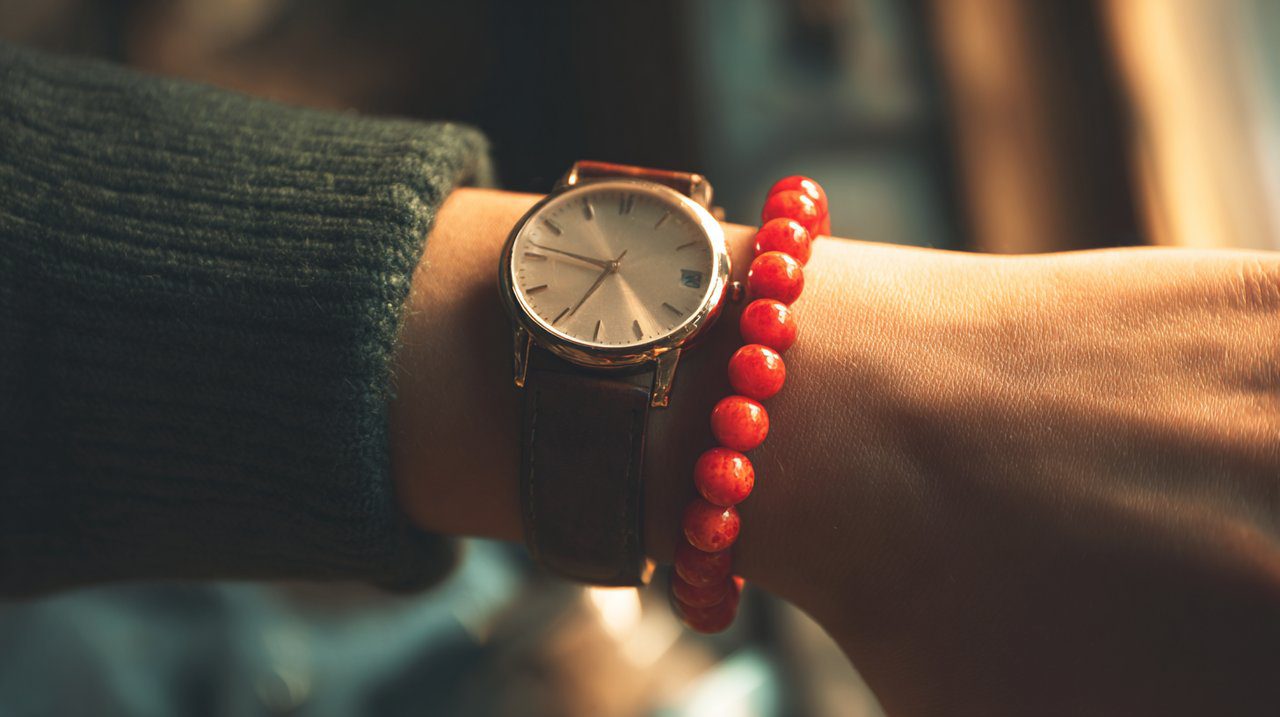
- Layered look: Combine it with bracelets of different textures or colors—a red Chinese bracelet next to black, gold, silver, or wooden pieces works well for a stacked-wrist look.
- Casual: Works fine with jeans and a T-shirt or any simple everyday outfit.
- Dressed up: Polished stones like garnet, or pieces with metallic accents, hold up better next to more formal clothing.
- Gender-neutral: Red bead bracelets aren’t tied to a specific gender presentation—the color and material do the work, not the cut.
Sharing the Ritual
When you offer a red bead bracelet as a gift, it becomes more than a physical object. It is a quiet way of showing care, extending a sense of safety and grounding to someone you value. For the recipient, wearing this gift serves as a physical reminder of being seen, appreciated, and supported. Every time they look at their wrist during a challenging day, they are reminded that they do not have to carry their burdens entirely alone—there is someone who cares deeply about their well-being.
Caring for Your Red Bead Bracelet
How long a bracelet lasts has more to do with the specific material than with how carefully you treat it in the abstract. Here’s what actually matters, by material.
Care Tips by Material
- Coral. Calcium carbonate is sensitive to acids—perfume, sweat, lotion, and even some cleaning products can dull or etch the surface over time, the same way they affect pearls. Apply perfume or lotion before putting the bracelet on, not after.
- Turquoise (Accent Beads). If your red bead bracelet features turquoise accent beads to contrast the warm red tones, keep in mind that turquoise is a highly porous phosphate mineral. It absorbs liquids easily, which can alter its color over time. Always remove the bracelet before swimming, bathing, or washing your hands, and avoid contact with hand sanitizers.
- Agate, Jasper, and Carnelian. These quartz-family stones are fairly hard and hold up well to daily wear, but avoid ultrasonic jewelry cleaners. Carnelian in particular is sometimes heat-treated to deepen its color, and aggressive cleaning can affect that treatment over time.
- Garnet. Durable day to day, but avoid sudden temperature swings—going straight from a hot car into an air-conditioned room, for example. Rapid temperature change can stress natural inclusions in some garnet varieties.
- Lava Stone. Its porosity is useful for essential oils but a liability for everything else—it will also absorb sweat, lotion, and perfume, which can darken or discolor the stone permanently. Keep it dedicated to oil diffusing rather than everyday wear if you want to preserve its color.
- Elastic Cord. The cord, not the beads, is usually the first thing to fail. Avoid repeatedly overstretching it to put the bracelet on, and replace it every year or two on bracelets worn daily.
For general handling: wipe beads with a soft, dry cloth after wearing to remove oils, store away from direct sunlight to limit fading, and keep the bracelet in a pouch or box rather than loose in a drawer where it could get scratched by other jewelry.
None of this requires treating the bracelet as anything more than what it is—a small, physical object that, used consistently, can function the same way a sticky note or a gentle chime does: pointing your attention back to the quiet space within, and to the values you have chosen to guide your day.
Frequently Asked Questions
What is the primary symbolism of red bead bracelets?+
Red bead bracelets often symbolize protection, good fortune, prosperity, love, passion, vitality, energy, action, and confidence across various cultures.
What materials are commonly used to make red bead bracelets?+
Common materials include natural stones such as Red Agate, Red Jasper, Carnelian, Garnet, Coral, and Lava Stone. Other materials are glass beads, ceramic beads, and wood beads.
How can I style a red bead bracelet?+
You can wear a red bead bracelet as a solo statement piece, layer it with other bracelets of different textures and colors, incorporate it into casual chic outfits, or choose more polished designs for elevated elegance. They are also considered gender-neutral.
What are the recommended care tips for a red bead bracelet?+
To care for your red bead bracelet, avoid harsh chemicals, clean it gently with a soft, dry cloth (or a slightly damp cloth with mild soap for deeper cleaning), store it properly in a jewelry pouch or box away from direct sunlight, and handle it with care to prevent excessive stretching or snagging.