Chinese Zodiac Pig

We often view the final position in the Chinese zodiac sequence through the lens of a race, reducing the last animal to a simple story of laziness. However, this misses a sophisticated architectural truth within Eastern cosmology. The twelfth position is not a sign of failure; it serves as a vital symbol of completion and stored potential.
To understand the placement of this final sign, we have to look at the structural philosophy of ancient agricultural societies. The sequence isn’t about winners or losers, but about the consolidation of energy. It represents the quiet moment before a new cycle begins, a concept deeply rooted in the cycles of Chinese astrology cycles.
Because the Chinese lunar new year can begin in late January or early February, birth dates near the start of the Gregorian year may belong to the previous zodiac sign. Use the calculator below to confirm your exact sign before applying the symbolism in this article.
Ask a specific question for a more tailored AI interpretation.







Cosmological Purpose
The Earthly Branches function as a circular system rather than a linear competition. In the ancient text 「Huainanzi」, the twelfth branch, 「Hai」, is explicitly linked to the concept of containment. This linguistic connection reveals the true function of the twelfth hour.
It acts as the vessel that seals the previous cycle and holds the raw material for the next one. This corresponds exactly to the period of the winter solstice. In traditional philosophy, this is the moment when dormant energy reaches its absolute peak.
The twelfth position is a cosmological necessity. It is the absolute stillness of winter that makes the explosive growth of spring physically possible.
According to the principle of 「yin ji ze yang sheng」, it is only when energy reaches its extreme limit of stillness that it can be born again. The final sign provides the space for this transition to occur. This is not an abstract philosophical claim — agricultural observation provides the concrete evidence. A seed buried under winter frost is not idle; it is actively undergoing vernalization, the biochemical priming required before any visible germination can occur. The most concentrated period of preparation always precedes the most visible burst of growth.
Vessel of Material Abundance
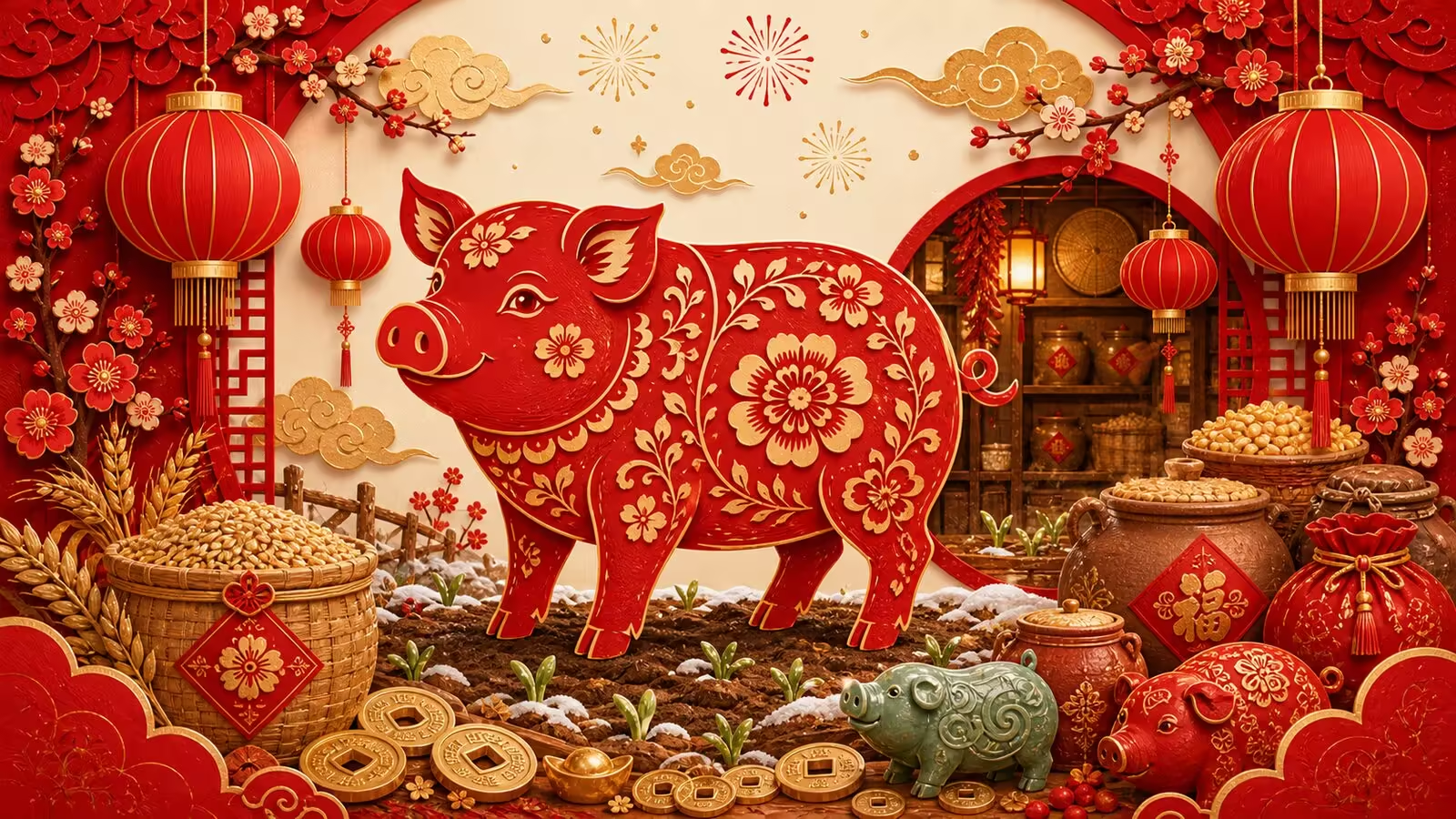
In ancient agricultural societies, survival depended on the physical accumulation of resources for the harsh winter months. The pig served as a concrete symbol of this security. It represented the final line of defense against scarcity and the successful completion of the harvest cycle.
Archaeological evidence from Han Dynasty tombs perfectly illustrates this dependence. Excavations frequently uncover 「Tao Zhu」 (pottery pigs) and 「Wo Zhu」 (jade pigs) placed in the hands of the deceased. These artifacts were essential components of the afterlife economy, acting as a vessel of wealth and a precursor to the tradition of carrying protective adornments for spiritual and material security.
Craftspersons molded these figures with specific exaggerations to emphasize their function:
- Short legs that suggest a heavy, grounded connection to the earth.
- Prominent features representing the physical storage of critical nutritional reserves.
- An extended snout reflecting an active capacity to gather resources.
These design choices served as a visual anchor for household abundance. Placing these figures in a tomb ensured that the deceased carried a secure foundation into the next plane of existence.
Five Elements of the Pig
Within the sixty-year cycle, the same Pig archetype takes on five distinct textures depending on which of the Five Elements pairs with the branch Hai. Each combination preserves the Pig’s core function — containment and patient accumulation — but expresses it through a different temperament. Because the Pig branch is yin, it pairs only with the five yin stems, producing the following sequence:
- Wood Pig (乙亥, 1935, 1995) — Patient generosity that grows outward. Pursues abundance in service of others, often well-suited to teaching, healing, or community-building roles.
- Fire Pig (丁亥, 1947, 2007) — Warmth that draws others in. The accumulator who shares what is gathered, building wealth through relationships rather than solitary saving.
- Earth Pig (己亥, 1959, 2019) — Stability through deep roots. Most aligned with the archetype’s original agricultural meaning: slow, dependable, tied to physical and family security.
- Metal Pig (辛亥, 1911, 1971) — Quiet decisiveness. Where other Pigs cushion conflict, this one cuts cleanly when needed. Generosity becomes principled rather than yielding.
- Water Pig (癸亥, 1923, 1983) — Adaptive intelligence. The Pig as sensor — reading currents others overlook, finding accumulation through perception rather than effort.
These differences are texture, not substance. Beneath all five sits the same architectural function: the vessel that closes one cycle so the next can begin.
Cross Cultural Variations
The archetype of the passive accumulator is not universal across Asia. Geography and history significantly alter how this final sign of the Sheng Xiao tradition is interpreted. A clear contrast emerges when we look at the Japanese cultural sphere.
In Japan, the twelfth sign is the wild boar, known as 「Inoshishi」. This ecological shift fundamentally changes the psychological associations of the symbol. The 「Inoshishi」 is untamed, aggressive, and highly kinetic.
This difference is captured in the idiom 「Chototsu Moushin」. The phrase describes a boar charging blindly forward and is used to define reckless, headlong courage. Here, the twelfth sign becomes a symbol of martial prowess rather than passive accumulation.
Modern Application
The principle of energy containment is not confined to ancient cosmology. Contemporary research on attention and decision-making has arrived at a strikingly similar conclusion: human cognitive capacity is a finite reserve, and protecting it is one of the highest-leverage activities a person can undertake. The twelfth sign’s archetype, viewed through this lens, is less a personality type and more an early model of resource economics.
This approach is rooted in the classical concept of 「Dazhi Ruoyu」 — great wisdom often appears simple or unassuming. By adopting a non-threatening posture, an individual avoids unnecessary conflict and conserves the cognitive reserves that more aggressive postures continually deplete.
The parallel in modern behavioral science is the concept of ego depletion, popularized by social psychologist Roy Baumeister. The research suggests that self-control, focused attention, and willpower draw from a shared limited pool, which is depleted by every contested interaction and every unnecessary emotional engagement. The pig archetype, in effect, anticipated this finding by several thousand years: by deliberately stepping out of the race for visible primacy, the practitioner preserves the inner reserves needed for the work that actually matters.
Metaphysical Strategy
Traditional metaphysics offers another layer of complexity regarding how this sign interacts with external forces. The stillness of the final branch is actually a source of strategic strength when viewed through the lens of relationships. It never operates in complete isolation.
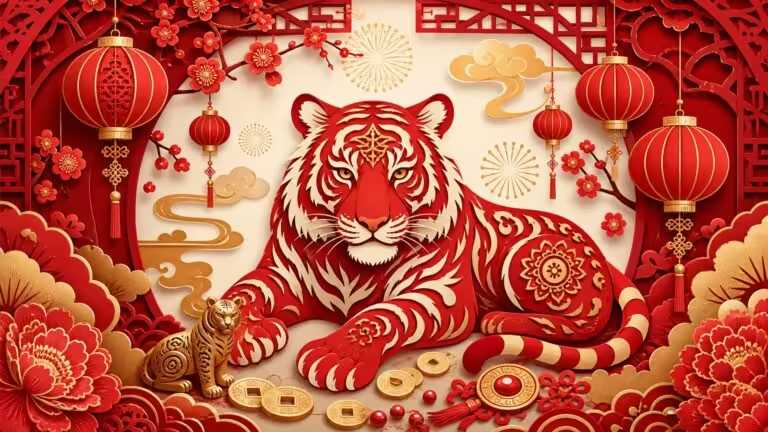
Within the system of Six Harmonies (六合), the twelfth branch shares a beneficial relationship with the third branch — specifically, the pairing of Pig (亥, Hai) and Tiger (寅, Yin). This is an energetic connection based on nourishment. As a water element, the Pig acts as a silent partner to the wood-element Tiger.
It provides the foundational resources that allow proactive, aggressive energy to thrive. Rather than expending energy to capture territory, the final sign acts as a resource aggregator. This internal focus and gathering of energy is much like the meditative practice involving meditative counting beads, where one internalizes focus to build strength.
Just as the darkest depths of winter secretly hold the water that will feed the spring forests, the final position proves that true power often lies in what is quietly contained rather than what is loudly displayed.
Frequently Asked Questions
What does the Zodiac Pig symbolize?+
The Chinese Zodiac Pig symbolizes completion, stored potential, and the consolidation of energy before a new cycle. It represents the crucial stillness of winter that enables the explosive growth of spring to occur.
Why is the Pig the last zodiac animal?+
Its final position, known as "Hai," signifies containment and the sealing of the previous cycle. This cosmological role holds the raw material and dormant energy necessary for the next cycle's birth.
How did ancient Chinese view the Pig?+
Ancient agricultural societies saw the pig as a concrete symbol of material abundance and security, representing the successful completion of the harvest. Jade and pottery pig figures were placed in tombs as vessels of wealth.
Are all zodiac pigs the same in Asia?+
No, interpretations vary culturally. In Japan, the twelfth sign is the wild boar ("Inoshishi"), which symbolizes untamed, reckless courage, a distinct contrast to the Chinese concept of passive accumulation.
What is the Pig's modern psychological strategy?+
It embodies "Dazhi Ruoyu," a strategic approach where appearing unassuming helps avoid conflict and preserves energy. This allows individuals to focus on quality and well-being rather than constant, draining action.
How does the Pig interact with other signs?+
Within the Six Harmonies, the Pig (water element) shares a nourishing relationship with the Tiger (wood element). It acts as a silent partner, providing foundational resources for the Tiger's proactive energy to thrive.
What jewelry is good for Pig zodiac?+
Historically, jade pig figures were treasured for security. Modern pieces often feature materials associated with grounding and protection, such as black obsidian or red jasper, to align with the Pig's abundant energy. Buddha Auras offers pieces curated for these qualities.
Can zodiac symbols offer personal protection?+
Many traditions suggest that symbols, like zodiac animals, can serve as personal anchors for desired qualities or protection. Wearing such a symbol can act as a mindful reminder of your inherent strengths and intentions. Buddha Auras provides items designed for this purpose.