The Stones That Help When a Room Feels Too Clinical

There is a particular kind of exhaustion that has nothing to do with physical pain. It comes from fluorescent lights that never dim, from the constant hum of monitors, and from walls that offer nothing to rest your eyes on. Anyone who has spent time in an oncology ward — as a patient or as the person sitting in the chair beside the bed — knows this feeling.
You cannot always change the room. But you can change what is in it. For anyone looking for chemotherapy room comfort, understanding the supportive role of healing crystals can offer a vital sense of agency in a sterile environment.
This is not a claim about healing. Crystals do not treat cancer. What they can do is give your hands something to hold, your eyes somewhere to land, and your nervous system a small, consistent signal that says: you are still here, and you are okay.
For anyone searching for meaningful gifts for cancer patients in hospital, these three stones are a place to start.
Something to Hold When the Words Are Too Much
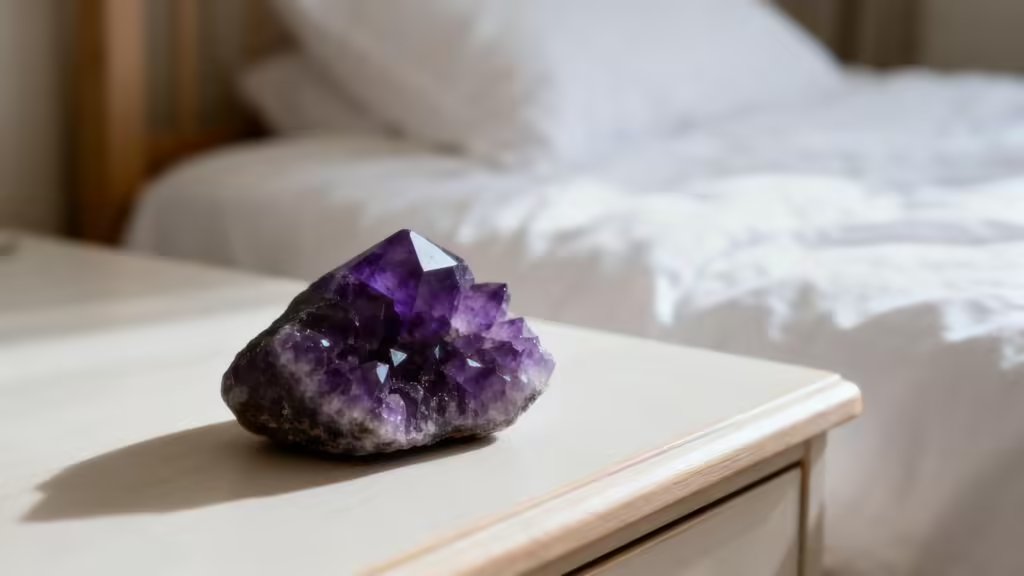
Amethyst is one of the most instinctively reaching-for stones there is. It has weight. It has texture. When a doctor is explaining something complicated and fear starts to crowd out the ability to listen, having something solid in your hand can act as a quiet anchor.
The ancient Greeks called it amethystos — meaning clear-headed, unswooned. That is still a useful way to think about it. Not that it removes the fear, but that it gives fear somewhere to go that is not your chest.
When anxiety peaks, try running your thumb slowly across the polished face of the stone in a steady back-and-forth motion.
That small, repetitive contact gives the nervous system something rhythmic to follow. It draws attention away from the sound of monitors in a way that simply telling yourself to calm down never quite does.
This physical anchor works because it gives the body a task. The hands stop searching for something to grip. The breath finds a pace to match. It is a small mechanism, but in a room where so much is out of your control, small mechanisms matter.
A tumbled piece on the bedside table, or a small polished point that fits in a pocket, is enough. The goal is not display. It is something to reach for.
Something to Watch When the Room Feels Static
Hospital rooms are full of things that do not move — monitors, rails, ceiling tiles. Satin spar, a form of gypsum, does something different. Its surface catches light and shifts it, producing a soft moving glow that has no equivalent in clinical equipment.
This matters more than it sounds. The eye naturally seeks variation. When everything in a room is flat and fixed, the visual system stays on alert. A single piece of satin spar near a lamp or window gives the eye something to follow without effort — which is closer to rest than it might seem.
Caring for it becomes, in a small way, a daily practice of paying attention to something fragile — which is not the worst habit to cultivate during a difficult time.
Something Cool When Anxiety Runs Hot
Anxiety has a physical signature. The chest tightens. The face flushes. The hands feel warm and restless.
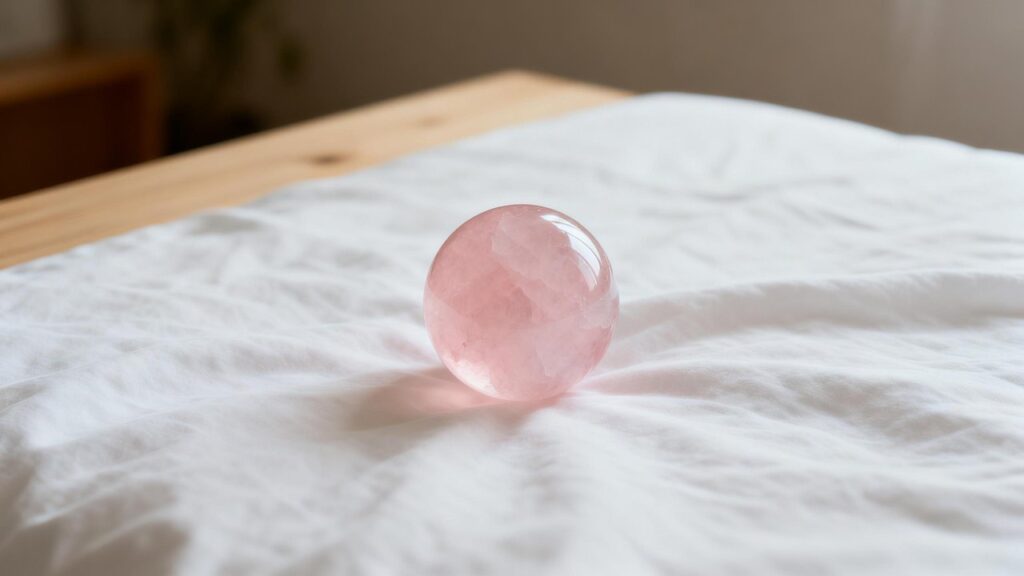
Rose quartz stays naturally cool to the touch. This is not metaphor — it is how the mineral conducts heat. Picking it up when anxiety spikes provides an immediate and uncomplicated sensory counterpoint to what the body is doing.
A sphere works well for this. It has no edges, no orientation, no correct way to hold it. Milky varieties diffuse light softly, which can make a small room feel slightly less enclosed. Clear pieces feel lighter. The choice between specific textures or clarity levels often comes down to what your hands are looking for in a given moment.
How to Arrange Them Without Making It Feel Like More Clutter
A hospital room is already full of objects with jobs to do. Adding more things to a cluttered surface defeats the purpose entirely.
Keep it simple: three pieces, thoughtfully placed, with clear space between them.
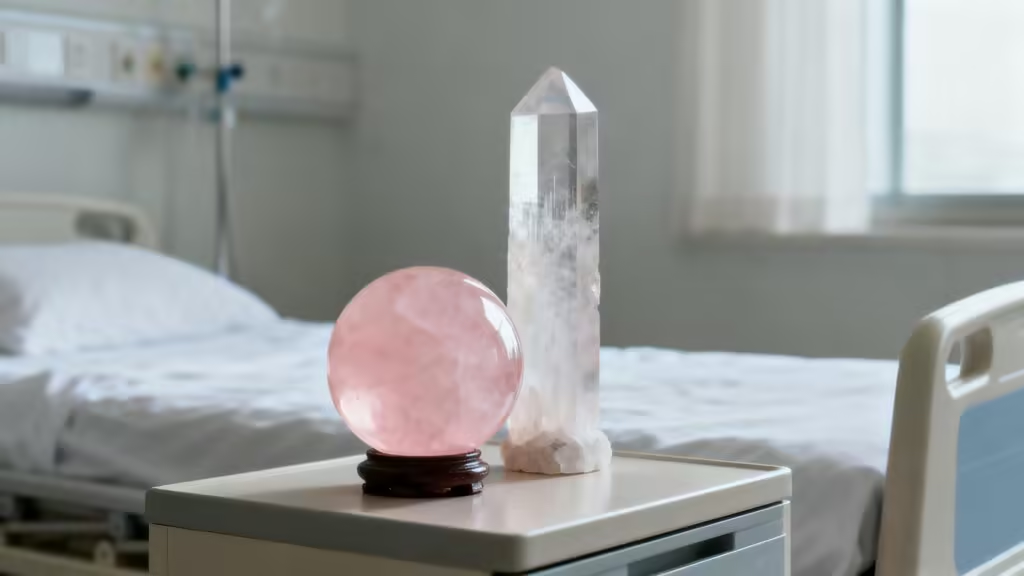
Vary the height — something tall at the back (a satin spar tower works well here), something mid-height in the middle, something low and reachable at the front. Place the arrangement at the natural eye level of someone lying in the bed, so it can be seen without lifting the head or searching for it. That detail matters more than it seems.
The space between each piece is as important as the pieces themselves. The arrangement should feel like a pause in the room, not an addition to it.
A Note on Hygiene in Clinical Settings
Bringing any object into a hospital room — especially an oncology ward — raises a practical question: how do you keep it clean?
For polished stones like tumbled amethyst or a rose quartz sphere, a wipe-down with a medical alcohol swab is enough. The smooth surface holds nothing, dries in seconds, and won’t degrade with occasional cleaning.
Satin spar needs more care. Because it is water-soluble, avoid wet cloths entirely — a dry microfibre cloth is sufficient for surface dust. Keep it away from the sink area and any condensation near windows.
Raw or rough-textured crystals are harder to recommend for active treatment wards — the uneven surface is difficult to clean thoroughly. Polished pieces are the practical choice here. If in doubt, ask the ward nurse before placing anything new in the room. Most will appreciate that you asked.
When the Nurses Come In
Treatment sessions and routine checks mean the bedside table gets rearranged more than you might expect. It helps to think ahead.
Keep the stones in a small pouch or a shallow tray so they can be moved as a single unit — one action, not three. During IV changes or dressing procedures, slide the tray to the windowsill or the foot of the bed, somewhere out of the way but still visible. This keeps the clinical space clear without dismantling what you have built.
It is also worth letting the care team know what is there. Most nurses have seen far stranger things on a bedside table. A brief mention — “those are just stones, they can be moved” — removes any ambiguity and usually earns a small nod of recognition.
Starting Small
You do not need all three. You do not need a considered arrangement on the first day.
Start with one piece — a cool, smooth sphere on the surface you look at first in the morning. That is enough to begin shifting how a room feels. The rest can follow when it feels right.
Illness takes away a lot of choices. What sits on your bedside table doesn’t have to be one of them. The point is not the stones themselves. It is the act of bringing something intentional into a space that otherwise belongs entirely to medicine.
That small reclamation of the environment is, for many people, one of the few things in a hospital that feels entirely theirs.