Buddha Auras: Light and Depth

There is a specific quietness just before the sun rises. The sky holds a heavy indigo, creating a stillness that seems to absorb all sound. Then, a single edge of gold fractures the darkness, changing how we see the world around us. Ancient Buddhist painters noticed this moment too — and spent centuries trying to capture it on temple walls.

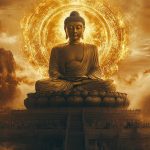
In Buddhist art, this interplay of light and depth appears behind the figures of awakened beings. The auras of gold and blue surrounding the Buddha are among the most recognizable images in sacred art. But their meaning runs deeper than most introductions suggest — and their origins are stranger and more interesting than they appear.
A Form Borrowed from the Sun God
The halo did not begin in Buddhism. In the earliest Buddhist art — the reliefs at Sanchi, the carvings at Amaravati, dating to around the 2nd century BCE — the Buddha does not appear as a human figure at all. His presence is indicated by symbols: a footprint, an empty throne, a parasol. The idea of placing a luminous disc behind a sacred head came from somewhere else entirely.
That somewhere was the eastern edge of Alexander’s empire.
After Alexander’s campaigns in the 4th century BCE, Greek-speaking kingdoms took root in Bactria and the northwestern regions of the Indian subcontinent. When Buddhism encountered this Hellenistic world, something unprecedented happened: Buddhist artists adopted the visual grammar of Greek sacred art. The halo — the radiate crown of Apollo and Helios, the solar disc that identified divine beings in Greek and Roman imagery — was absorbed into Buddhist iconography and given new meaning.
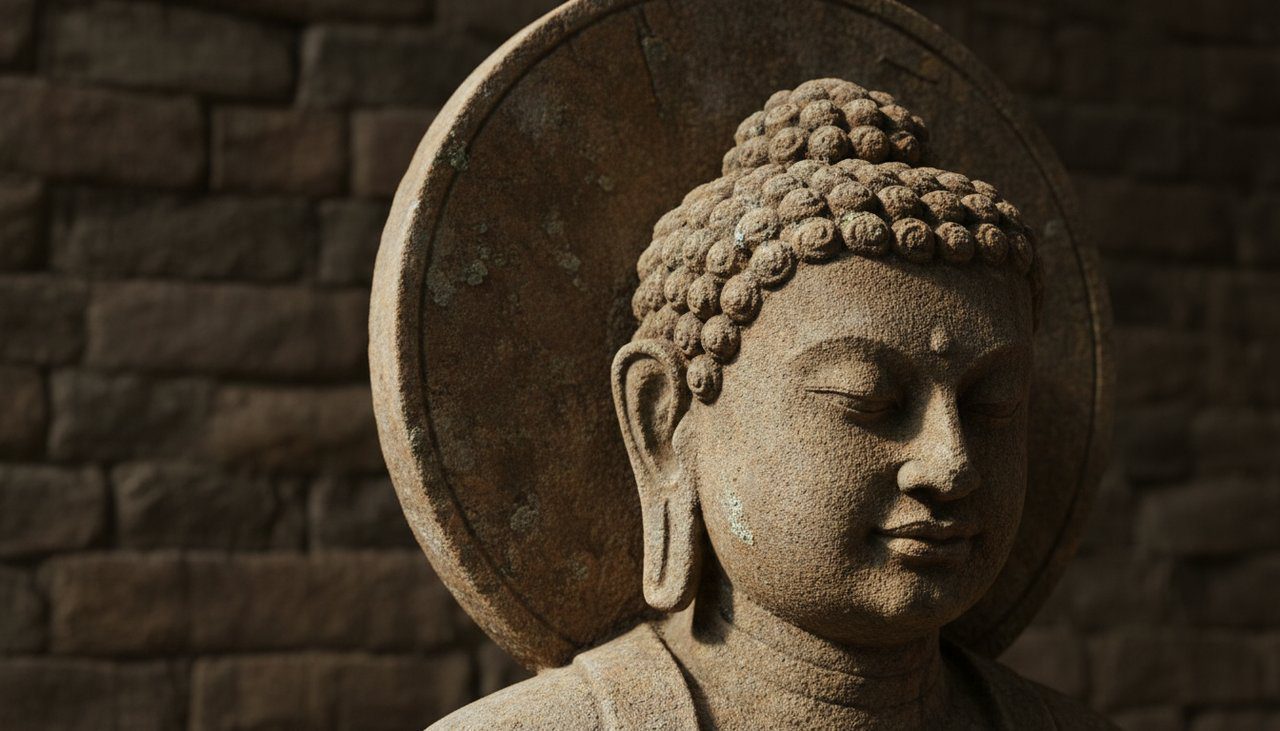
The Gandharan sculptures of the 1st to 3rd centuries CE — found today in the museums of Peshawar, Kabul, and London — show this fusion in physical form. The Buddha’s face carries the idealized proportions of Greek sculpture, and behind his head sits a clean stone disc, unmistakably descended from the halos of Hellenistic gods. Art historians including Alfred Foucher and John Marshall have traced this lineage extensively.
This history is worth sitting with. Buddhism did not resist a foreign visual form — it recognized something useful in it and made it its own. The halo already carried the idea of sacred radiance across cultures. Buddhist thought simply gave that radiance a different source: not divine birth, but the quality of an awakened mind.
Early scriptures describe this as the 「Byama-prabha」, the fathom-wide aura. Unlike a temporary flash of inspiration, it is portrayed as a continuous emanation — a steady field that extends in all directions. The 「Sirascakra」 behind the head marks the center of individual wisdom. The 「Prabhamandala」 that surrounds the entire body suggests an energy that has dissolved its own boundaries. These are not metaphors in the text. They are described as perceivable phenomena, as real as warmth from fire.
The Gold That Does Not Choose
Of the two dominant colors in Buddhist aura iconography, gold carries the more immediate meaning. It functions like the midday sun: it does not select who deserves warmth. The light falls on everything equally, without preference or judgment. This is not sentimentality. In Buddhist thought, it is the precise definition of 「Metta」 — loving-kindness that extends to all beings without condition.

This solar quality is most closely associated with 「Amitabha」, whose name translates as Immeasurable Light. The gold of his aura is not passive illumination but an active force — wisdom expressed as warmth, reaching into every corner of existence. It is not something the awakened being does. It is something the awakened being is.
The artistic treatment of gold evolved to reflect this understanding. In early Gandharan work, the halo was a plain disc — direct and unadorned, marking a sacred figure against carved stone. By the Gupta period, it had grown into elaborate fields of lotus petals and flowering vines. The shift is significant: compassion is not just a light that reveals, but a ground that supports growth. Warmth, when it is genuine, is also generative.
What Blue Actually Means
The deep blue aura presents a harder concept — one that Western readers often misread on first encounter, and that even those familiar with Buddhism sometimes approach with some unease.
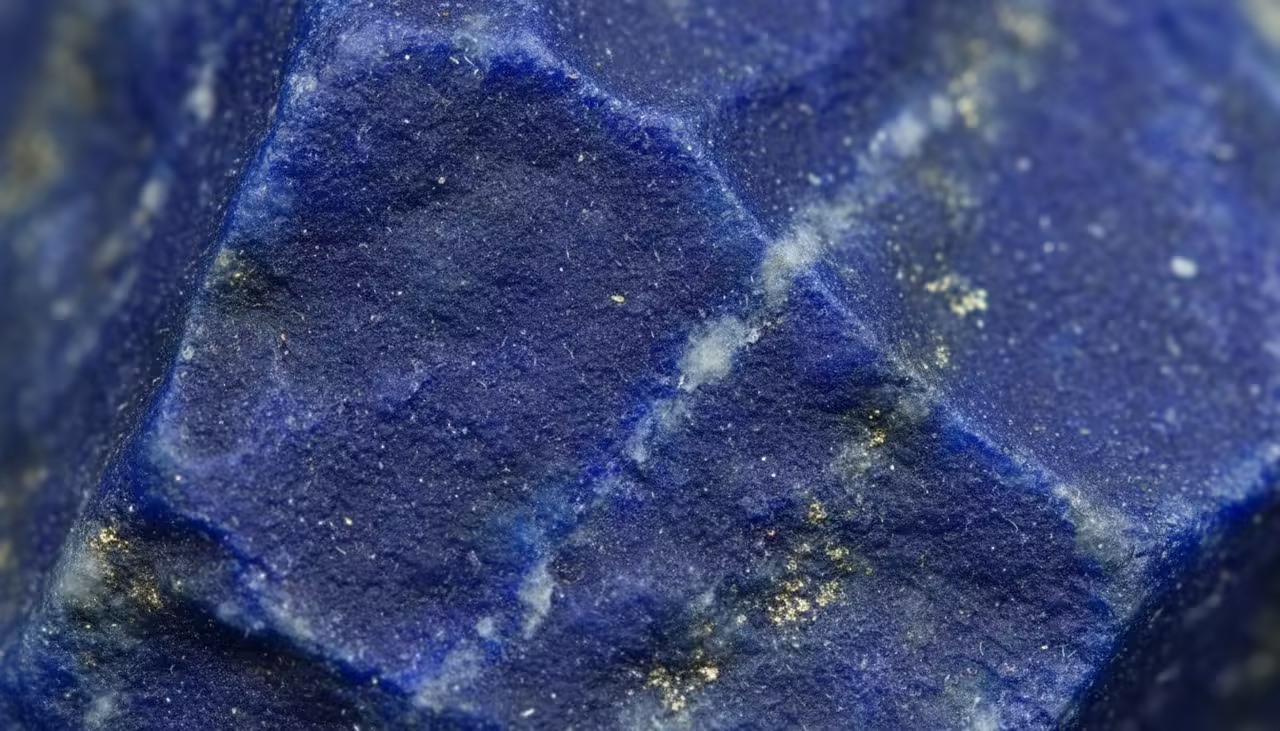
Blue in this context is the color of 「Sunyata」 — emptiness. The word tends to land wrong. Emptiness sounds like absence, like loss, like a room with nothing in it. But this is almost precisely the opposite of what the term means in practice.
「Sunyata」 does not mean that things do not exist. It means that things do not exist with fixed, independent, unchanging selfhood. A person is not a permanent, bounded entity but a process — a pattern sustained by conditions, continuously changing, inseparable from everything around it. The same is true of emotions, opinions, identities. None of them are as solid as they feel.
Far from being a bleak conclusion, this is where Buddhist thought makes its most striking move: because nothing is fixed, nothing is stuck. Grief softens. Anger passes. Habitual patterns can be unwound. The blue does not represent coldness or nihilism. It represents the open quality of mind that makes transformation possible — the depth beneath the surface where storms do not reach.
This is the primary characteristic associated with 「Bhaisajyaguru」, the Medicine Buddha, whose form scriptures describe as resembling Lapis Lazuli: transparent, luminous, and pure. The comparison is deliberate. Lapis allows light to pass through without distorting it. A mind that has touched 「Sunyata」 perceives without the distortions of self-protective thinking — without the constant editing that ordinary perception performs on experience.
Traditional painters ground actual Lapis Lazuli stone to create this blue. The material matters: crushed stone produces a matte surface that absorbs rather than reflects light. Where gold radiates outward, blue draws the eye inward. The physical properties of the pigment enact the meaning it is meant to carry.
Why These Two Colors Belong Together
Gold and blue are not simply complementary colors placed side by side for visual balance. In Buddhist thought, the qualities they represent — compassion and emptiness — are philosophically inseparable. Understanding one requires the other.

The connection is not obvious at first. Compassion seems like something warm and personal — a feeling directed toward specific beings. Emptiness seems like its opposite: vast, impersonal, beyond feeling. But the logic runs like this: boundless compassion is only possible when the sense of a fixed self has loosened. As long as there is a rigid “I” drawing a line between self and other, care will naturally be partial, conditional, protective of its own. It is 「Sunyata」 — the dissolution of that rigid boundary — that allows compassion to extend without limit. The gold needs the blue to be genuinely boundless. The blue, without the gold, would be mere detachment.
The 「Avatamsaka Sutra」 describes this unity through the image of Indra’s net: a cosmic web in which every intersection holds a jewel, and every jewel reflects every other jewel simultaneously. The gold and the blue do not merge into a single color. They illuminate each other. The sun does not exhaust itself warming the earth, and the ocean does not lose its depth reflecting the sky.
This synthesis appears in the chabbannarangsi, the six-colored rays that Buddhist texts say emanate from an awakened mind. Among them:
- Nila: the deep blue of meditative stillness.
- Pita: the golden yellow of active compassion.
- Pabhassara: the final radiance that contains the whole spectrum.
That final emanation resists description — which is consistent with what it points toward. Both the depth of the sea and the warmth of the sun, held together without contradiction.
The auras on temple walls are not decorative convention. They are a sustained argument, rendered in pigment and stone, about the structure of an awakened mind. That argument has been made for nearly two thousand years, across languages and continents, in gold leaf and crushed stone. Every morning, before the world grows loud, the sky makes it again.
Frequently Asked Questions
What do the gold and blue auras in Buddhist art primarily symbolize?+
These auras represent the dual nature of an enlightened mind. Gold symbolizes universal compassion and active wisdom, akin to the midday sun's boundless warmth. Blue signifies profound inner stillness and the healing capacity of emptiness (Sunyata), mirroring the deep, unmoving ocean.
What is the distinction between the 'Sirascakra' and 'Prabhamandala' halos?+
The 'Sirascakra' is the halo positioned directly behind the Buddha's head, symbolizing the focal point of individual wisdom. The 'Prabhamandala' is the larger field that encompasses the entire body, illustrating an expansive, boundless spiritual energy that transcends physical limits.
How does the golden aura relate to the concept of universal compassion?+
The golden aura functions like the midday sun, providing warmth and light to everything without discrimination. This outward energy is a visual metaphor for universal compassion, an active force closely linked to Amitabha Buddha, whose name signifies 'Immeasurable Light' and embodies wisdom in motion.
What spiritual principle does the deep blue aura represent?+
The deep blue aura signifies inner stillness and the healing capacity of emptiness, known as 'Sunyata.' It evokes a vast space where surface disturbances cannot reach, representing the transformation of reactive emotions into clear wisdom. This color is a primary characteristic of the Medicine Buddha, Bhaisajyaguru, whose form is likened to transparent and pure Lapis Lazuli.
Why did traditional painters specifically use Lapis Lazuli for blue auras?+
Traditional painters utilized ground Lapis Lazuli stone to achieve the unique visual depth of blue auras. Unlike synthetic paints, its matte surface absorbs light, creating a receptive calm that perfectly embodies the inward focus and profound stillness of an awakened mind, enhancing the spiritual resonance of the artwork.
How are compassion and emptiness integrated in the depiction of Buddha auras?+
Compassion (gold) and emptiness (blue) are not separate goals but interpenetrating forces, essential for true realization. The 'Avatamsaka Sutra' describes this union as a cosmic web where every element reflects the whole. The auras visually express this synthesis, showing that radiant wisdom requires both outward warmth and silent inner depth, revealing each other.
What are the 'chabbannarangsi' and their significance?+
The 'chabbannarangsi' are the six-colored rays emitted by an awakened mind, representing the ultimate unity of spiritual understanding. They comprise core hues like Nila (deep blue of meditative absorption) and Pita (golden yellow of active compassion), culminating in Pabhassara, the final brilliance that unites the entire spectrum, embodying a state beyond simple categorization.