Buddha’s Third Eye: Cultivating Inner Vision

People searching for the “Buddha’s third eye” are usually looking at the small mark between the eyebrows of a Buddha image. In Buddhist art, that mark is called the urna. It is an auspicious mark associated with Buddhahood, not simply the Buddhist name for a third-eye chakra.
The distinction matters because several traditions use similar visual language while teaching different things. Buddhist iconography, yogic chakra systems, and modern crystal practices can inform one another, but they should not be presented as a single historical teaching.
Is the Urna a Third Eye?
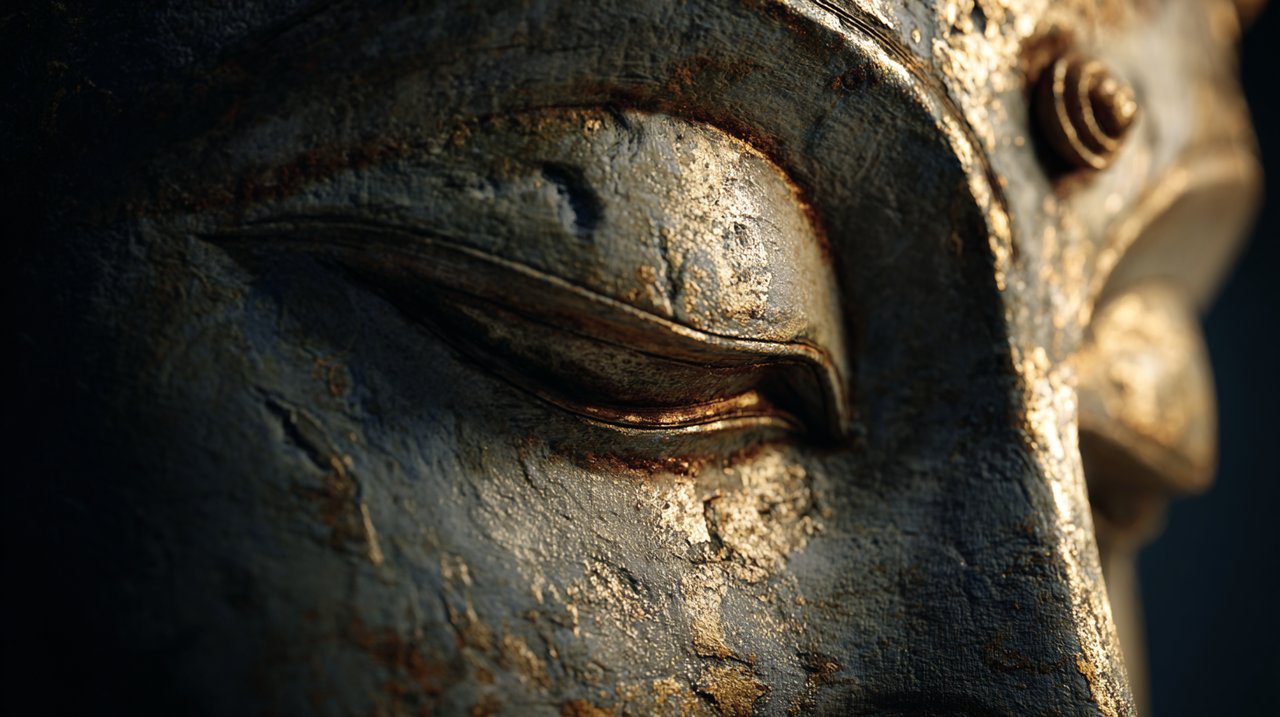
Not in the ordinary anatomical sense. Buddhist texts describe the urna as one of the distinguishing marks of a Buddha. In art it may appear as a small circle, a raised mark, a jewel-like inset, or a curl of hair between the eyebrows.
Modern viewers often call it a third eye because of its location and its association with wisdom. That comparison can be a helpful metaphor, but urna remains the more accurate term when discussing Buddhist art.
Museums describe the urna in slightly different ways depending on the artwork and interpretive tradition. The consistent point is that it identifies the figure as a Buddha and signals awakened qualities rather than a physical extra eye.
Urna and Ushnisha
The urna and ushnisha are separate features:
- Urna: the auspicious mark between the eyebrows.
- Ushnisha: the cranial protuberance or hair-bun-like form on top of the head.
Both belong to the visual vocabulary used to identify a Buddha. The urna draws attention to the face and awakened perception; the ushnisha is commonly associated with the Buddha’s exceptional knowledge or spiritual attainment.
Neither feature should be reduced to a decorative dot or hairstyle. They are part of an iconographic system that also includes elongated earlobes, monastic robes, hand gestures, posture, and other marks.
What Inner Vision Means in Buddhism
“Inner vision” is useful only if it points toward clearer seeing. In Buddhist practice, clarity is not measured by unusual sensations or confident predictions. It is developed through attention, ethical conduct, and wisdom.
A practical test is simple: does an insight reduce confusion, greed, and hostility, or does it strengthen fear and self-importance? Intuition can feel immediate, but immediacy alone does not make it reliable.
Before acting on a strong inner impression, pause and examine it:
- Is it consistent with observable facts?
- Does it remain clear after emotion settles?
- Would acting on it cause avoidable harm?
- Can it be tested without demanding blind belief?
This kind of discernment is less dramatic than “opening a third eye,” yet it is closer to the patient work of seeing conditions clearly.
Ajna Belongs to a Different Framework
The ajna chakra is part of yogic and tantric systems developed within South Asian religious traditions. It is commonly located between the eyebrows and is widely called the third-eye chakra in modern English.
Its location makes comparison with the urna understandable. Still, the two terms are not interchangeable. The urna is a mark in Buddhist descriptions and images of a Buddha; ajna is an energy center within particular subtle-body systems.
Some later tantric traditions share concepts and practices across Buddhist and Hindu contexts, but broad claims about “Buddhism teaching third-eye activation” erase important differences between schools and historical periods.

A Grounded Practice for Clarity
You do not need to force attention into the forehead or seek unusual visions. A steadier practice begins with the body and breath.
- Sit in a stable, comfortable position.
- Notice the natural breath without trying to change it.
- When a thought or image appears, label it gently as thinking or imagining.
- Return attention to the breath and bodily sensation.
- Afterward, write down any important insight and review it later with a calmer mind.
If concentrating at the brow creates pressure, anxiety, headaches, or sleep disturbance, stop that technique and return to ordinary grounding practices. Meditation should not replace appropriate medical or mental-health care.
Where Crystals Fit
Amethyst, lapis lazuli, and sodalite are often associated with the third eye in contemporary crystal practice. A stone may function as a visual cue, a tactile meditation object, or a reminder to pause.
Those uses are personal and symbolic. There is no established scientific evidence that a crystal opens the urna, activates a chakra, or grants psychic perception. Readers interested in the modern symbolic tradition can explore our guide to third-eye chakra crystals while keeping that distinction clear.
Seeing the Buddha Image Clearly
The mark on a Buddha’s forehead does not need to promise supernatural sight to be meaningful. It asks a quieter question: are you seeing what is present, or only what expectation has placed in front of you?
Learning the name urna is a small act of clarity. It allows the image to remain rooted in Buddhist iconography while leaving space for careful comparison with other traditions.
References
- Art Institute of Chicago: Head of Buddha — identifies the urna and ushnisha as traditional marks associated with the Buddha’s wisdom.
- Los Angeles County Museum of Art: Head of a Buddha — describes the urna as a sacred forehead mark and distinguishes it from the ushnisha.