Yin Yang: Focus for Modern Demands

Productivity systems often fail because they treat the human mind like an infinite resource. If the underlying energy architecture is broken, even the most sophisticated workflow will eventually collapse. Taoist philosophy offers a precise diagnostic tool to prevent this: the structural map of Yin and Yang.
Stability is not a fixed point of rest. It is a continuous act of adjustment between two interdependent forces. Understanding how these forces interact allows us to move beyond motivational clichés and toward a functional alignment of effort and recovery.
Functional Roles of Energy
In classical Chinese thought, Yin and Yang are not fixed substances. They are paired tendencies that describe how change unfolds: active and receptive, bright and shaded, expansion and return. The Stanford Encyclopedia of Philosophy’s overview of Chinese metaphysics treats these patterns as part of a broader framework for understanding correlative order rather than isolated opposites.
Ancient thought also suggests that existence is governed by Qi, a vital energy fluctuating between two states. Experts distinguish between Pre-natal Qi (Xian Tian), the core vitality we are born with, and Post-natal Qi (Hou Tian), the energy we generate through breath and nutrition. Yang represents the active, visible, and expansive state, while Yin embodies the receptive and contractive.
Within the peak of Yang activity, the seed of Yin rest is already forming. Constant expansion without contraction is physically impossible. When a team pushes through an all-nighter, decision accuracy drops not from lack of effort, but because Yin’s restorative function has been deferred.
The system breaks down because of intensity, not despite it. This balance is as essential for mental clarity as it is for selecting the right tools for focus.
If you need a concrete starting point, a 10-minute Yin recovery window requires nothing elaborate. Sit without a screen. Close your eyes. Breathe in for four counts, hold for four, and exhale for six. Repeat for ten cycles.
The extended exhale is a practical way to shift the body away from constant activation. A Frontiers in Human Neuroscience systematic review on slow breathing links controlled breathing with psychophysiological changes related to autonomic regulation, which makes it a useful modern counterpart to the Yin principle of contraction and recovery.
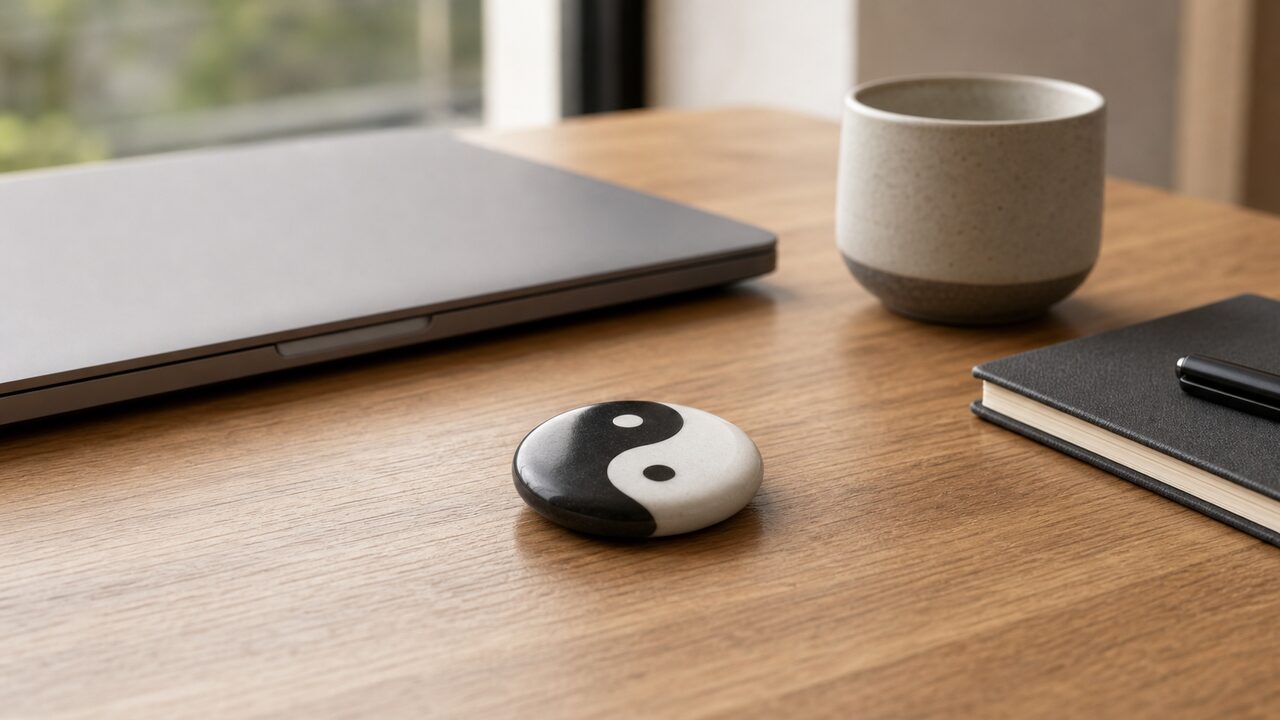
The Yin Yang symbol is a functional diagram of a feedback loop. It demonstrates that separate forces are linked, where each gives meaning to its opposite. Systems require both tension and release to remain functional.
Identifying Systemic Imbalance
Modern work environments foster a chronic surplus of Yang. We operate in a state of 24-hour notification loops and back-to-back video conferences. This constant digital engagement prevents the nervous system from returning to a baseline state.
- Yang Saturation: This is the state of perpetual activation. It manifests as a frantic need to stay visible, leading to a point where the brain can no longer process new information.
- Yin Depletion: This results in shallow decision-making. For instance, a manager might choose a software vendor based on a flashy interface rather than long-term technical compatibility because they lack the quiet focus required for deep analysis.
Physical anchors can interrupt this drift toward saturation. Objects like protective pieces, including red agate or obsidian, work through a simple tactile mechanism: the weight and cool texture of the stone deliver a sensory input that the body registers as grounding, nudging the nervous system away from high-alert and back toward the physical present.
A Portable Reminder of Balance
A physical symbol can make the Yin Yang framework easier to use when attention is already overloaded. A smooth Yin Yang balance stone or meditation coin does not create balance by itself. Its value is more specific: it gives the hand a cool, weighted surface at the exact moment the mind is about to move on autopilot.
Use that brief contact as a prompt to ask one practical question: what is overrepresented right now? If the day has become all urgency and output, introduce a quieter task. If reflection has turned into avoidance, choose one visible action. The object works as a tactile reminder to make the adjustment before imbalance becomes exhaustion.
Operationalizing Balance
Translating these concepts into habits requires deliberate design. It is not about working less; it is about working with natural rhythms. Consider the case of a senior engineer who faced a total cognitive block after years of constant sprints. He found that ending each day with an hour of screen-free activity, walking or cooking, restored his pattern recognition within three weeks.

The engineer’s success provides evidence for Cognitive Synthesis. While Yang logic gathers data, Yin incubation allows the mind to synthesize that data into solutions. In practical terms, mental fatigue recovery steps work best when they stop adding input and give the brain time to reorganize fragments already collected.
To replicate this, you can implement specific structures:
- Productivity Cycles: Map high-intensity strategic tasks to your peak energy hours. Follow these with administrative or reflective tasks to allow for natural cooling.
- Sensory Regulation: Use mala bead strand for a three-minute reset. Close your eyes and complete 108 counts of deep diaphragmatic breathing, moving one bead with your thumb for every full breath cycle.
- Intentional Boundaries: Use a physical object like a Tibetan bracelet anchor to mark the end of a work phase, similar to the physical anchors mentioned earlier.

Building Cognitive Durability
A Yin Yang perspective changes your relationship with stress. Friction is no longer an obstacle; it is a signal that a transition is occurring. Just as a storm is a necessary release of atmospheric tension, a period of stagnation is often the accumulation of energy before a breakthrough.
This shift builds durability. It allows you to recognize that intense activity is unsustainable without deep recovery. Loss often clears the space required for new acquisition, and every constraint contains the blueprint for a new solution.
Identify one area of your routine that is currently over-saturated. What specific tactile or quiet action can you take today to introduce its necessary opposite?
References
- Stanford Encyclopedia of Philosophy: Chinese Metaphysics – background on Yin Yang, Qi, and correlative patterns in Chinese thought.
- Frontiers in Human Neuroscience: Systematic review on slow breathing – research context for breath control and autonomic regulation.
Frequently Asked Questions
What is the core concept of Yin Yang Philosophy?+
Yin Yang Philosophy, originating thousands of years ago in ancient China, represents complementary forces such as dark and light, or passive and active, that together create wholeness. The symbol itself shows a dynamic, ever-shifting balance where each half contains a small circle of its opposite.
How can Yin Yang Philosophy help balance modern life?+
In modern life, which often pulls towards extremes, Yin Yang Philosophy offers a remedy by inviting us to honor both sides of our nature. This can be achieved by creating quiet moments, balancing digital connection with physical presence, and valuing both logical thinking and intuitive knowing.
What are some daily rituals that embody Yin Yang balance?+
To embody Yin Yang balance daily, one can practice morning rituals that honor active 'yang' energy, such as movement and planning, and evening practices that embrace receptive 'yin' qualities, like reflection and rest. This rhythm forms the foundation of wellbeing.
What is the most profound teaching of Yin Yang Philosophy regarding life's challenges?+
The most profound teaching is to view the tension between opposites not as something to resolve, but to witness with curiosity. This perspective transforms how we view challenges, seeing them as natural fluctuations that build resilience, understanding that darkness yields to light and difficulty reveals hidden gifts.