What Is Thangka

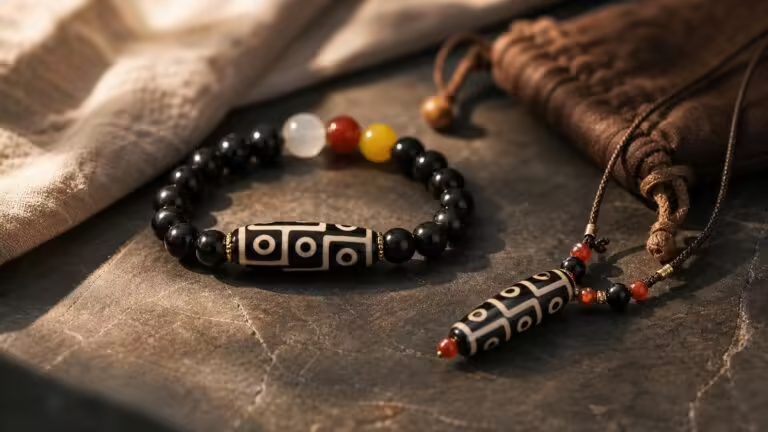
A Thangka is more than a painting; it is a complex ritual of practice. It serves as a precise diagram of enlightenment, translating spiritual concepts into a rigorous visual logic that has defined Himalayan sacred arts for generations. This tradition extends from the canvas to the very items worn by practitioners. For those interested in how these spiritual principles manifest in other forms, our guide on Tibetan Jewelry: Wearable Wisdom and Sacred Adornment explores the deeper meanings behind sacred ornaments.
A Thangka is a precise diagram of enlightenment, designed to transform human consciousness through specific visual logic.
The Nature of Mineral Colors
The foundation of these images comes from the earth. Traditional artists avoid modern chemical paints, choosing instead to work with mineral pigments known as stone colors. These pigments are the raw essence of the natural world, ground by hand to a fine powder.
Preparing the canvas is a matter of physics. The cotton is stretched and coated with a mixture of lime and hide glue, then polished with a smooth river stone. The surface must be rubbed for days until it is as smooth as silk, meeting the strict standards of the lineage traditions. Only then can the charcoal sketch be applied.
Each mineral serves a specific purpose in this visual language:
- Lapis lazuli provides a deep blue representing the boundless void.
- Cinnabar yields a vibrant red symbolizing life force and protection.
- Malachite creates a rich green reflecting balance and growth.
- Orpiment provides a brilliant yellow used for the radiance of the deities.
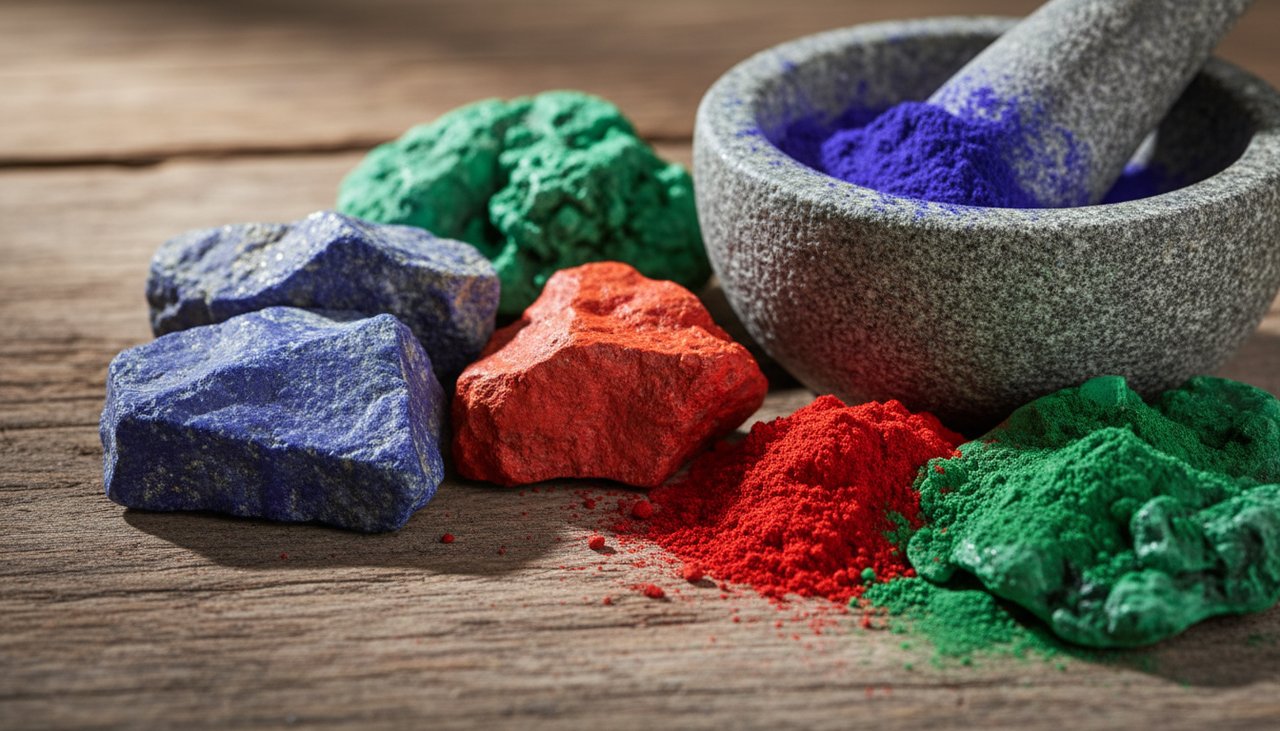
Instead of oil, these minerals are mixed with hide glue. This creates a textured surface where light bounces between individual grains rather than reflecting off a flat layer. This unique interaction gives the artwork an inner luster that remains stable for centuries.
The Grid of Enlightenment
Beneath the colors lies a strict mathematical framework. Figures are not drawn from imagination but follow a precise grid system called the thigse. This structure translates spiritual concepts into geometric order.
Every line follows specific rules centered around a vertical axis known as the Sog-shing. Proportions are calculated using a base unit called the Tala, which is the length of a palm. Even the smallest details, such as the curve of a finger or the distance from the hairline to the chin, must meet these mathematical standards to ensure the image acts as a stable anchor for the mind.
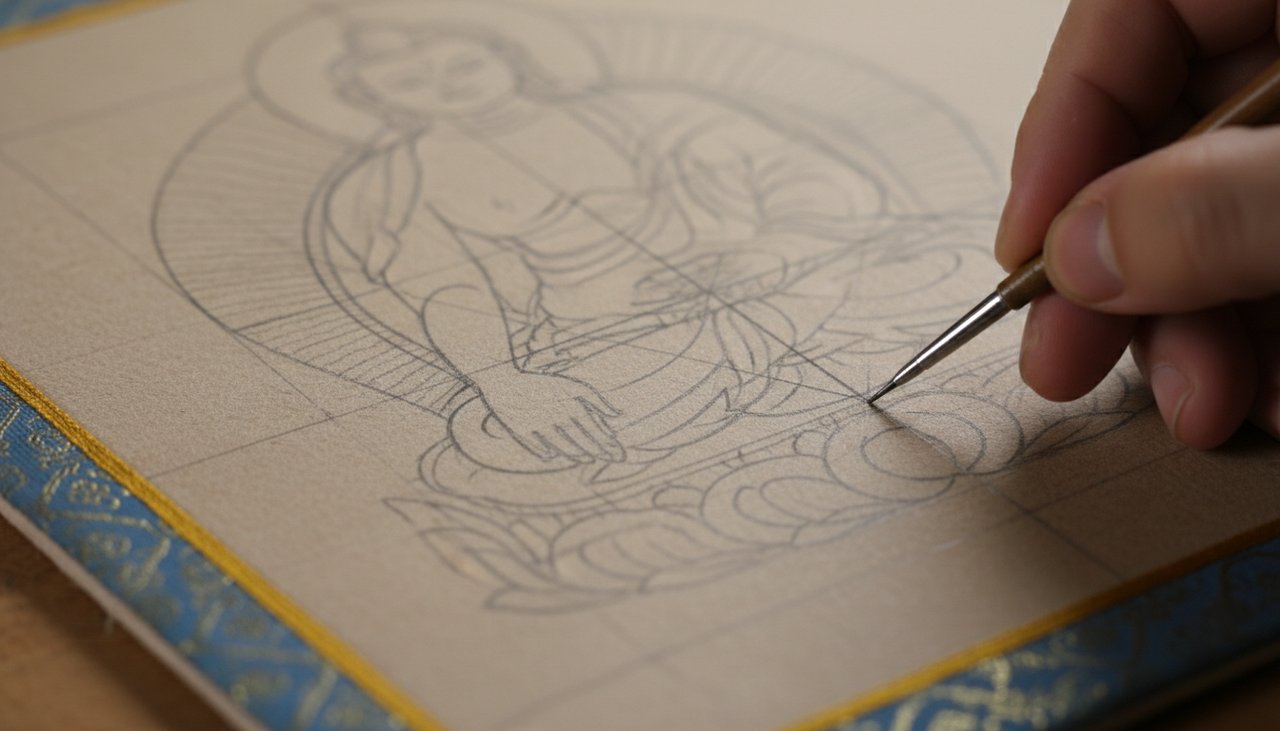
This precision removes the artist’s personal ego from the work. The result is an idealized form that represents a state of balance. When you look at a Thangka, you are seeing a reflection of a mind that is clear and undisturbed.
The Language of Form
The figures in these paintings speak through a specific visual code. To understand them, one must read their forms as instructions for practice. In the actual visualization of Green Tara, for instance, the practitioner focuses on the specific emerald hue of her skin and the slight extension of her right foot, which signifies her readiness to step into the world to assist.
The practice begins with the breath, slowing it until the internal landscape becomes still like a mountain lake after a storm.
Then, the deity is constructed in the mind, piece by piece, starting from the lotus seat and rising to the light at the brow center.
Finally, the mantra is recited, allowing the sound to resonate within the center of the chest, vibrating through the visualization.
Wrathful deities take a different approach. They appear muscular and fierce, often standing in dynamic poses with three bulging eyes and bared fangs. These aggressive forms are not meant to be scary; they represent the energy needed to transform negative emotions into clarity.
The Cosmic Palace
Some Thangkas focus on complex geometric patterns rather than central figures. A Mandala is a map for the mind, a flat projection of a three-dimensional divine palace called a Vimana. The process involves moving through several structural layers from the outside in:
- The outer Fire Wall represents the removal of ignorance.
- The Vajra fence acts as a psychological barrier against distractions.
- The four gates serve as checkpoints guarded by specific entities.
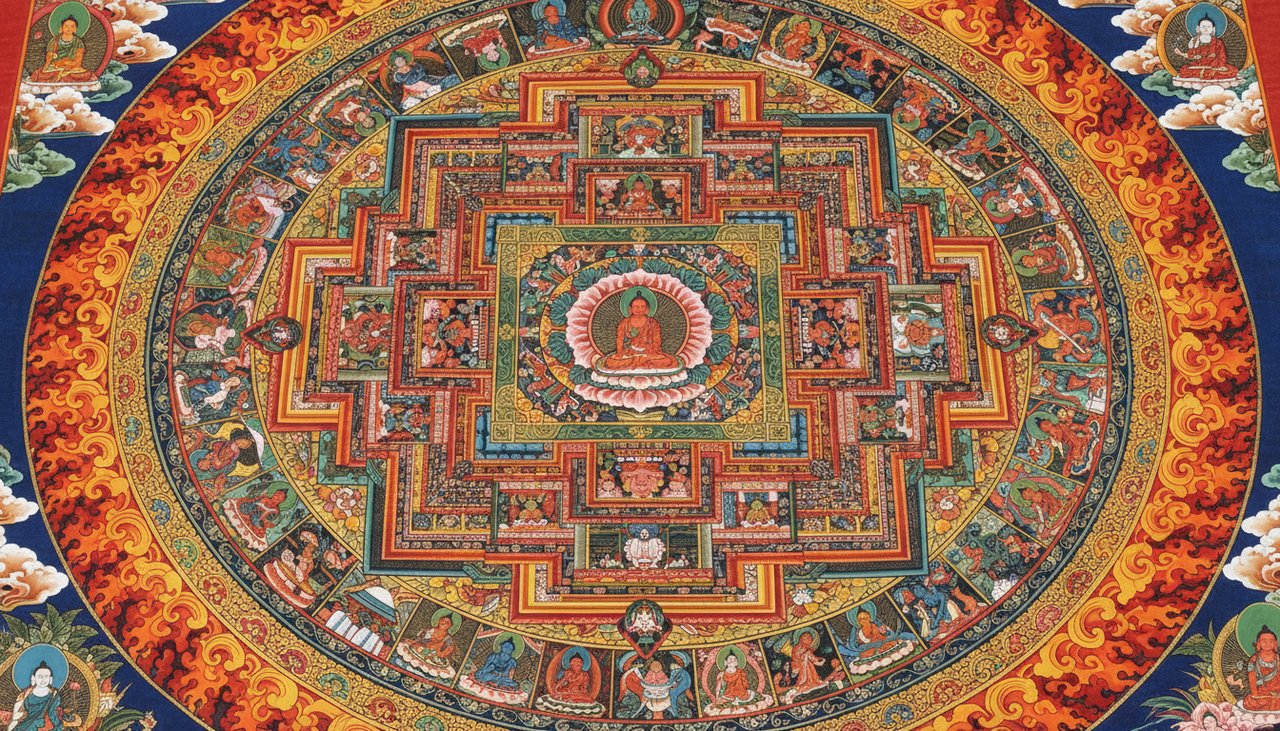
At the center lies the lotus, representing pure, self-arising consciousness. The entire diagram works like a guide, helping the mind settle into its own nature, step by step.
Awakening the Image
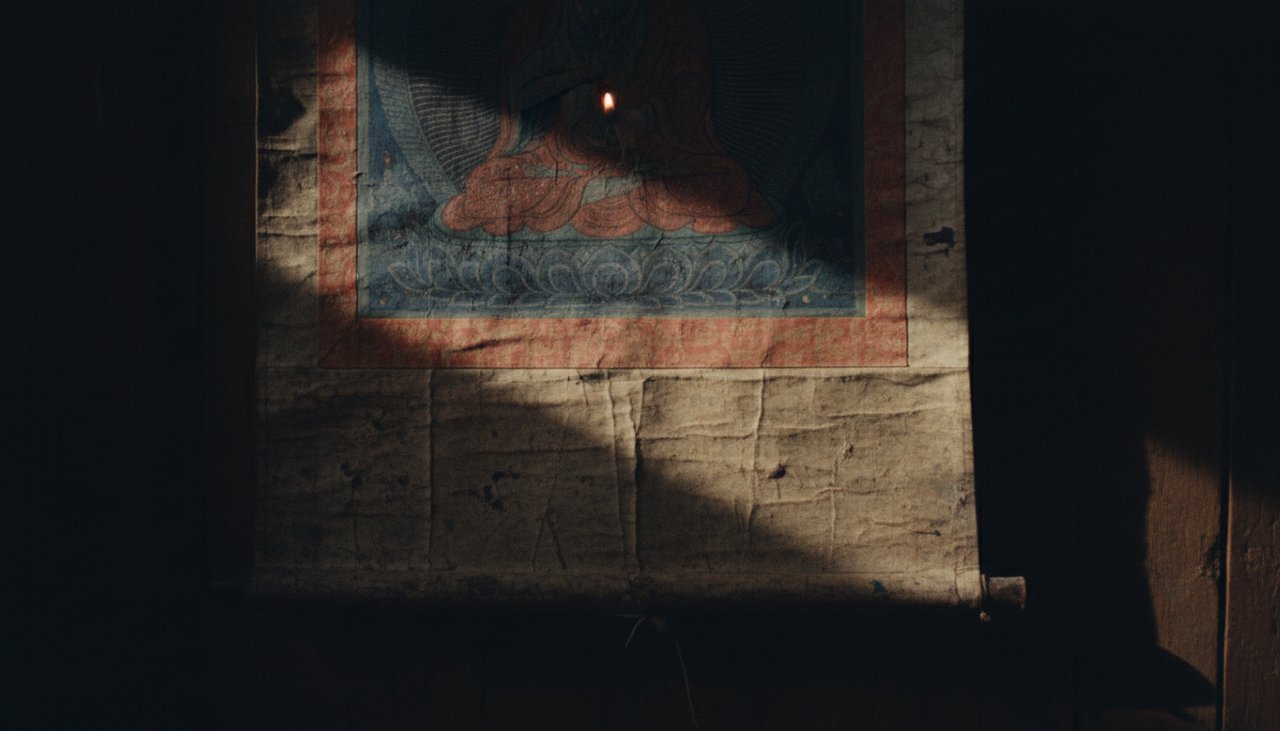
Even after months of work, a finished painting is just an object. It only becomes a tool after a final ceremony called the Rabney. This ritual brings the image to life through the eye-opening ceremony.
A master uses a fine brush to paint the pupils of the deity with gold or cinnabar. This act symbolizes the infusion of life force, or Prana, into the work. Once this is done, the painting is no longer just a representation. It transforms into a living vessel known as a Ten-gyur, treated with the same respect as a teacher, its physical glow reflecting the light of an awakened mind.
Frequently Asked Questions
What is a Thangka painting?+
A Thangka is a precise, hand-painted scroll from the Himalayas, functioning not merely as art but as a sophisticated visual tool designed to guide the mind toward enlightenment and clarity. It serves as a diagram of spiritual principles, transforming consciousness through specific visual logic inherent in Himalayan sacred arts.
What traditional materials are used to create Thangka art?+
Authentic Thangkas are crafted using natural mineral pigments, often referred to as 'stone colors,' such as deep blue lapis lazuli, vibrant red cinnabar, and rich green malachite. These finely ground minerals are meticulously mixed with hide glue, creating a unique textured surface that imparts an enduring inner luster to the artwork.
How is sacred geometry incorporated into Thangka paintings?+
Beneath the vibrant colors, Thangkas are built upon a strict mathematical framework known as the 'thigse' grid system. This precise geometry, centered around a vertical 'Sog-shing' axis and using the 'Tala' unit for proportions, ensures that every figure adheres to idealized forms, reflecting perfect balance and removing the artist's personal ego from the creation.
What is the significance of peaceful versus wrathful deities in Thangka art?+
Thangka deities serve distinct meditative functions. Peaceful figures, often depicted in soft hues and serene poses, are designed to cultivate compassion and kindness. In contrast, wrathful deities, with their dynamic stances and fierce expressions, embody the energetic force required to cut through deep-seated confusion and transform negative emotions into clarity, acting as psychological catalysts.
What is a Mandala Thangka and its purpose?+
A Mandala Thangka is a complex geometric diagram representing a 'Vimana,' or three-dimensional divine cosmic palace. It functions as a spiritual algorithm, providing a detailed map for the mind to navigate during meditation. Practitioners mentally journey through its structural layers—from the outer fire wall to the central lotus—to achieve a state of pure, integrated consciousness.
What is the 'Rabney' ceremony for a Thangka?+
The 'Rabney' is a crucial consecration ceremony that awakens a finished Thangka, transforming it from a mere object into a living spiritual vessel, or 'Ten-gyur.' The most symbolic moment is the 'eye-opening,' where a master meticulously paints the deity's pupils, infusing the artwork with 'Prana' or life force, making it a revered object of respect and a living teacher.