How to Choose Your Meditation Zen Garden Mindfully

Many beginners rush to buy a beautiful Zen garden kit, only to find it gathering dust on a cluttered desk weeks later. Choosing a meditation Zen garden is not about acquiring another decorative object. It is about intentionally selecting a physical anchor for your daily practice. The right garden pulls you naturally into a state of quiet focus, making mindfulness feel like a gift rather than a chore.
Before refining the details of your personal sanctuary, consult our broader collection of . This hub serves as a foundational resource for those seeking to harmonize their entire living space with intentional design and spiritual tools.
Where Does Your Intention Rest
Before evaluating the look of a stone or the color of sand, pause and reflect. The most meaningful way to create your Zen garden starts with what you feel inside. Your garden’s true power emerges from this emotional clarity. Let your garden become a silent witness to your daily breath.
Ask yourself these critical questions:
- What specific feeling do you hope to bring into your room?
- Do you need a brief mental reset during a hectic workday, or a dedicated area for practicing patience?
- Are you seeking sharper focus, a spark for creativity, or simply a quiet place to sit?
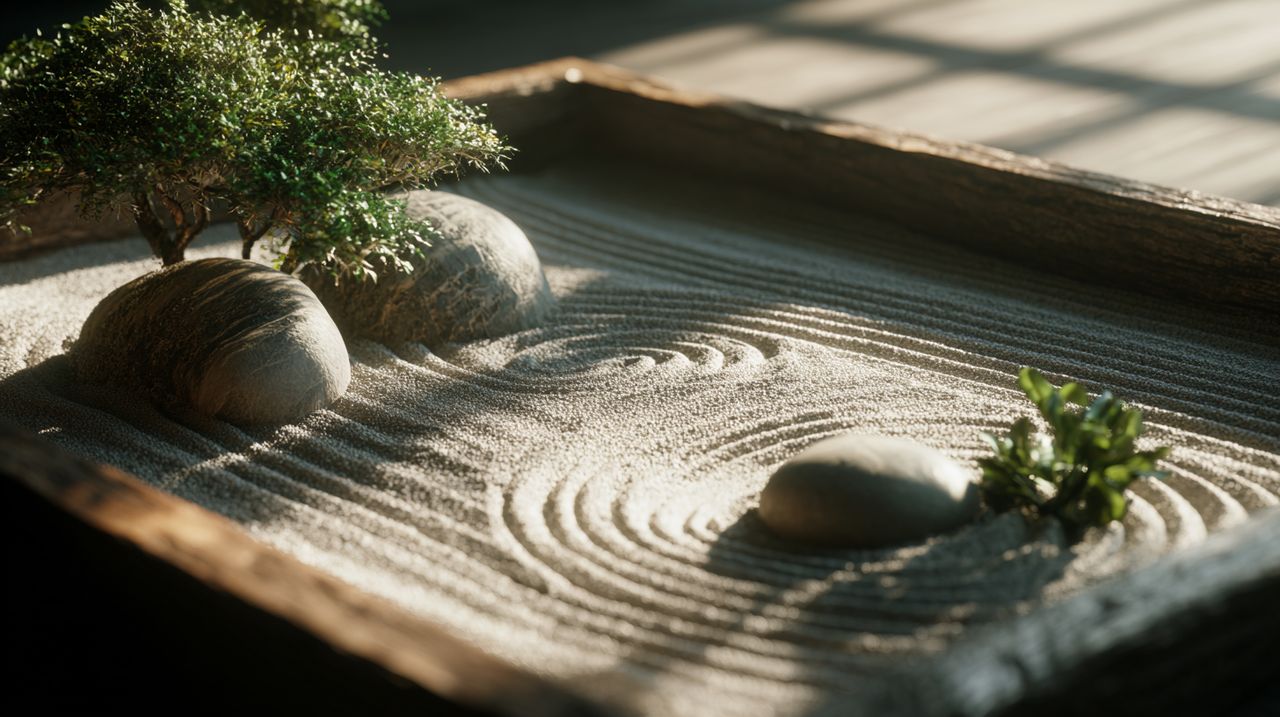
Your garden’s purpose dictates its physical design. Consider the exact kind of contemplation you envision. Are you creating a karesansui (dry landscape) for quiet, seated reflection? Within this lineage of design, raked sand represents the ocean, while islands of stone emerge from the stillness.
Space and Surroundings
Assess your surroundings and daily rhythm realistically. Matching the garden’s scale to your living situation ensures it remains a functional part of your mindful living routine. Desktop arrangements are ideal for apartment dwellers seeking a visual anchor against digital fatigue.
Material choice is critical in unventilated indoor spaces. Traditional decomposed granite, or Shirakawa-suna, offers an authentic aesthetic but is friable. Repeated raking releases fine dust containing feldspar and mica into the air.
For interior setups, you must prioritize high-purity, wet-washed crushed quartz. This material minimizes airborne particles while providing a crisp, tactile resistance that grounds the senses.
True Zen gardens rely on grains that reveal sharp, angular edges under a microscope, rather than rounded curves. This physical structure creates an interlocking grip. When you push a rake through crushed quartz, the grains bite into each other. This generates a mechanical friction that travels up the wooden handle and straight into your palms.
You receive distinct tactile feedback. It snaps your focus and pulls you straight back to the present moment. Crushed quartz boasts a Mohs hardness of 7, ensuring the angular grains resist breaking down.
Selecting a professional-grade grain size between 0.8mm and 1.2mm achieves the best plasticity for holding patterns. The subtle acoustic crunch of the rake against these grains acts as a rhythmic metronome for your spiritual practice.
A home with a dedicated yard allows for an expansive outdoor plot. Applying ancient spiritual practices here connects your garden directly to the raw elements of nature. Journaling about your motivations reveals whether a contained focus or an immersive natural environment better serves your path.
The most effective Zen garden fits naturally into your daily life, rather than demanding extensive alterations to it.
Weighing Your Tray Materials
Beyond the sand and stones, your choice of container material impacts both physical durability and room acoustics. Consider these structural foundations for your tray:
- Paulownia wood: Offers excellent thermal insulation and dampens high-frequency sounds, keeping your space acoustically soft and grounded.
- Glazed stoneware: Brings heavy thermal stability but reflects sound sharply, which might echo in a sparse, quiet room.
- High-density polyresin: Absorbs rake vibrations far better than rigid ceramic, making it a quiet and resilient foundation for daily use.
The Visual Canvas
With your intention and space defined, you can focus on the physical layout. A Zen garden is a living landscape where peace flourishes. By adhering to a few core principles, you cultivate a space that truly nurtures your mind.
Mastering Empty Space
A common mistake is assuming that more elements equal a better design. Overloading the frame with too many rocks or plants creates exhausting visual noise. The guiding principle is yohaku-no-bi, the beauty of empty space, which creates a clearing for the mind to find stillness.

This negative space must work in harmony with the scale of your physical elements. Stones that are too grand for a small tray disrupt the delicate balance. Step back and observe if each element feels in proportion to its neighbors and the empty sand surrounding it.
Guiding The Eye
A Zen garden is a practice in observation. Think about your primary viewing spots, like your desk chair or a meditation cushion. Traditional gardens often use sanzon-ishi (tripartite rock arrangements) to evoke depth. You might even incorporate koi fish symbolism through specific stone shapes to suggest movement and perseverance.
Finding Wabi Sabi
The quest for sterile perfection misses the core of Zen aesthetics, known as Wabi Sabi. This is the appreciation for beauty that is imperfect, temporary, and incomplete. Look for asymmetry (fukinsei) in the placement of your stones.
When your bamboo rake inevitably slips and creates an uneven groove, resist the urge to immediately smooth it over. Use this tiny visual flaw as a physical reminder to accept the present moment exactly as it is. Observing these slightly irregular, fractal-like patterns can actively lower your cortisol levels.
The Weight of Your Elements
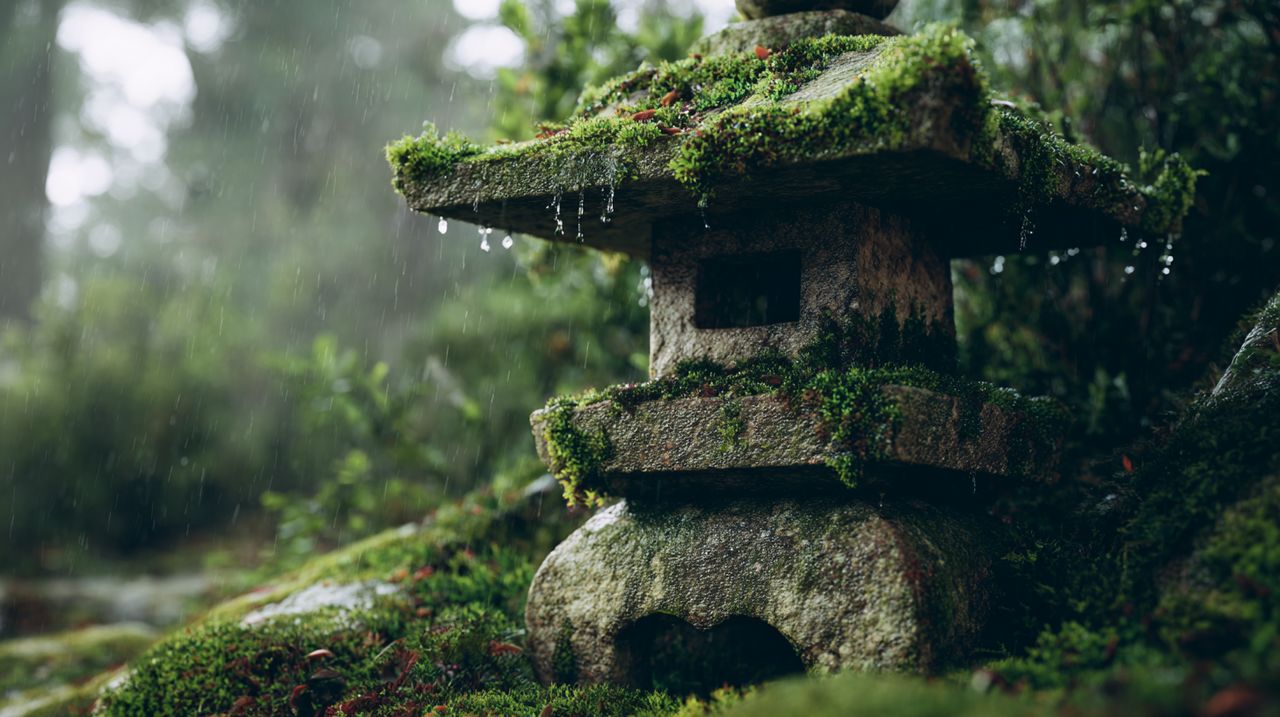
Each part of a meditation Zen garden holds a quiet meaning. Stones act as the structural bones of the layout. According to the traditional concept of mitate, a vertical stone (Reisho) can represent spiritual aspiration, while a horizontal stone (Kigyo) suggests the grounding calm of the earth.
This arrangement requires careful observation of natural form. The 11th-century Japanese gardening classic, Sakuteiki, warns against forcing rocks into unnatural postures. This violation is known as Fugyoseki.
Placing a naturally reclining stone in a standing position creates an immediate energetic conflict that shatters the spiritual cohesion of the space. You must place stones according to their natural center of gravity to maintain authentic tactile and visual harmony.
Consider the physical sensations of these anchors. Dense grounding materials like basalt or specific root chakra stones deliver a sharp, icy chill that immediately snaps your attention to the present. This thermal feedback is a vital part of your spiritual rituals, pulling you away from abstract thoughts and back into your body.
When incorporating heavy elements like Dzi stones, structural awareness is vital. These are not static ornaments; they are portable power sources. A genuine Dzi stone resting in your garden actively gathers ambient energy, waiting to be worn close to your heart when you step outside.
Authentic agate is surprisingly dense. A large 55mm Dzi stone creates a significant point load. To prevent a ceramic tray from fracturing, ensure the base is at least 8mm thick or use a discrete silicone gasket as a shock absorber. This protective layer also dampens vibrations during raking.
Draping a meditation necklace or traditional mala beads over a vertical rock introduces a softening organic curve. These beads act as portable spiritual companions. When anxiety spikes, picking up the mala from your garden tray offers immediate grounding through the rhythmic friction of the seeds against your skin.
Carving Depth Into Sand
The raked sand acts as your garden’s water element. A simple ripple pattern (sazanami-mon) evokes flowing energy. Raking concentric circles (uzumaki-mon) around a stone symbolizes the ripples from a single moment of insight. This process is a form of crystal healing properties in motion, as you organize the mineral field around your anchors.
Raking requires precise physical alignment to clear mental fog. Traditional maintenance, known as samu, demands that your center of gravity rests deep in the lower abdomen, or Tanden. You drive the rake from your hips and core, never just your shoulders.
Your breathing must match the movement of the tool. Exhale slowly as you pull the teeth through the top layer of sand. Inhale deeply the moment you stop to change direction. This physical coordination turns a simple chore into a profound spiritual practice.
To avoid visual flattening, your rake marks require sufficient physical depth. Angular crushed quartz locks together mechanically, holding these steep, crisp patterns much longer than rounded beach sand. This ensures the shadows remain deep and the mental focus remains sharp.
Finding Your Rake
The rake is more than a tool; it is an extension of your intention. Bamboo offers a light, natural touch, while solid wood provides a heavier, grounding feel. The handle length and tooth design should allow your movements to translate directly into the sand without conscious effort.
Building A Morning Ritual
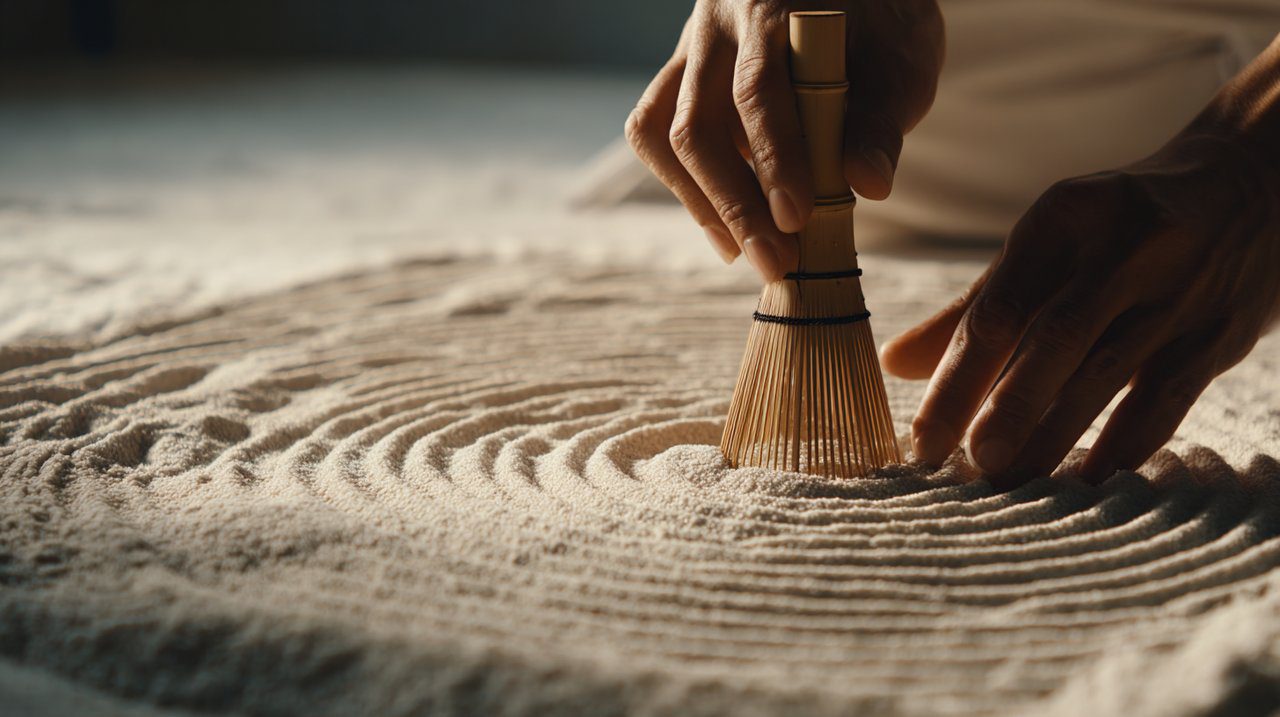
A meditation garden serves its true purpose only when your hands actually touch the sand. Set aside five minutes each morning to engage with these physical materials. Notice the rigid weight of the wooden handle resting in your palm.
Listen to the crisp, rhythmic scratching of the tines dragging through the quartz grains. As you carve deep, deliberate lines, allow your breathing to slow down and match the pace of your sweeping arm. Mastering these physical rituals helps anchor your wandering thoughts and builds a sturdy foundation for long-term peace.
Once the physical work at the tray stops, the need for grounding remains. You eventually step away from the desk, returning to the demands of the day. This is where the concept of tactile meditation evolves into the continuity of touch.
You can sustain the exact tactile feedback of the garden through portable touchstones. Moving your fingers across mala beads keeps the mind anchored in the physical realm. This provides an immediate sensory continuation of your raking practice wherever you go.
As the smooth mineral surface of your portable beads absorbs heat from your skin, it generates a subtle cooling sensation. This thermal shift physically helps to lower your pulse, acting as a direct extension of the Earth element you cultivated in the tray.
Integrating these small tactile habits keeps your focus sharp. The silent architecture of the sand simply becomes the starting point for moving through the world with a steady heart and continuous spiritual practice.