How to Practice With Mala Beads

The grounding effect of a mala usually comes down to the weight in your hand. Whether you’re feeling the grain of wood or the cool texture of a seed, that physical sensation acts as an anchor. It’s not really about how the beads look; it’s about having a tangible point of contact to pull you back when your mind starts to wander.
A Buddhist mala is effective because it gives the mind something concrete to track. Each time your thumb advances a bead, it creates a small, physical break in the flow of distracted thoughts. It’s a manual process that provides a much-needed tactile counterweight to the mental noise of a normal day.
A full 108-bead string is built for longer, seated sessions where you have the space to find a slow rhythm. For most people, though, a wrist mala with 18, 21, or 27 beads is more practical for daily life. These shorter versions offer the same sensory feedback but are easier to carry around, serving as a subtle reminder to stay present even when things get busy.
The Mechanics of the String
In Himalayan practice, you’ll often see a Tibetan mala used in tandem with tibetan prayer wheels. This isn’t just tradition for tradition’s sake; it’s a practical way to engage the body. When your hands are occupied with a specific, repetitive motion, it’s much harder for the mind to drift off into a tangent. It gives your nervous system something to do while you focus on your breath or mantra.
The construction of the string itself is what makes this work. If you look closely at authentic Tibetan jewelry, you’ll notice a small overhand knot between every single bead. These knots create a gap of about 1mm to 2mm, which is intentional. That extra bit of play allows the beads to slide freely. Mass-produced, machine-tight strings usually skip this step entirely, leaving the beads bunched together and making it difficult to maintain a steady count without the string catching on itself.
Knowing this makes it easy to spot a poorly made mala before you buy. Run your thumb down the strand. If the beads press flush against each other with no give, the knots are either absent or machine-compressed. A well-strung mala will have a faint, even spacing you can feel between every bead, and each knot will be consistent in size. Uneven knotting, loose Guru bead fittings, or a tassel that pulls directly off a single loop rather than a reinforced knot are all signs of a string that won’t hold up to daily use.
That fluid, sliding movement is what creates a sense of momentum. You aren’t fighting with a stiff cord; instead, you get a predictable tactile response every time your thumb moves. This physical repetition acts as a quiet signal to the brain, helping you settle into a rhythm where the practice becomes second nature.
Choosing Your Material
The material of the beads is more than just an aesthetic choice; it’s about how the string feels against your skin and the literal weight you’re comfortable holding for twenty minutes. If you usually practice in the early morning or in a cooler environment, wood or seeds have a natural warmth that feels more inviting than the cold surface of a stone.
Dense woods like Sandalwood and Rosewood offer a soft, organic texture, but they require a bit of care. Rosewood grounds the practice, connecting the physical weight to a steady rhythm with its rich, dark grains. Sandalwood is sensitive to humidity; it can crack if the air is too dry. It relies on the natural oils from your skin to stay seasoned. The scent is a highly practical tool. Over time, the brain associates that specific fragrance with the act of sitting down, helping to transition into a focused state almost instantly.
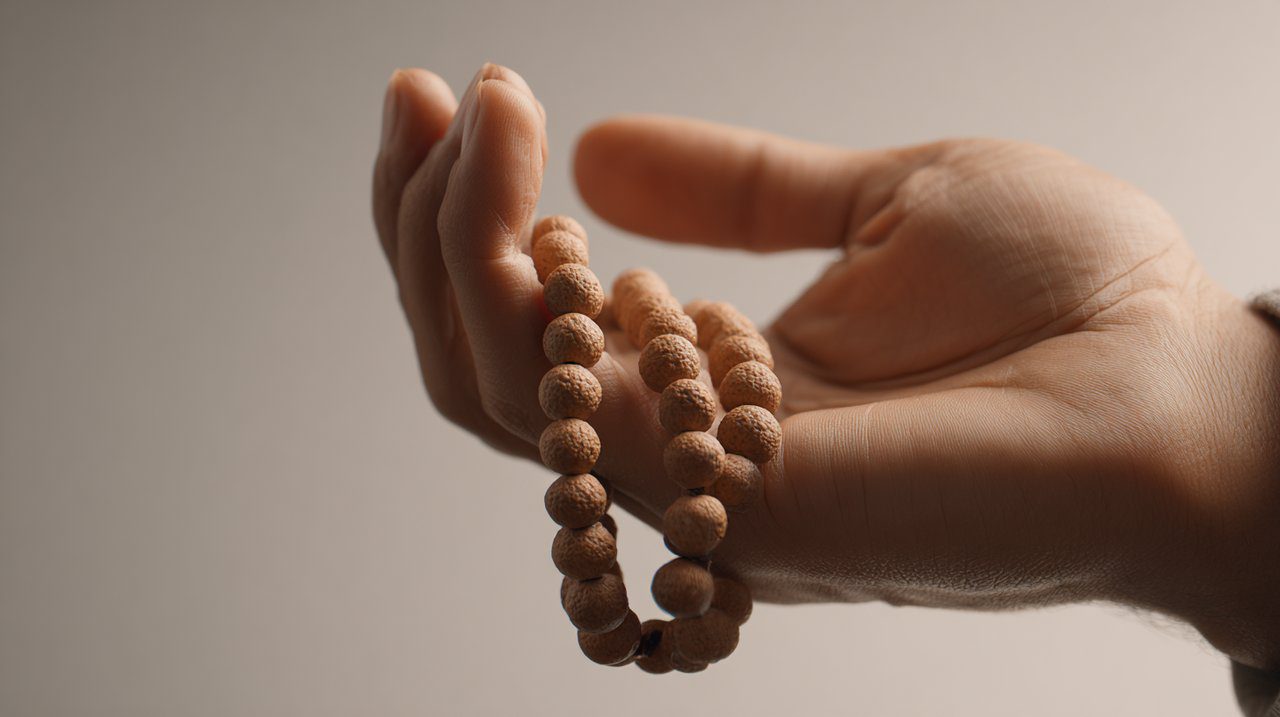
Seeds, specifically the bodhi mala or Rudraksha, are unique because they evolve with use. Bodhi wood is deeply rooted in historical practice, carrying the structural memory of the Bodhi tree. A genuine Bodhi seed is slightly porous. After roughly 10,000 repetitions, the oils from the hands fill these tiny pores, physically hardening the seed and creating a deep, polished patina. It is a slow, tactile record of the time spent with the string.
Rudraksha seeds have a much rawer, textured feel that provides significant sensory feedback. These are often categorized by their mukhi, the natural segments on the surface, which practitioners select based on their current focus.
- One Mukhi is used for cultivating singular, sharp intent.
- Five Mukhi is the most common variety, generally used for maintaining internal balance.
- Eight Mukhi is traditionally chosen when working through specific personal or mental obstacles.
- Fourteen Mukhi is associated with more intuitive work and a sense of protection.
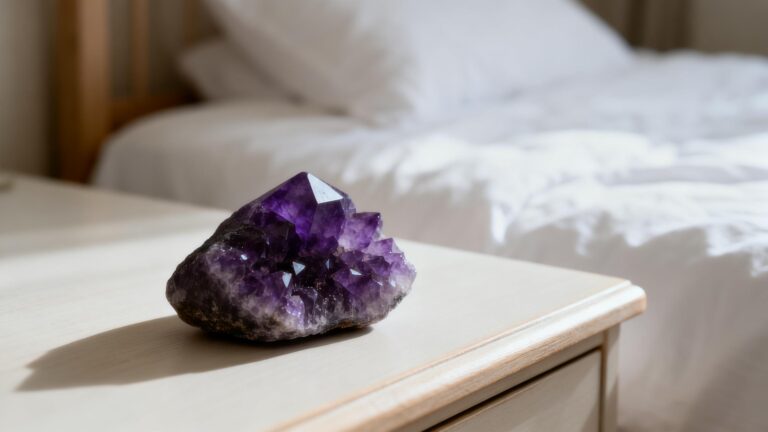
If you find your mind feels particularly scattered, the physical gravity of healing crystals can be very grounding. A stone mala usually weighs between 80 and 110 grams, significantly heavier than wood, which acts as a constant, heavy anchor for your attention. The material you choose carries distinct qualities that influence the psychological space of your practice. Amethyst is a standard choice for those prioritizing mental clarity. Its structure acts as a quiet anchor for focus, helping maintain a calm presence and guiding thoughts with precision. Rose Quartz is often picked for its substantial, smooth feel during heart-centered sessions. It is associated with cultivating compassion, using its tender weight to soothe feelings of unease and encourage an open disposition. For those requiring a sense of protective presence, the red agate stone offers robust grounding. Its steady physical density provides inner strength, acting as a reliable anchor when facing daily challenges.
You’ll also see people incorporate Dzi beads to maintain a connection to Tibetan lineage, or place Root chakra stones at the base of the mala. This adds a bit of extra weight at the bottom of the loop, which helps the string hang straight and feel more balanced in the hand.
How Color Primes Your Mind
The color of your mala acts as a subtle psychological cue. Before you even start the first round, the visual tone sets the pace for the session. It isn’t about matching your outfit; it’s about choosing a shade that mirrors the specific mental state you’re trying to reach.
- Blue carries the open quality of the Medicine Buddha and the Lapis Lazuli sky. In Tibetan traditions, this shade helps the breath become more expansive and rhythmic. If your chest feels tight or your thoughts feel claustrophobic, the deep blue offers a visual sense of space, encouraging a slower, more deliberate inhale.
- Red carries a certain heat and physical presence. It is the color of tapas — the internal discipline and vitality needed for endurance. Practitioners often reflect on the red agate stone meaning when focus flags during a long retreat. The deep, heavy red keeps you anchored when the mind wants to wander or give up.
- Green is tied to the energy of Green Tara and the concept of active compassion. It’s a restorative color, often used when a practice starts to feel too rigid or technical. The green beads shift the focus back to a more fluid, natural rhythm, making the transition between mantra and breath feel less forced.
- White is the color of Vajrasattva and the process of purification. Think of it as the clarity that remains after you’ve cleared the day’s mental clutter. When using white beads, the practice often emphasizes the exhale — stripping away distractions to return to a state of quiet, focused simplicity.
Practical Daily Use
A mala doesn’t need a dedicated cushion or a quiet room to be useful. In many ways, its real value shows up in the messy middle of a workday or a hectic commute. It acts as a physical reset button — something tactile to grab onto when your schedule starts to feel like it’s running away from you. It isn’t about performing a ritual; it’s just about having a reliable home base for your hands and your focus.
- Between meetings. If you’ve just come out of a tense call, thumbing through a dozen beads under your desk can help clear that residual noise. It’s a quick, invisible way to drop the stress of the last interaction so you aren’t carrying that baggage into the next one.
- During a commute. When you’re stuck in a crowd or a loud environment, reaching for the texture of a single seed gives you a solid point of contact. It creates a small, private boundary, helping to break the loop of reactive thoughts before they settle into your mood for the day.
- Morning digital habits. Try making it a rule to finish one full circuit of the strand before you ever open your inbox or start scrolling. It’s a way to claim your own headspace and establish your own pace before the rest of the world starts making demands on your attention.
The Mechanics of Focus
Your pace will naturally settle after the first few minutes of practice. It isn’t about speed; it’s about finding a steady, repeatable movement that fades into the background. In practice, the middle finger acts as your primary anchor. In the tradition of Mudra Vigyan, the middle finger represents the element of space, providing the most stable pivot point for the strand.
Keep your index finger extended and away from the loop. The index finger is traditionally associated with the ego and the tendency to judge or point. By bypassing it, we symbolically step away from the grasping self and move toward a more selfless form of Japa Meditation. The thumb does all the actual work, pulling each bead toward the heart one by one.
A simple way to sync them is to hold the bead still while you inhale. Then, use the full length of your exhale to transition to the next one. This tactile shift creates a physical click in your awareness, making it much harder for the mind to wander off without notice.
A full circuit traditionally covers 108 repetitions. This number is rooted in Vedic tradition and early astronomy, reflecting mathematical ratios between the earth and the sun. Across various disciplines, this structure holds significant symbolic weight. It represents the 108 worldly afflictions or distractions a practitioner seeks to transcend through mindful effort. It maps out 108 distinct paths to self-realization and reflects the 108 names of revered figures or manifestations of universal compassion. In broader terms, the count symbolizes the totality of human experience, encompassing the past, present, and future, while inviting a unified understanding of the mind, body, and spirit.
When your fingers reach the 109th bead, known as the Guru bead or Meru, it signals the completion of a full cycle. The Guru bead represents the teacher and the destination of the practice. It is a sacred boundary that calls for a moment of stillness. In traditional practice, you do not cross over the Guru bead — crossing it is symbolically stepping over a teacher. Instead, to continue the count, flip the mala 180 degrees and proceed back in the direction you came. This pause allows a brief moment of gratitude for the space of silence created.
Distractions are part of the process. When the mind drifts, use the texture of the bead to ground the physical body. Press your thumb firmly into the material; that sharp sensation breaks the loop of anxious thoughts.
Daily Practice Steps
Before the thumb moves the first bead, pause to clarify the internal motivation. This act of setting an intention, known as Sankalpa, ensures the practice is fueled by clear purpose rather than mere physical repetition. Consider what quality needs cultivation — whether it is equanimity during a transition or clarity for complex thoughts. Think of this intention as a seed being planted with the first touch.
A structured approach helps transform a scattered mind into a focused one. This simple physical routine weaves into any part of the day.
Preparation
Take your Wooden Prayer Beads into the dominant hand. Allow the strand to drape naturally over the middle finger, establishing a comfortable and secure grip.
Tactile Engagement
Soften the gaze or close the eyes. Begin by feeling the specific texture of the material between your thumb and forefinger. Notice if the surface is smooth, slightly ridged, or uniquely uneven like a miniature landscape. Pay attention to the subtle temperature of the beads against your skin, observing whether they are naturally cool, carry an organic warmth, or simply reflect the ambient air. Finally, sense the physical weight of the mala in your palm. Acknowledge whether it feels light or carries a comforting density that firmly anchors your hand to the present moment.
Breath Integration
Bring your attention entirely to the breath. Feel the gentle current of air entering and leaving the nostrils without attempting to alter its natural rhythm. Hold the first bead still while you inhale. Then, use the full length of your exhale to transition to the next bead. This synchronization of breath and touch creates a physical click in your awareness.
Mindful Movement
Gently move the thumb to pull the next bead forward. With each new bead, silently affirm the initial intention or use a simple anchor word. Allow the steady rhythm of the breath to guide the physical movement from bead to bead.
Continuous Presence
When thoughts drift, gently bring attention back to the tangible sensation of the beads and the rhythm of respiration. The objective is not flawless concentration, but the consistent, calm return to the physical anchors of weight, temperature, and breath without internal criticism.
The Wrist Mala
The logic for choosing materials applies just as much to shorter strands as it does to full-length ones. A wrist mala is essentially the portable version of that same focus, designed to be worn rather than carried in a pouch. Most people keep it on their non-dominant wrist so it stays out of the way while working, but having that constant, subtle weight against your pulse serves as a quiet anchor throughout the day.
While they look like standard jewelry to anyone else, these smaller loops are functional tools. Instead of needing to step away for a formal session, you have a tactile point of contact right there on your skin. If you feel your focus start to fragment, just touching a bead can be enough to pull you back into the present moment.
Counting on a wrist mala doesn’t require removing it. Keep the strand on the wrist and use the opposite hand’s thumb to advance each bead, pressing it along the inside of the wrist with a small rolling motion. If the loop is snug, a single finger can pin the strand lightly against the skin while the thumb works. It takes a session or two to find your natural rhythm, but once it clicks, the whole process stays invisible — no one around you will notice anything other than a hand resting on a wrist.
- 27 beads. A clean one-quarter of a full circuit. The most practical choice if you want to do a mini-session of repetitions but don’t have the time for a full 108.
- 21 beads. A staple in Tibetan traditions, often used for specific daily recitations that follow a shorter rhythm.
- 18 beads. The most compact version available. At this size, the specific count matters less than the physical presence — it’s about having a reachable reference point at all times.
Wearing a mala makes the practice accessible. You don’t have to go looking for a tool or wait for the perfect environment; the physical interrupt for a busy mind is already attached to you, ready whenever you need a moment of clarity.
Care and Purification
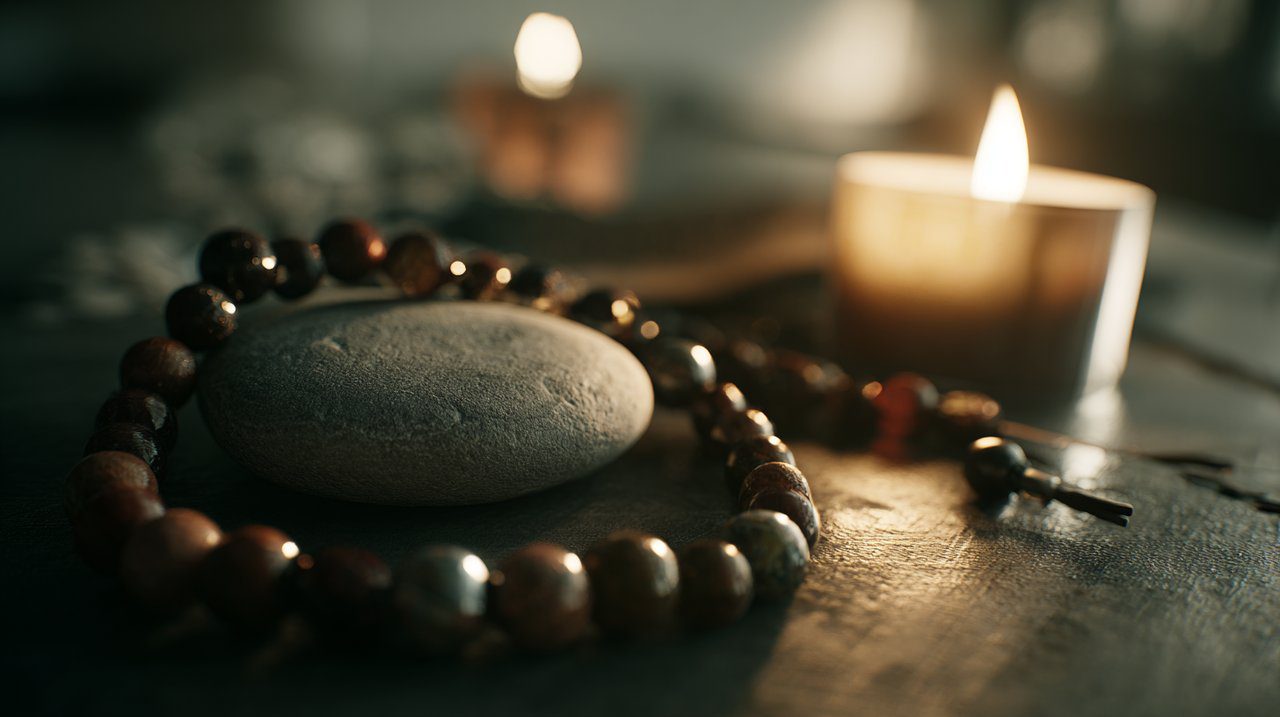
Wood and stone are responsive materials that react to the environment. Dense varieties like Sandalwood are sensitive to humidity and can warp if soaked, making traditional, non-water-based care methods essential. Just as the mind requires quiet moments to reset, these tools benefit from intentional pauses and gentle restoration to maintain their structural integrity.
Daily Maintenance
Natural materials naturally absorb oils from the skin over time, developing a deep, unique patina. To maintain the structural integrity and cleanliness of your string, simply wipe the beads gently with a soft, dry cloth after each use before storing them.
Light Purification
Sunlight provides a warm, active clearing, while moonlight offers a cool, calming influence. Place the beads on a windowsill where natural light can reach them. Morning sunlight for thirty minutes is highly effective for refreshing wood beads. For materials like amethyst or rose quartz, resting the beads in the gentle glow of a full moon overnight serves as a quiet method for purifying the string, refreshing the material without the risk of color fading.
Smoke Purification
The use of aromatic smoke is a classic Himalayan method for clearing physical objects. Burning natural juniper or sandalwood resin purifies the surrounding air. Light the incense and hold the mala with both hands, slowly moving it through the steady stream of smoke. Ensure the smoke touches every bead to clear accumulated dust and stagnant energy.
Salt and Soil
Salt provides a quiet, stabilizing environment and acts as a dry, safe way to reset the baseline of the string without using moisture. Fill a ceramic bowl with natural sea salt or Himalayan pink salt. Nestle the beads inside and allow them to rest overnight. Afterward, discard the salt, as it has fulfilled its purpose of absorption.
Vibrational Harmony
Sound operates as a tactile force — the vibration can be felt in the fingertips before it is fully heard. Using a singing bowl restores the natural resonance of the materials through pure frequency. Place the mala on a soft cloth near the bowl. Strike the metal and let the sustained harmonic tone wash over the beads. Hold the mala loosely so the vibration can travel through the strand rather than being damped by a tight grip.
Crystal Synergy
The steady frequencies of certain stones act as a passive resting environment for prayer beads. Rest the string near clear quartz or selenite between formal meditation sessions. The proximity keeps the tool in a stable, calm environment without requiring any active effort on your part.