Alashan Agate: How to Identify, Choose, and Care for a Gobi Stone

Deep within the Alashan Plateau of Inner Mongolia, the Gobi Desert holds a quiet secret. Wind and sand have worked these stones for millions of years, stripping everything superficial until only the essential remains. The result is Alashan Agate — unhurried, unpretentious, and carrying a stillness that feels almost earned.
I have spent time with many stones. Few settle into the hand the way a piece of Alashan does. It does not announce itself. It simply rests there, cool and solid, like a companion who has learned that silence is its own kind of presence.
Born from the Desert Floor
The Alxa Desert UNESCO Global Geopark sits in Alxa League, Inner Mongolia, where singing sands, desert lakes, and wind-shaped landforms give the region its severe geological character. Alashan Agate belongs to that landscape: silica-rich fluids once moved through volcanic cavities and cooled with extraordinary slowness, leaving banding, translucency, and mineral color inside the stone.
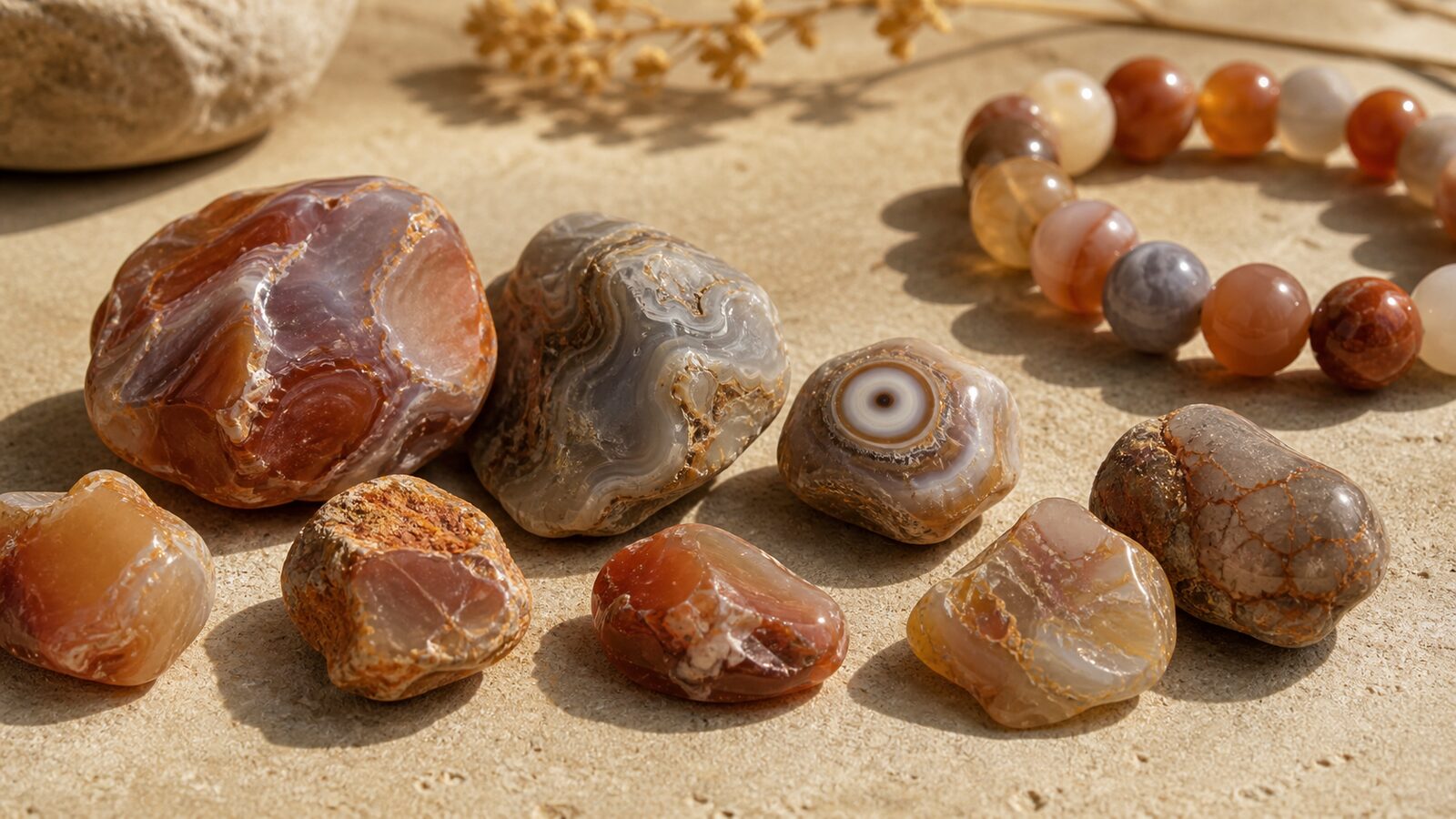
Mineralogically, agate is a banded form of chalcedony. Alashan Agate sits in the same practical range: 6.5 to 7 on the Mohs hardness scale — durable enough to survive the desert’s abrasion for geological ages, yet not so hard that it feels cold or impersonal in the hand. Its surface carries the hues of the land itself: ochre from sun-drenched dunes, dusty grey from ancient riverbeds, and the faint blush of a Gobi dawn.
What gives Alashan stones their identity is not a single color, but a texture — the quiet complexity of a landscape that has had time to settle into itself.
What Collectors Actually Look For
Among collectors and practitioners in Inner Mongolia and Northern China, Alashan Agate is not treated as a single category. The most recognized agate varieties each carry distinct visual signatures and reputations:
- Eye Agate (眼睛石): Stones displaying concentric ring patterns that resemble an open eye. These are among the most prized in the collector’s market. The rings form when mineral-rich water deposits layers at different rates — each ring a frozen moment in the stone’s long formation. A well-defined “eye” in a small Gobi stone is genuinely rare.
- Vein Agate (经脉玛瑙): Stones laced with fine, branching mineral lines running through translucent or semi-translucent body. The veins are not imperfections — they are the stone’s growth record, visible. Collectors read them the way a doctor reads an X-ray.
- Sugar-heart Agate (糖心玛瑙): Named for the warm, amber-caramel core that forms when iron oxides concentrate at the center during cooling. The outer shell is often lighter or more translucent, which creates a glow effect when the stone is held to light. The “sugar heart” formation requires a specific balance of mineral concentration and cooling speed — it cannot be replicated or faked convincingly.
Knowing these distinctions changes how you look at a stone on a market table. You are no longer guessing at beauty — you are reading a record.
The Natural Glaze: Understanding Patina
Here is something that most general articles on Alashan Agate skip entirely: the stone changes with handling.
Over months and years of being held, worn, and touched, Alashan Agate develops what collectors call 包浆 (bāo jiāng) — a natural patina. The surface gradually takes on a warmer, deeper luster that cannot be achieved by polishing. It is the accumulated trace of skin oils and the slow compression of microscopic surface features. An old piece with authentic patina has a quality that is immediately perceptible: it looks lived-in, not just pretty.
This is why oil nourishing (油养) is the recommended care method among serious keepers of these stones — not just water rinsing. Periodically rubbing the stone with a small amount of camellia oil or even clean olive oil, then buffing it gently with a soft cloth, feeds the patina process and deepens the stone’s natural glaze over time.
The stone does not try to be a mountain. It simply is. In its patience, something accumulates — and that accumulation, over time, becomes its beauty.
Earth Connection: Cultural Roots in the Gobi
For the herders and travelers of Inner Mongolia, Gobi stones were not decorative objects. They were carried. The desert is vast and disorienting, and having a piece of it in your pocket was a way of remaining oriented — grounded to a specific place, a specific earth.
In local tradition, these stones are often called “gifts from the sky and earth”, collected from the surface of the Gobi after wind strips away the surrounding sediment. No digging. The desert offers them up on its own terms, when it chooses. That origin story shapes how people relate to them — not as extracted resources, but as something found.
Alashan Agate is associated with the root and the present moment. Not elevation, not transcendence — just the steadiness of being where you are. In a culture shaped by long desert crossings, that quality was practical before it was spiritual.
Working with the Stone
The energy of Alashan Agate is slow and downward. If you have ever sat beside a very old tree and felt the ground beneath you become more real, you have some sense of what these stones offer.
Many practitioners keep an Alashan bead or tumbled stone at their desk, not as a ritual object, but as a tactile anchor. When the mind begins to scatter — into tomorrow’s problems, last week’s conversations — the cool, textured weight of the stone pulls attention back to the hand, and through the hand, back to the body.
This is not mysticism. It is the simple mechanics of sensory attention: you cannot fully feel a stone in your hand and simultaneously be lost in an abstract worry. If you use Mala beads for repeated practice, the principle is similar: touch gives attention somewhere simple to return. The stone occupies the channel.
Choosing Your First Alashan Agate
If you are looking at Alashan stones for the first time, here is honest guidance rather than mystique.
Start by ignoring the most dramatic pieces. The stones with the loudest colors and the most aggressive patterns are often treated or sourced from outside the Alashan region entirely. Authentic Alashan Agate is quietly beautiful — it earns your attention slowly, not immediately.
Look instead for:
- Translucency under light: Hold the stone up to a lamp or window. Genuine Alashan agate often shows internal depth — a subtle glow, particularly visible in sugar-heart varieties.
- Surface texture: The natural surface of an unpolished Gobi stone has a specific matte quality. If everything looks identical and glassy, it has likely been heavily treated.
- Weight and cool temperature: Real agate has a satisfying density and takes noticeably longer to warm in the hand than glass or resin imitations.
- Pattern logic: The veins, rings, and color gradients in genuine stones follow natural growth patterns — they have a kind of internal consistency. Fakes tend to have patterns that feel random or too symmetrical.
A simple, honest piece with clear provenance from the Alashan region will serve you far better than a dramatic stone of uncertain origin.
Wearing and Daily Care
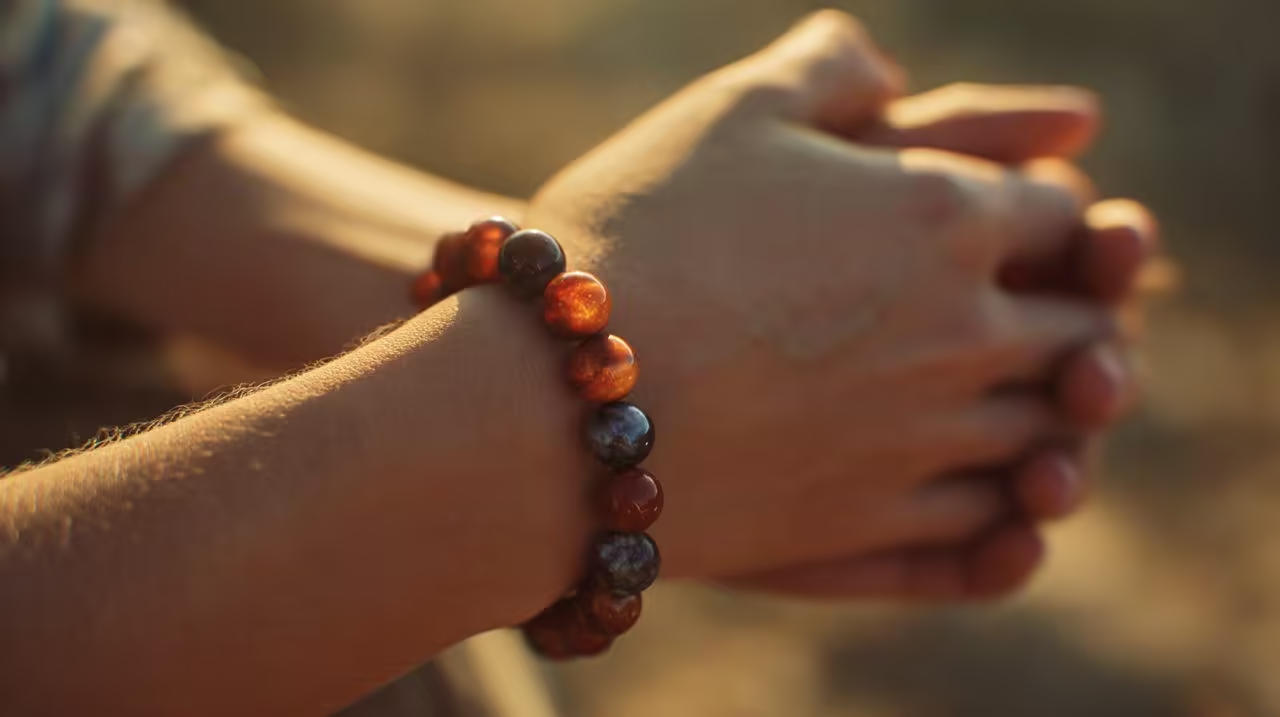
An Alashan Agate bracelet is an easy way to keep the stone in contact with the skin throughout the day. Its muted, earthy tones sit quietly against any outfit — it does not need to announce itself to do its work.
Caring for the stone well is straightforward:
- Oil nourishing: Every few weeks, apply a small amount of camellia oil or clean olive oil with your fingers, let it sit for a minute, then buff with a dry soft cloth. This is the most important care practice for developing and maintaining patina.
- Water rinse: Use cool, clean water occasionally to remove accumulated dust or residue. Avoid harsh soaps or ultrasonic cleaners.
- Storage: Keep separate from harder stones (quartz, diamonds) that can scratch the surface. A soft pouch is sufficient.
- Moonlight: Placing the stone on a windowsill during a full moon is a traditional practice for refreshing its connection to natural cycles — gentle and unhurried, like the stone itself.
The patina that builds over years of careful handling is, in the collector’s view, the stone’s truest beauty. You are not just wearing it. You are slowly completing it.
Frequently Asked Questions
What is the primary meaning and symbolism associated with Alashan Agate?+
Alashan Agate symbolizes patience and endurance, embodying the resilience and adaptability needed in life. It offers understated wisdom, grounding energy, and encourages finding insight and peace in stillness, much like a hidden oasis in the desert.
How is Alashan Agate formed, and what contributes to its unique appearance?+
Alashan Agate is formed over millions of years through volcanic activity and shifts in the Earth's crust. Mineral-rich groundwater seeps into rocks, slowly crystallizing into these silica treasures. Its distinct layers, patterns, and varied colors, from earth tones to pastels, are a result of this geological process, making each piece unique.
What are the spiritual and energetic properties of Alashan Agate?+
Spiritually, Alashan Agate is considered a grounding stone that helps connect wearers to the present moment and quiet mental chatter. Its gentle yet enduring energy promotes emotional balance, tranquility, and a sense of inner peace. It acts as a peaceful anchor, helping to observe thoughts and emotions without being overwhelmed.
How can wearing an Alashan Agate bracelet benefit daily life?+
Wearing an Alashan Agate bracelet serves as a tangible connection to the Earth's ancient wisdom and a constant reminder of natural balance and calm. It's a gentle way to integrate the stone's calming energy into daily life, promoting mindfulness and grounding effects.
What are the recommended methods for caring for and cleansing an Alashan Agate bracelet?+
Caring for Alashan Agate involves gentle renewal methods such as moonlight cleansing, rinsing with water, or smudge smoke purification. Regular cleaning and conscious interaction help maintain its vibrancy and deepen the connection with the stone.