How Do Jade Buddha Colors Influence Your Chi?

The first touch of jade against your skin is a quiet conversation. It’s cool, solid, and speaks of ancient stillness.
A jade Buddha necklace is a personal energetic anchor—a subtle tool for influencing your internal state. This isn’t mysticism; it’s a form of environmental psychology. Much like understanding the red string bracelet meaning gives it power, specific symbols and materials serve as potent reminders, gently guiding your subconscious toward desired states of being.
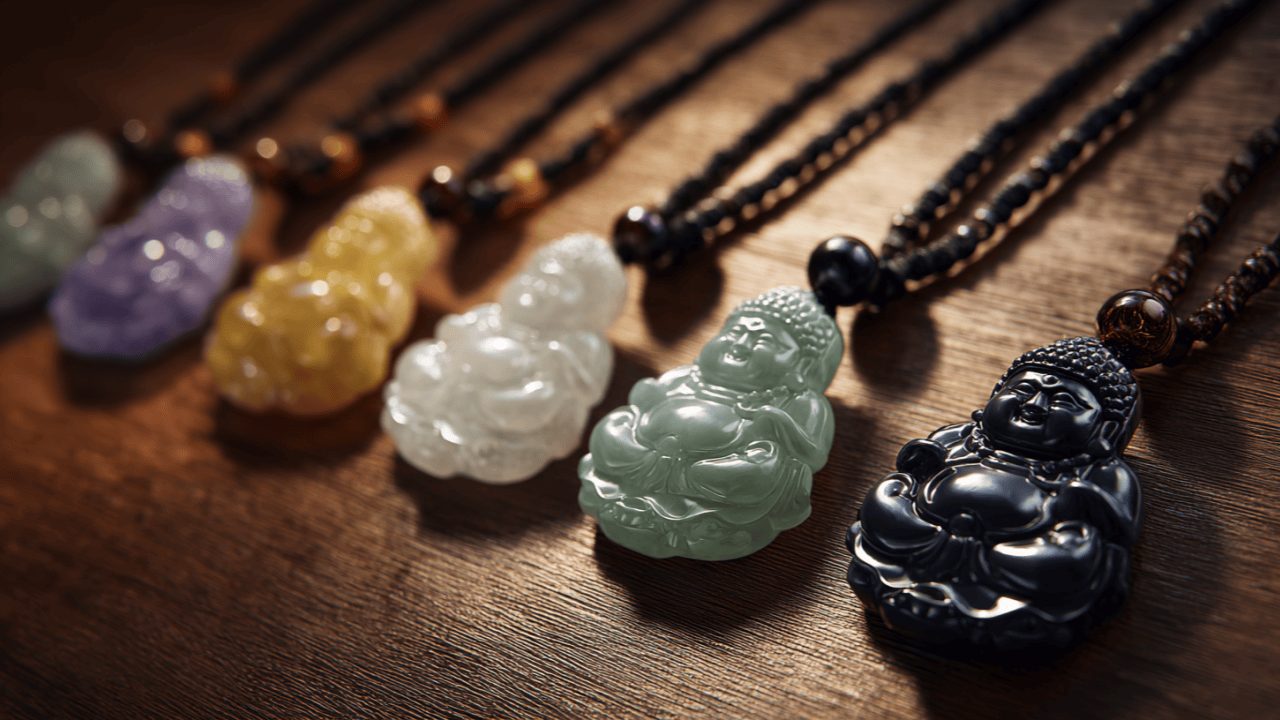
Understanding the meaning behind different colored jade helps you select a piece that truly resonates with your unique energy, aligning an adornment with your daily life.
Why Has Jade Been Worn for Thousands of Years?
Jade Buddha necklaces are a fusion of cultural heritage and spiritual principles. The practice of wearing jade stretches back millennia across East Asian cultures—a tradition deeply embedded in the jade bracelet chinese meaning.
In ancient China, jade wasn’t simply decorative. It was classified alongside gold as one of the highest-value materials a person could own, and it carried a moral dimension that gold did not. Confucian scholars compared jade’s five virtues—hardness, luster, translucence, purity of sound when struck, and the fact that it never cuts its wearer—to the qualities of an ideal person. Wearing jade was an act of aspiration, not just adornment.
There’s also a folk concept that still circulates in Chinese jewelry culture today: rén yǎng yù, yù yǎng rén — “the person nurtures the jade, and the jade nurtures the person.” The idea is that over years of skin contact, jade slowly absorbs the oils and warmth of its wearer, deepening in color; and in return, the stone’s cooling, grounding presence benefits the wearer’s health and temperament.
Modern materials science would describe this as jade’s high thermal conductivity causing it to feel cooler than ambient temperature—a genuine, measurable sensation that the body interprets as calming.
When paired with the image of the Buddha, the necklace becomes a potent visual anchor for enlightenment and inner peace—a concept that extends to other forms like the The Jade Buddha Bracelet: A Synthesis of Sacred Symbolism.
Does the Color of Your Jade Actually Matter?
Yes—and the reason goes back to the Five Elements framework (wǔ xíng) that has organized Chinese medicine, architecture, and daily life for over two thousand years. Each element—Wood, Fire, Earth, Metal, Water—maps to colors, seasons, organs, emotions, and life stages. Jade’s color isn’t just aesthetic; it’s a shorthand for which element’s energy you’re trying to invite in.
The color doesn’t change the Buddha’s universal message but refines its expression in your life.
Green Jade: Does It Actually Help With Stress?
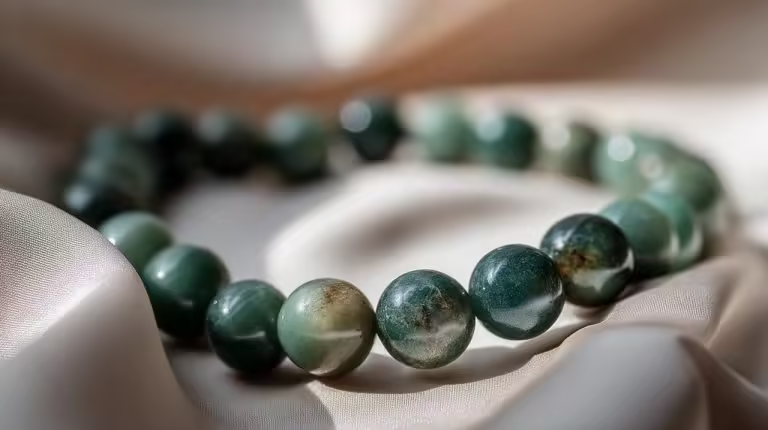
Green is the most classic jade hue, and its association with the Wood element is older than most written records. Wood governs growth, flexibility, and the liver—in Chinese medicine, the organ most linked to emotional frustration and blocked energy.
From a modern angle, there’s something concrete happening too. Green sits in the middle of the visible spectrum, where the human eye requires the least optical effort to process. Insights into what the color green means suggest it is often associated with nature and tranquility. Furthermore, research in environmental psychology has linked exposure to green tones to lower cortisol response and reduced perceived tension, as explored in studies regarding stress recovery during exposure to natural and urban environments.
Wear green jade into a tense family conversation, and you’re carrying a quiet visual cue that signals safety to your own nervous system—before you’ve said a word.
White Jade: The Stone for Clearing Your Head
White jade is tied to the Metal element, which in Five Elements theory governs precision, structure, and the lungs—the organ of boundaries and letting go. Metal energy is about cutting through noise to what’s essential.
In practice, the cool weight of white jade in your hand before a difficult negotiation or presentation works like a physical anchor: something concrete to return your attention to when your mind starts to scatter. It’s a grounding object that asks nothing of you except to notice it’s there.
Yellow and Brown Jade: Why They’re Linked to Wealth
In the Five Elements system, Earth sits at the center—literally. On traditional cosmological diagrams, Earth occupies the middle position, with all other elements arranged around it. It represents stability, nourishment, and the harvest: the accumulation that comes after sustained effort.
Yellow and brown jades carry this Earth energy. But this isn’t the energy of a sudden windfall—it’s something more useful for most people. Think of it as the energy of long-game thinking.
Where this becomes practically relevant: when you’re mapping out a multi-year budget, navigating a career transition, or grinding through the unglamorous middle stretch of a long project. The warm, grounded tones of yellow and brown jade work as a visual anchor against future-anxiety—a quiet counter to the mental spiral that often derails financial planning before it starts. If you find your attention jumping between worst-case scenarios instead of staying with the actual numbers in front of you, this is the stone worth having on your desk.
Black Jade: What Makes It a Protective Stone?
Black jade is connected to the Water element, the element of depth, adaptability, and the winter—a time of turning inward and conserving strength. Water in Five Elements theory also governs the kidneys, which store what Chinese medicine calls jīng, your core vital reserves.
Wearing black jade is less about blocking outside forces and more about reinforcing what’s already inside you. Much like a Pixiu symbol or Tibetan Dzi beads, black jade is valued for its capacity to absorb and neutralize heavy energies—useful on a crowded commute, a difficult workday, or any situation where you need to stay centered in your own skin.
Lavender Jade: The Rarest Color, and What It’s For
Lavender jade sits outside the traditional Five Elements color map, which is part of what makes it unusual. Its energy is most often associated with the spiritual dimension of Fire—not the outward, warming fire of summer, but the inner fire of consciousness, the spark that animates self-awareness.
In practical terms, it’s the jade to reach for when you need to quiet the inner critic. Picture this: you’ve just closed a browser tab with 40 unread emails, your attention is fractured, and you have ten minutes before your next call. Holding lavender jade during even a five-minute eyes-closed pause—no guided audio, no app, just stillness—creates a small but real boundary between the noise of the day and whatever clarity is waiting underneath it. Its rarity makes this feel less like a habit and more like a ritual you’ve actually chosen.
Can You Wear Two Jade Buddha Necklaces at Once?
From a Feng Shui perspective, the answer lies in energetic coherence. You can wear multiple jade necklaces, provided their combined energies are complementary and align with a clear, unified intention.
The key is synergy, not conflict. Combining a green jade Buddha for emotional balance with a yellow jade Buddha for grounded stability makes intuitive sense—both energies reinforce each other without pulling in opposite directions.
There’s also a combination worth actively avoiding: black jade and lavender jade worn together. Black jade pulls inward toward conservation and stillness; lavender jade reaches inward toward heightened self-awareness and inner fire. Together, they can create a kind of internal static—each asking something subtly different of your attention, neither completing its job cleanly. Better to choose one based on what the next few hours actually demand of you.
The practical rule: each piece should have a distinct, consciously chosen purpose. The more cluttered the intention, the less any single piece can do its job.
How Do You Actually Connect With a New Jade Piece?
Start With What Draws You In
Let your intuition guide you as much as any description. When you’re choosing a piece, notice the subtle pull—the one you keep coming back to, the one that feels like it’s already yours. For some, this resonance is even influenced by their Chinese Zodiac animal. The right piece will simply feel like it belongs with you.
Set an Intention Before You Wear It
Before you wear it for the first time, spend a quiet moment with the stone. You can leave it under full moonlight overnight, or let it sit in the morning sun for an hour—both are traditional ways of aligning a new object with natural rhythms before it enters your daily routine.
Then hold it in your palm. Feel it warm slightly from your skin. Close your eyes and name, clearly and specifically, what you’re carrying it for—peace before a difficult conversation, focus during a busy week, a reminder to slow down. This act transforms the jade from a beautiful object into a focused reminder of your goals, much like traditional mala beads.
Clean It When It Feels Heavy
Every few weeks—or after a particularly draining day—rinse your necklace under cool running water for a minute. You can also rest it on a selenite plate overnight. Think of it the way you’d think of airing out a room: not because anything dramatic has happened, but because freshness is a form of maintenance. It’s a way of clearing your mind from daily digital noise as much as it’s caring for the stone.
Where You Wear It Changes What It Does
Wearing your jade Buddha close to your heart centers its energy around emotional regulation—what practitioners associate with the heart chakra, the seat of compassion and relational balance. Positioned over the solar plexus chakra, it connects more directly to your sense of personal agency and confidence, the energetic center tied to decision-making and self-trust. Neither placement is wrong—it’s worth experimenting to notice which feels more useful for your life right now.
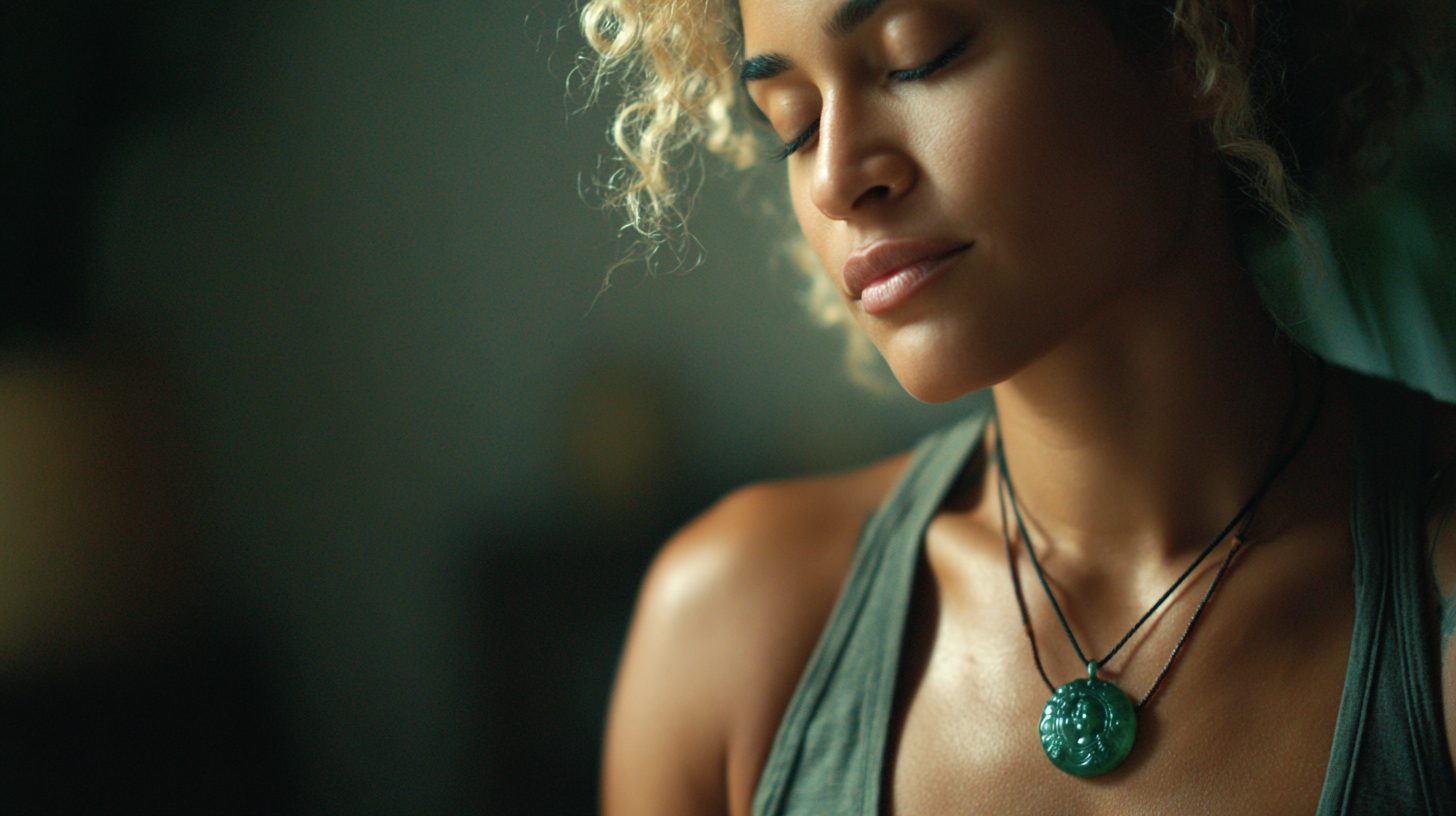
Your jade Buddha necklace becomes a quiet companion—a tangible anchor to the balance, clarity, and resilience you cultivate within yourself.
Frequently Asked Questions
What is the primary significance of a jade Buddha necklace in Feng Shui?+
From a Feng Shui perspective, a jade Buddha necklace functions as a tangible anchor within your personal energy field, influencing your internal state and external environment, and acts as a personal energy regulator that encourages calm and resilience.
What core symbolism does jade itself hold?+
Jade symbolizes purity, wisdom, longevity, and protection. It is believed to absorb negative energies and radiate positive, harmonizing vibrations.
What spiritual meanings do different colored jade Buddha necklaces convey?+
Green jade promotes growth, renewal, and healing; white jade signifies purity, clarity, and wisdom; yellow/brown jade attracts wealth, abundance, and joy; black/dark jade provides powerful protection and grounding; and lavender jade is linked to emotional healing, inner peace, and spiritual insight.
Can multiple jade Buddha necklaces be worn together?+
Yes, multiple jade Buddha necklaces can be worn together, provided their combined energies are complementary and serve a clear, unified intention to avoid creating energetic dissonance.
How should one care for a jade Buddha necklace to maintain its energetic properties?+
To care for it, hold it and imbue it with your specific intention before wearing. Periodically cleanse it by rinsing under cool, running water or placing it on a selenite charging plate. Wear it close to your heart or over your solar plexus.