What Black Obsidian Does in Feng Shui

There is something about black obsidian that stops people. Not just its appearance — though the depth of its color is unusual, closer to an absence of light than a surface — but a quality that is harder to name. A sense that the stone is doing something, even when it is just sitting on a shelf.
Feng Shui has worked with this quality for centuries. So have the Aztecs, the ancient Greeks, and cultures across the Mediterranean. They did not agree on much, but they agreed on obsidian: it protects, it clarifies, it belongs at thresholds.
This guide does not ask you to take that on faith. It also does not try to explain it away. Instead, it looks at what obsidian actually is, what it has meant across human history, and how to work with it in the spaces where you live and work.
What black obsidian does in Feng Shui:
- Protection — marks boundaries, absorbs what doesn’t belong in your space
- Clarity — removes the mental noise that blocks decision and action
- Placement — entrance, desk, body: each location works differently

What Obsidian Actually Is
Obsidian is volcanic glass. When lava cools fast enough — faster than crystals can form — the result is a material with no internal grain, no scatter, no give. It is one of the few natural substances that is truly, optically black.
That matters more than it might seem. Most dark materials still reflect light at certain angles. Obsidian absorbs it. Hold a piece in natural light and the surface does not brighten — it deepens. The eye finds no foothold, no reflection of itself. There is a reason people throughout history have described it as a stone that takes things in.
It also fractures with an edge sharper than surgical steel. Before metal, obsidian was used for blades, arrowheads, and instruments precise enough for early surgery. The same stone used in ritual mirrors was also the sharpest cutting tool available to human hands for thousands of years. That combination — the capacity for both reflection and precision — runs through every culture that encountered it.
A Stone That Travelled the World
The Aztecs polished obsidian into mirrors called tezcatl — used by priests and rulers to see what ordinary vision could not. The god Tezcatlipoca, whose name translates roughly as “smoking mirror,” was depicted holding one. These were not decorative objects. They were instruments of revelation, believed to show hidden truths and coming dangers.
Across the Mediterranean, obsidian trade routes predate written history. It was one of the first materials humans transported long distances, which tells you something about how much it was valued.
In Chinese tradition, black stones have long been associated with the Water element — the element of depth, stillness, and the kind of wisdom that comes from sitting with difficulty rather than rushing past it. Obsidian in Feng Shui carries this quality: not aggressive protection, but a steady, absorptive calm.
What is striking is that cultures with no contact with each other landed on the same intuitions about this stone. That kind of convergence tends to point toward something real in the material itself.
Protection: What It Means in Practice
The most consistent claim made about obsidian across traditions is that it protects — specifically, that it absorbs or deflects negative energy.
You do not need to take a literal view of that to find it useful.
A stone that is visually dense, historically associated with guardianship, and placed with intention at the entrance of a space does something to how that space feels. It marks a boundary. It signals, at a level below conscious thought, that what lies beyond it is held and watched over.
Whether that signal comes from the stone’s energy or from the accumulated weight of human belief across millennia is, in some ways, a secondary question.
What most people notice is simpler: obsidian in a space tends to make the space feel more settled. Less permeable. Like the walls hold better.
Wealth and Clarity
The connection between obsidian and wealth in Feng Shui is less about attraction and more about removal. The traditional view is that obsidian clears what blocks abundance — fear, scattered thinking, the mental noise that gets between intention and action.
This is a more honest framing than “place this stone and money will come.” Obsidian is not a passive talisman. It is associated with the kind of clarity that requires looking directly at what is difficult — the same quality the Aztec priests sought in their smoking mirrors.
On a desk, a polished obsidian piece functions as a quiet prompt toward that clarity. Not magical thinking, but intentional placement of an object that carries a specific meaning — and that meaning, held consistently, shapes behavior over time.
Where to Place It
The Entrance
The most traditional placement, and the one with the deepest cross-cultural roots. Near the front door, obsidian marks the threshold between outside and inside — between the world’s demands and your personal space.
A raw piece or a carved figure works well here. The Pixiu obsidian bracelet hung near an entrance is a common practice in Chinese households — the Pixiu’s mouth open to receive, the obsidian’s depth absorbing what should not enter.
The Workspace
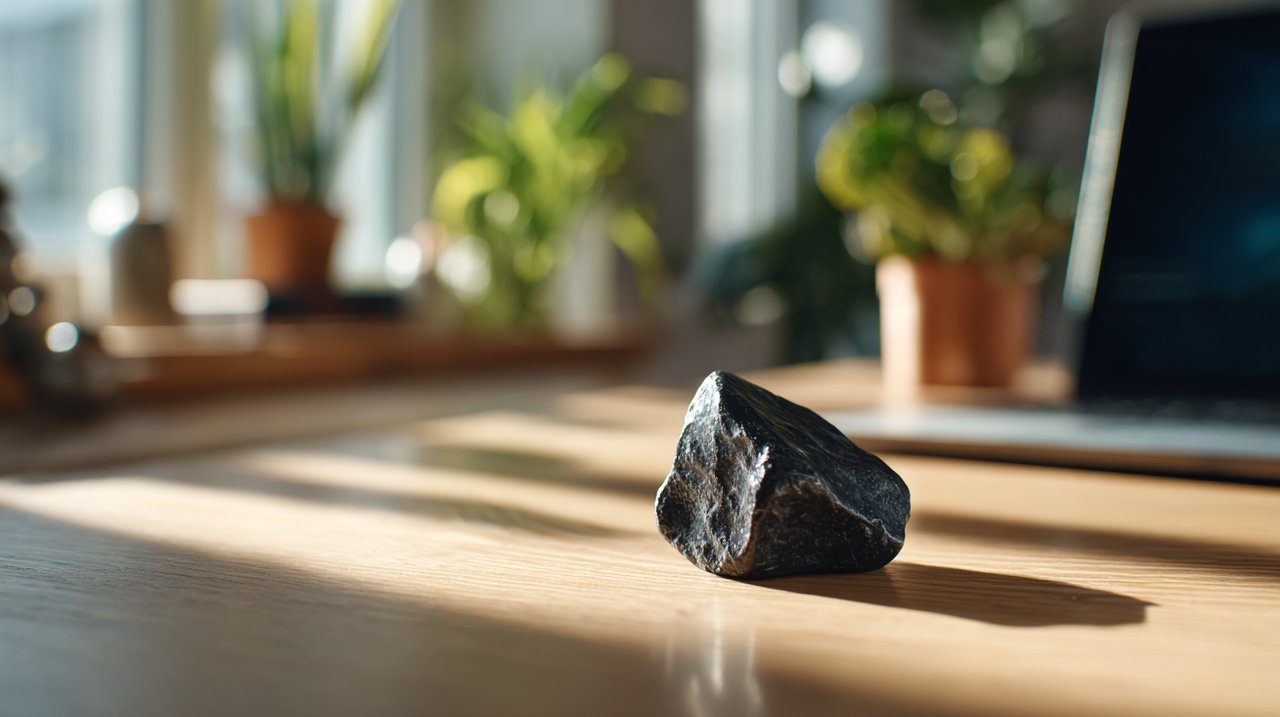
A small polished piece on the desk, placed where your eye lands during a pause. The form matters here in a way that is easy to overlook.
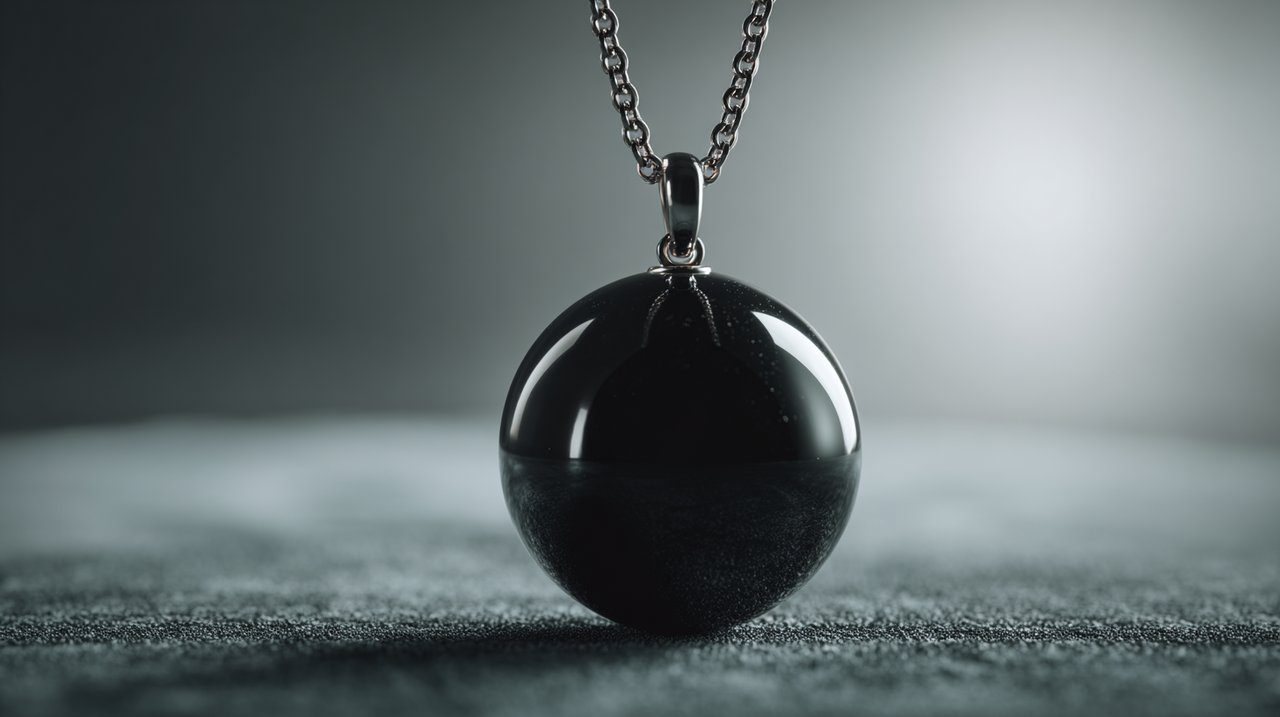
A sphere invites a more open, meditative quality of attention — useful for creative or strategic thinking. A raw piece with natural edges carries a sharper energy, better suited to tasks that require decisiveness and precision. Neither is wrong. The choice is about what kind of focus the space is meant to hold.
For people who make dozens of small decisions daily, obsidian on a desk serves a specific function: it reduces decision fatigue by anchoring attention to one clear object. When the mind scatters, the eye returns to something solid, dark, and still. That visual reset is often enough to restore strategic clarity for the next task.
The Bedroom
This one requires attention. Obsidian in a bedroom can deepen a sense of security and calm — particularly for people who feel vulnerable at night, or who carry anxiety into sleep.
But for some people, its presence activates rather than settles. If you find your thoughts becoming more active after placing it, move the stone out of your direct line of sight rather than removing it entirely. The visual presence is most of what you are working with. Less visibility, less stimulation.
Wearing Obsidian
Carrying obsidian on the body extends its quality into your day in a way that a stationary piece cannot. The stone stays within peripheral awareness — a continuous, quiet presence rather than something you encounter only when you walk past it.
Black obsidian bracelets and pendants are among the most common forms of protective jewelry across East Asian traditions. The bracelet worn on the left wrist — the receiving side in Chinese tradition — is believed to draw in protection while the stone’s absorptive quality handles what does not serve you. This echoes the Water element logic from earlier: obsidian’s nature is to take in, not to push out. Wearing it on the receiving hand aligns the stone’s physical property with its traditional function — absorption working in the same direction as the body’s own energetic flow.
A wolf tooth pendant carries a different energy: more directional, more outward-facing. Where a smooth sphere or round bead suggests receptivity, the carved tooth suggests boundary and will. The same stone, shaped differently, used differently.
How to Cleanse Obsidian
Hold the stone under cool running water for about a minute. Use a gentle stream, not a hard jet — you want to feel the water moving across the surface, not blasting it. After thirty seconds or so, you will notice a subtle shift: the stone feels slightly cooler than the water itself, as if it is resetting to a baseline temperature. That physical feedback is your cue that the process is doing what it needs to do.
Dry it with a soft cloth, running your thumb slowly across the polished face. With obsidian, you will feel the surface go from slick to grippy as the water leaves — a faint resistance that tells you the stone is clean and dry.
Alternatively, leave it on a windowsill overnight during a full moon. Either method works. What matters most is the act itself: a moment of returning to the stone with attention, of renewing what you originally placed in it.
Working With Obsidian
Obsidian does not ask for belief. It asks for placement, attention, and a degree of honesty about what you are carrying and what you want to set down.
The cultures that worked with it most deeply — the Aztec priests, the Feng Shui practitioners, the traders who carried it across ancient trade routes — were not naive. They understood that the stone’s power was inseparable from the person working with it. The mirror shows what you bring to it.
That remains true. Place it with intention and it works as an anchor for that intention. Treat it as decoration and it will function as decoration. The difference is not in the stone.
Frequently Asked Questions
What are the primary benefits of black obsidian in Feng Shui?+
Black obsidian is revered in Feng Shui for its profound protective qualities, its ability to foster mental clarity, and its capacity to define energetic boundaries within a space. It acts as an anchor, absorbing unwanted energies and clearing the path for focused intention and action.
Where is the optimal placement for black obsidian in a home or workspace?+
For classic protection, position black obsidian near your **front door** to guard the threshold. On a **desk**, it can enhance clarity and decisiveness. In the **bedroom**, it may offer a sense of security, though some individuals find its energy too stimulating; adjust its visibility if you experience heightened activity.
How does black obsidian contribute to wealth and abundance in Feng Shui?+
Rather than directly attracting wealth, black obsidian is believed to clear the energetic and mental obstacles that impede abundance. It helps dissipate fear, scattered thinking, and the internal noise that can block intention and action, thereby fostering a clearer path to prosperity.
Is it beneficial to wear black obsidian jewelry, and on which wrist?+
Absolutely. Wearing black obsidian, particularly as a bracelet on the **left wrist** (the receiving side in Chinese tradition), extends its protective and absorptive qualities into your daily life. Pendants, like a wolf tooth, can offer a more directional, assertive form of protection.
What is the recommended method for cleansing black obsidian?+
To refresh your black obsidian, hold it under cool running water for approximately one minute, allowing its temperature to shift. Alternatively, you can place it on a windowsill overnight during a full moon. The ritual of conscious attention during cleansing is as vital as the method itself.
What is the historical significance of black obsidian beyond Feng Shui?+
Across millennia, black obsidian has been a stone of profound significance. The Aztecs crafted it into 'smoking mirrors' (tezcatl) for divination and revelation, while ancient cultures prized its surgical sharpness for tools and weapons. Its universal appeal lies in its dual capacity for deep reflection and precise application.
Does the shape of black obsidian influence its Feng Shui properties?+
Yes, the form can influence its energetic application. A smooth sphere promotes open, meditative focus, ideal for creative thought. A raw piece with natural edges carries a sharper, more decisive energy, suited for tasks requiring precision. Choose the form that aligns with the specific intention for your space.