Brooch or Lapel Pin: How to Choose

A common misconception in modern styling is treating the brooch and the lapel pin as interchangeable items. While both serve as decorative accents, they occupy entirely different positions in the hierarchy of sartorial mechanics and social signaling. Understanding these distinctions allows for intentional accessory coordination that aligns with both the garment’s weight and the occasion’s gravity.
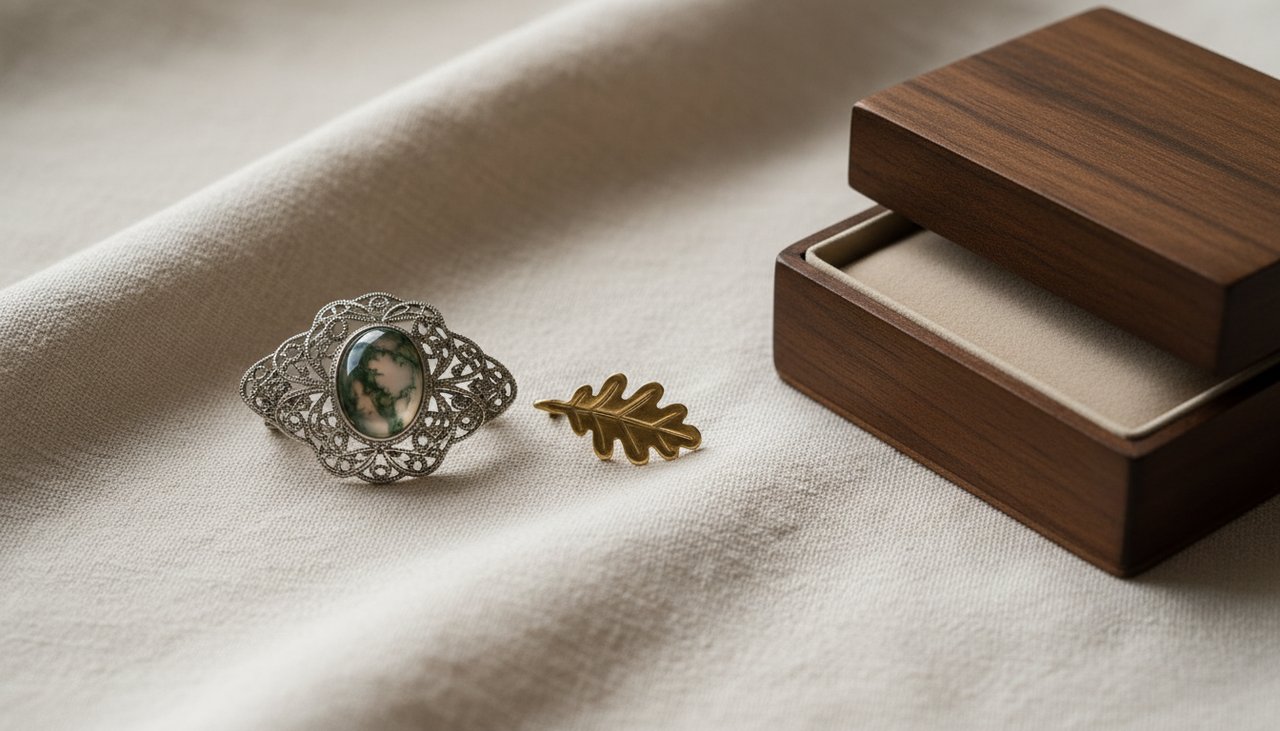
Before examining the technical nuances of these pieces, it is helpful to view this guide within the broader context of our brooch collection. This hub serves as a central resource for those seeking to master the art of fine adornment.
Structural Mechanics and Fastening Systems
The primary differentiator between these two accessories lies in their engineering. Brooches are heavy-duty instruments of style. They typically feature a horizontal pin-back mechanism with a rotating safety catch, designed to pierce and hold substantial fabrics like wool, tweed, or heavy silk.
The robust hinge-and-catch system is a functional requirement for the brooch’s scale. Because these pieces are often larger and more ornate—frequently categorized as vintage brooches when featuring antique filigree—the clasp must support significant weight without sagging or damaging the textile. A brooch does not merely sit on a garment; it anchors itself to the architecture of the clothing.
In contrast, lapel pins are lightweight and minimalist. Their fastening systems prioritize speed and fabric preservation over heavy-duty security. Common mechanisms include:
- The butterfly clutch (or military clutch) for instant attachment.
- Rubber stoppers for a modern, low-profile grip.
- Long, thin straight pins with decorative caps.
These thin needles are specifically designed for the delicate weave of blazer lapels or ties, leaving minimal traces once removed.
Spatial Dynamics: Placement and Proportions
The physical scale of an accessory dictates its placement. A brooch is a focal point, often measuring several inches in diameter. Its natural habitat is the upper chest, the shoulder of a coat, or even the waist of a sash. Because of its visual weight, brooch placement is crucial; it should sit where the garment is most structurally sound to prevent pulling the fabric out of shape.
Lapel pins operate on a smaller canvas. They are traditionally confined to the lapel of a jacket or blazer, specifically the buttonhole (the boutonnière). While a brooch might dominate an ensemble, a lapel pin acts as a subtle punctuation mark. It is a detail for the observant, rather than a statement pins meant for the entire room.
Evolutionary Trajectories: Utility vs. Affiliation
The history of these items reveals a divergence in purpose. The brooch began as the “fibula,” a necessary tool for ancient Greeks and Romans to hold cloaks together. It was a functional necessity that eventually evolved into a display of status and wealth.
The lapel pin followed a more communicative path. Its ancestors are military medals and club insignias used to signal allegiance or achievement. Historically, while vintage brooches were aesthetic expressions often associated with femininity, lapel pins were markers of identity within fraternal or professional organizations.
Sartorial Insight: A brooch often tells a story of personal taste or family history, while a lapel pin typically communicates a current affiliation or a specific professional standard.
Contextual Etiquette and Social Signaling
Choosing between these two pieces requires an understanding of social context. For high-stakes professional environments, lapel pin etiquette suggests a single, subtle pin. Over-accessorizing a blazer can clutter the visual profile and distract from the wearer’s presence.
Brooches thrive in creative or formal evening settings. A large, ornate piece on a monochrome coat provides a level of sophistication that a small pin cannot match. In the modern era, these boundaries are blurring. We are seeing a rise in “gender-neutral styling,” where men adopt larger brooches for red-carpet events and women utilize minimalist pins for corporate branding.
Maintenance and Preservation Techniques
To preserve the integrity of these ornaments, regular maintenance is mandatory. Metal components should be wiped with a microfiber cloth to prevent the buildup of skin oils and environmental tarnish. For gemstones, avoid harsh chemicals that could weaken the settings.
Storage is the most overlooked aspect of care. High-quality pieces should be stored individually in lined boxes. This prevents the sharp needles of one piece from scratching the polished surface of another, ensuring your collection remains pristine for years of use.
Ultimately, the choice between a brooch and a lapel pin is a decision of intent. One offers a bold, artistic narrative, while the other provides a sharp, disciplined accent. By mastering the technical differences and historical contexts, you can select the accessory that best reinforces your personal brand and sartorial goals.